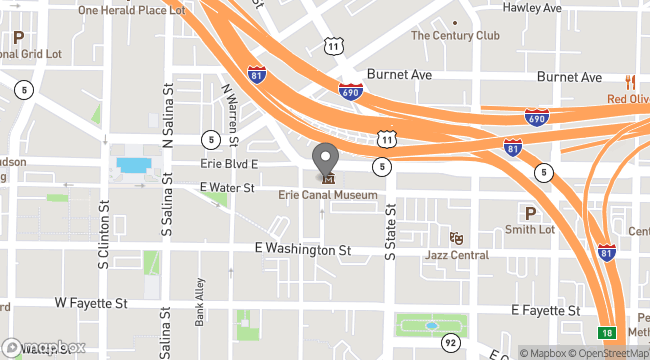
The Erie Canal Museum, located in Downtown Syracuse, NY, engages the public in the story of the Erie Canal’s transformative impacts on peoples and places in the past, present, and future. We are stewards and interpreters of Erie Canal related materials and heritage. The Museum is housed in the 1850 National Register Weighlock Building, the last remaining structure of its kind. Visit us for exhibits with interactive displays and original artifacts, and engaging programs. The Erie Canal Museum is a must-see for adults and children of all ages.
Description
2026 Sloan Lecture Series
We offer lectures each month on a variety of topics. Our theme for 2026 is Rooted. Throughout its history, the Erie Canal has been an agent of change and transformation. Through this lecture series we aim to explore the many facets of this transformative waterway's history. We look forward to sharing these stories with you throughout the year. All Sloan Lectures are available both in person and via Zoom. Everyone who registers will also receive a recording of the talk. Registering for the Annual Pass registers you for all talks for the remainder of the year, as well as provides access to all previously recorded talks for the year.
Thank you to the Winifred & DeVillo Sloan, Jr. Family Fund for supporting this series.
If you have difficulty registering please call 315-471-0593 or email educator@eriecanalmuseum.org
Current Schedule of Lectures (more lectures and information will be added soon!)
October 29 @ 12PM- Fires along the Canals of CNY
Hear Madison County Historian Matt Urtz discuss stories of fires that took place along the canals of Central New York, including one of the earliest photos to be credited as “photo journalism” in the U.S. Fires are covered from across the counties of Chenango, Madison, Oneida, Onondaga and Oswego. Discover fascinating stories of destruction, mayhem, and how communities responded.
November 12 @ 12PM- Short Stories Along the Genesee Valley Canal
To sum up the Genesee Valley Canal in a word? Dramatic. The timing was terrible. The route was ambitious: one of the highest canals in the world, pinned to the side of a canyon, along one of New York state’s most visited waterfalls. Then there were the people and their shovel-swinging, whiskey-drinking, religion-bringing, gun-spinning stories. Join Environmental Educator Jules Hoepting from New York State Parks for this engaging talk on one of New York's most enigmatic lateral canals.
December 10th @ 12pm- 15 Miles on the Sacandaga Canal?
This presentation will discuss the successful construction of the Erie Canal and the subsequent “canal craze” that sparked the idea of a great Sacandaga Canal. Discover the efforts of the Sacandaga Valley to expand their commercial reach as they sought to draw raw goods and resources from throughout the Adirondack Mountains down to the Mohawk Valley and Erie Canal.
--
Previous Lectures- Please note that registering for an Annual Pass gives you access to recordings of all previous lectures
January 15 @ 6:30 PM- The Making of Flower City: The Erie Canal, American Empire, and the Horticultural Transformation of the Country
Born of the Erie Canal, Rochester, New York exploded from a small village into a boomtown. Developing into a prominent hub for flour-milling, Rochester was an icon of America’s market revolution. But when the Panic of 1837 struck the region, the economic foundations of the city collapsed. In the wake of collapse a new group of horticulture reformers sought to reform the city, region, and their residents. By the middle of the decades of the nineteenth century, they city became home to a group of plant nurserymen and seed dealers whose transnational reach remade the North American landscape and transformed Rochester from the Flour City into the Flower City.
January 28 @ 7PM- Sloan Lecture- 2025 & 2026 Erie Canal Artists-in-Residence Roundtable
Join the Erie Canal Museum and New York State Canal Corporation in hosting 2025 Artists-in-Residence Sarah Cameron Sunde and Kari Varne in presenting their work over the last year as well as our incoming 2026 Artists-in-Residence Hannah Allen and Z Behl, who will discuss their upcoming projects.
February 11 @ 12PM- "Freedom For All: Civil Resistance and the fight against slavery in Antebellum Syracuse”
This presentation by Onondaaga Historical Association' Bob Searing examines the work of a small but dedicated group of abolitionists in Syracuse, New York, led by Rev. Samuel May and Rev. Jermain Loguen. Loguen, a man who escaped his own enslavement in Tennessee and settled in Syracuse in 1841, became one of the era's most successful and well-known Station Masters on the UGRR. These men and their compatriots helped make Syracuse a center for abolitionist activity and organization and were primary participants in of the era's most significant acts of civil disobedience, the Jerry Rescue, in October 1851. Additionally, the talk will place the efforts of local reformers in the larger national context of the growing sectional controversies over slavery, which ultimately resulted in the Civil War in 1861.
February 28 @ 12PM- Mules and Melodies: The Erie Canal's Impact on Music Commerce and Culture in Upstate New York
Laurence Libin, former curator of musical instruments at the Metropolitan Museum of Art will discuss how the canal helped spread piano culture and Anne Laver, associate professor of organ at Syracuse University will talk about the canal's impact on regional organ building and share clips from a new documentary film, The Organ in America.
We offer lectures each month on a variety of topics. As part of the Erie Canal Museum's mission, this series aims to examine the diverse transformative impacts the Erie Canal had on peoples and places in the past, present, and future . All Sloan Lectures are available both in person and via Zoom. Everyone who registers will also receive a recording of the talk. If you have trouble registering please contact educator@eriecanalmuseum.org or call 315-471-0593
March 19 @ 12PM- Dr. Mary Edwards Walker - Radical Reformer
Dr. Mary Edwards Walker (1832-1919), surgeon, abolitionist, suffragist, and dress reformer, spent her life advocating for human rights and equality of the sexes. She is the only woman to date who has been awarded the Congressional Medal of Honor. Born in the Town of Oswego, she graduated from Syracuse Medical College in 1855 and volunteered in the Civil War until she was recognized for her skill and hired as a contract surgeon for the Army. She was captured and held prisoner by the Confederates, and in 1865 was awarded the newly created Medal of Honor for her heroism. She spent the rest of her life campaigning for reforms, especially the right for women to wear pants. The lecture will touch on her life, the dramatic story of her Medal of Honor which was taken away and later restored, and how we honor her in the United States today. This talk will be presented by Oswego area historian Mary Kay Stone.
April 16 @ 12PM- The Great Steam Canal Boat Race of 1873
Nearly as soon as the Erie Canal was completed in 1825, inventors were already dreaming about powering canal boats by steam. Early attempts proved hopeful but not practical as the canal was not wide enough or deep enough to accommodate the heavier boats. With completion of the first enlargement by the 1860s many believed that steam-powered canal boats were possible. New York State agreed, and in 1873 sponsored a competition of steam canal boats from Syracuse to Utica for a prize of $100,000. Five boats competed to demonstrate how steam could revolutionize canal traffic. The trials and tribulations of that race would give rise to the motivation of modernizing the canal to allow for motor power on the canal. It was the construction of the barge canal in the early 20th century that would retire the horses and mules and welcome motorized boats on the canal system. The Great Steam Canal Boat Race of 1873 helped make it happen. This talk will be presented by Schuyler County Historian Gary Emerson.
May 28 @ 6PM- Making Humans More Humane—Henry Bergh and the Birth of Animal Rights in 19th century America
In Gilded Age America, people and animals lived cheek-by-jowl in environments that were dirty and dangerous to man and beast alike. The industrial city brought suffering, but it also inspired a compassion for animals that fueled a controversial anti-cruelty movement. When Henry Bergh founded the ASPCA in 1866, he launched a campaign to grant rights to animals that was applauded by many, and ridiculed by many more. Bergh fought with robber barons, Five Points gangs, and legendary impresario P.T. Barnum, as he came to the defense of trolley horses, livestock, stray dogs, and other animals. He also challenged the use, and abuse, of horses and mules on the Erie Canal, a showdown that engaged the nation and, some argued, threatened to shut down a crucial link in the national economy. This talk is based on Ernest Freeberg’s 2020 book, A Traitor to His Species, that tells the story of a remarkable man who helped to shape our modern relationship with animals.
June 18 @ 12PM- Reframing the Canal: Art and the Erie Canal
The Erie Canal has tremendously impacted both the State and the Nation in its two hundred years of history. The Canal itself—in addition to how we remember it and talk about it—helps shape American culture and our current reality. Steph Adams will use 19th century artwork, public murals and monuments, as well as work by past Erie Canal Artists-in-Residence to discuss the relationship between art, memory, heritage tourism, and history. As we move past the Canal’s Bicentennial period and into America 250 commemorations, it is up to us to shape how the Canal is remembered at its next milestone. This talk is presented by the Erie Canal Museum's Director of Interpretation Steph Adams.
July 15 @ 7PM- Revolutionary Waterway: The Erie Canal & the American Revolution
While the Erie Canal opened 50 years after the beginning of the American Revolution, this talk by ECM Director of Education Derrick Pratt examines how the Revolution shaped the people, places, and ideas that ultimately created this enormously influential public work. This talk will only be available via Zoom and recording.
August 19 @ 6PM- Canal Dreamers: The Epic Quest to Connect the Atlantic and Pacific in the Age of Revolutions
In the 1820s, there was a little-known quest to unite the world by building a waterway between the Atlantic and Pacific Oceans through the Central American isthmus. As Spanish American nations declared independence and new canals intensified US expansion and British industrialization, many imagined the construction of an interoceanic canal as predestined. For example, New York Governor DeWitt Clinton envisioned himself presiding over a project even more significant than the newly opened Erie Canal. With dreams substituting for data, he joined an international cast of politicians, lawyers, philosophers, and capitalists who sent competing agents on a race to transform Lake Nicaragua, the San Juan River, and the terra incognita of Central American forests into the world’s first global waterway. Although the idea of literally changing the world by connecting the oceans proved too revolutionary for the Age of Revolutions, the quest itself changed history. Jessica M. Lepler tells the captivating story of this global journey in her new book, Canal Dreamers: The Epic Quest to Connect the Atlantic and Pacific in the Age of Revolutions.
September 10 @ 12PM- Canals, Conductors and the Empire State: an Ecohydrological Perspective on the Erie Canal
For thousands of years before Europeans set foot in what is now called Upstate NY, Indigenous people traveled along the existing network of rivers and lakes in the state. These people worked with the natural flow regime (sometimes adding minor modifications such as fish weirs), based on different worldviews of water. These habitats in turn supported fishes, mussels, turtles, wild rice, medicine plants, and other beings critical to the Native diet and economy. Settler terraforming and engineering to canalize rivers and drain swamps destroyed many of the riparian and instream habitats on which these plants and animals relied. This pattern of building US and NYS wealth from Indigenous lands at the expense of Indigenous Nations continues today with the NYS Smart Innovation Corridor (our "Erie Canal moment").
September 11 @ 6PM- Who Celebrated Sullivan-Clinton in 1929 and Why? The Lasting Legacy of the 150th Anniversary
The Sullivan-Clinton Campaign of 1779 was a scorched earth mission that led to the burning of over 40 Haudenosaunee (Iroquois) settlements. Despite its grim features, settlers celebrated it with nearly 300 markers and monuments that span Pennsylvania and New York, leading it to be possibly the most recognized Revolutionary War expedition nation-wide. A. Lynn Smith's book, Memory Wars, exposes this vast commemorative complex for the first time. In her book talk, she will emphasize the celebration of Sullivan-Clinton in New York in 1929, considering the 150th anniversary projects in light of the country's settler colonial foundations. She will conclude with thoughts on how we might grapple with this history -- and the lasting legacy of its commemoration in 1929 -- as its 250th anniversary approaches in 2029. This event will be hosted at the Skä•noñh Great Law of Peace Center in partnership with them, Onondaga Historical Association, and the Liverpool Public Library.
Thank you to the Winifred & DeVillo Sloan, Jr. Family Fund for supporting this series.
Date & Time
Jan 15 - Dec 10, 2026
Venue Details
Erie Canal Museum
318 Erie Boulevard EastSyracuse, New York 13202