The Defense Health Agency (DHA) lacks an interoperable capability to objectively collect and analyze medical training data across the enterprise, limiting readiness assessment and performance improvement; therefore, the DHA requires a scalable ecosystem that delivers standardized data collection, real-time feedback, and data-driven combat casualty care readiness.
Reverse Industry Day Objectives
Purpose
The Defense Health Agency (DHA) is conducting this Reverse Industry Day as part of ongoing market research activities to better understand current and emerging industry capabilities supporting medical training data modernization across the Joint Force.
The DHA currently lacks an interoperable, enterprise-wide capability to objectively collect, standardize, aggregate, and analyze medical training performance data across the combat casualty care enterprise. Existing training environments rely on disconnected simulation platforms, live exercises, and instructor-driven assessments without a unified data architecture, limiting the ability to objectively measure readiness, identify performance gaps, and support data-driven improvements to combat casualty care outcomes.
This event is intended to:
Survey existing and emerging industry solutions
Assess current and future technical capabilities
Explore interoperability and integration approaches
Identify scalable architectural concepts
Help refine and solidify potential Government requirements
The Government recognizes that some desired capabilities may not currently exist as fully integrated solutions and encourages vendors to demonstrate mature technologies, developmental capabilities, modular approaches, and future-state concepts relevant to this problem space.
This Reverse Industry Day does not constitute a formal solicitation, request for proposal, or commitment by the Government to procure any capability or solution.
Desired Operational Capabilities
The Government seeks vendor solutions capable of supporting the following operational objectives:
Passive collection of medical training performance data with minimal instructor or operator input
Aggregation of data across:
Standardized and objective data capture across training systems and organizations
Real-time performance feedback for students, instructors, evaluators, and leadership
Advanced analytics capable of identifying:
Performance trends
Readiness gaps
Causative factors
Longitudinal tracking of individual and team proficiency over time
Alignment with operational trauma-registry structures, including the Department of Defense Trauma Registry (DoDTR)
Enterprise dashboards and reporting supporting:
Desired Technical & Architectural Capabilities
Data Ingestion
Passive ingestion of structured and unstructured data from diverse training systems and operational environments
Ability to aggregate data from multiple training modalities and distributed environments
Edge Processing
Edge computing capability supporting disconnected, intermittent, and low-bandwidth environments
Real-time analytics and feedback at the point of training
Data Architecture
Automated ETL/ELT pipelines and streaming data ingestion
Support for enterprise analytics environments, data lakes, warehouses, and curated data marts
Data Schema & Standardization
Modular, extensible, and standardized data schemas
Ability to evolve alongside operational requirements and emerging trauma-care doctrine
Mapping capability to DoDTR structures and related operational data frameworks
Interoperability
Scalability
Integration & Decision Support
Integration into operational and strategic decision-support environments
Support for strategic exercises, readiness analysis, curriculum optimization, and enterprise-level assessments
Industry Engagement Objective
Industry partners are encouraged to demonstrate:
Mature and emerging capabilities
Modular and scalable architectures
Integration and interoperability strategies
Existing operational use cases
Developmental roadmaps and future-state concepts
Lessons learned and implementation considerations relevant to DHA medical training modernization efforts
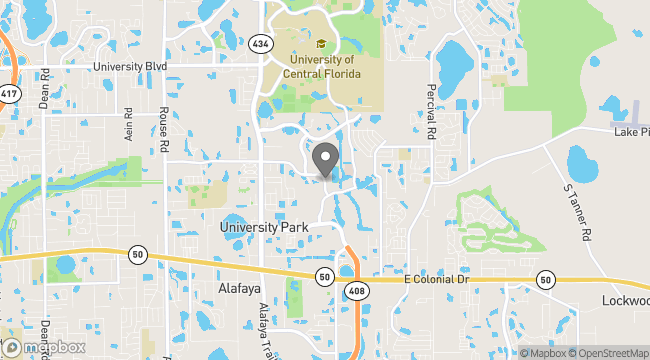
The Central Florida Tech Grove is a hub for accelerating collaboration and innovation in defense modeling, simulation, training, and human performance. Tech Grove is located in the Central Florida Research Park in Orlando, Florida which is the epicenter of the nation's largest cluster of government, industry, academic, and industry organizations developing and delivering training and simulation products for our nation's military. Tech Grove was established in 2020 through a Partnership Intermediary Agreement (PIA) between the Naval Air Warfare Center Training Systems Division (NAWCTSD) and the University of Central Florida Research Foundation. Ten other Department of Defense entities are Tech Grove members with NAWCTSD: US Army Program Executive Office for Simulation Training and Instrumentation (PEO STRI), US Air Force Agency for Modeling & Simulation (AFAMS), US Marine Corps Program Manager for Training Systems (PM TRASYS), US Army Simulation & Training Technology Center (STTC), US Army Futures Command Synthetic Training Environment Cross-Functional Team (STE CFT), Defense Health Agency (DHA), U.S. Space Force Space Training and Readiness Command (STARCOM), Strategic Environmental Research and Development (SERDP), Army Modeling Simulation Office (AMSO), and the Office of Naval Research through the NavalX Central Florida Tech Bridge.
www.CentralFloridaTechGrove.org