Using Zoo Management Software to Drive Revenue and Admissions
-
 by
by
Riley Manning has worked as a travel and entertainment writer for more than 10 years. Today, he writes about unique events and the technology that helps make them happen.

Running a zoo is a big job. From managing staff to feeding animals to keeping visitors satisfied, you have a lot going on at once. Let’s not forget about the large overhead you have to cope with too. With operating expenses growing rapidly, you need to streamline your workflow and financial processes to maximize your budget and keep guests wanting more. Using zoo software or zoo management software can help you simplify your operations and give your customers the best experience possible.
Creating Positive Customer Experiences with Zoo Software
Zoo admissions and ticketing are at the heart of running a zoo. Implementing zoo management software that helps make ticketing easier is essential. When the ticketing and admissions processes are easy for your customers, you are setting a positive tone from the start.
Bettering your customers’ experiences goes beyond ticketing. As a zoo, your goal is to educate people about animals from around the world. You are part of a larger conservation effort. Keeping customers coming back to your zoo helps you keep your doors open, your conservation efforts moving forward, your public education initiatives at the forefront, and your animals in the hearts of thousands.
Connecting with the public keeps them coming back, and returning customers are your most valuable customers. In fact, research shows that many customers believe that purchasing memberships is the best way to support a nonprofit, such as a zoo.
Additionally, members tend to spend an annual average of around $92.71 with their organization, compared to $18.94 by non-members. This is because members spend more on food and beverages, gifts, and donations to the organization in addition to their annual membership fees.
While gaining and retaining members is important, you also have to remember they started out as customers. You want to ensure the customer experience is fantastic for every kind of customer you have. Offering engaging exhibits, learning experiences, behind the scenes tours, and special offers are a few ways you can delight your customers.
When customers are happy, they are more likely to donate, make additional gift purchases, and become members.
Mitigating Bad Customer Experiences with Zoo Software
No organization or zoo is perfect, so mitigating bad customer experiences is key to retaining customers. Even customers who have a poor ticketing or admissions experience will remember if your organization handled the problem quickly and effectively.
Before they walk through your doors for the first time, many first-time customers meet your zoo on your website. Your site should make it as frictionless as possible to purchase a ticket. Once you’ve optimized your digital customer journey, you might consider driving customers to your site with Google Ads. Nonprofits like your zoo may be eligible for a grant for thousands of dollars in ad credits — but you don’t want to drive them to a bad experience.
The best way to mitigate bad customer experiences is to simplify your zoo admissions process. Nobody wants to spend time in virtual or in-person lines. Mobile e-tickets and scan-and-go check-ins keep the line at your entrance moving.
Great staff is key to happy zoo attendees. Customer satisfaction will sink or swim depending on interactions with your staff. Your staff will be answering questions, admitting customers, serving refreshments, talking about animals, keeping the park clean. So the more you can automate the administrative stuff, the more you free up the staff to delight your patrons.
When you utilize zoo software to manage some of the internal processes, your staff can pay more attention to customers’ needs. Using zoo software will also cut down on your operational costs, which means more money in your budget for improving your zoo.
Customer satisfaction surveys are a great way to hear directly from your customers about their good and bad experiences. You can address these issues and experiences with improvements to your zoo. Using zoo management software allows you to collect contact information from your customers, so you can send out satisfaction surveys, emails about special offers, and more.
Keeping Donations Rolling In
In addition to tickets and memberships, donations are an important source of revenue for any zoo. Satisfied customers and members are more likely to donate extra funds to your organization. When you use zoo management software, you can keep track of donations and donor information more easily. You can also:
– Establish a clear channel of communication with your visitors.
– Retain contact information for surveys, emails, and promos.
– Automate follow-up emails based on ticket purchases.
– Identify members and visitors with donor potential.
– Learn more about your visitors to create a better zoo experience.
– Streamline ticketing and admissions processes.
– Seamlessly integrate data analytics tools.
– Create custom packages, such as birthday parties or special events.
– Spend less time on minutiae, more with your customers.
Identifying potential donors and creating special events that are meaningful to your customers can help you turn an occasional customer into a member or a donor. Zoo software helps you keep track of all of your customers, including members and those with donor potential. When you need to start fundraising for something big, like renovations to an animal habitat, you will be able to easily identify who to send fundraising materials to first.
Customers’ needs and wants change rapidly, so you need to adapt just as quickly. Often, customers need to change the day or timeslot of their visit after buying tickets. When this happens, a staff member must take their request over the phone or through email, then log the change in the zoo’s internal system. Zoo software makes this tedious process a thing of the past by allowing customers to change their own time slot while your system automatically updates itself.
Taking the Next Step with Zoo Management Software
Your zoo is unique, and you are providing community engagement. Spending extra time on burdensome operational or internal tasks takes away from time you could be spending bettering the zoo and the customer experience. Get more people in the door, and delight your customers with great exhibits and educational experiences without the hassle of long lines or obsolete ticketing methods.
Using zoo software is key to bringing your zoo to the next level. You will have better visibility into what’s working well, what’s not working well, and where your revenue is going. Once you start streamlining your processes, you will see happier customers who keep coming back. And that means more revenue to continue growing your zoo. Satisfied customers will tell their friends about their great experience and will keep coming back to visit your zoo.
SimpleTix has offered an affordable, premium event ticketing platform that outperforms Eventbrite and similar apps for over 12 years. Compared to the competition, SimpleTix offers better options at a better price point. To learn more, call us at +1 (855) 550-3670 or email us at support@simpletix.com.
Latest News
Related Articles

Season Ticket Software for Fall 2026: Subscriptions, Reserved Seating & Renewals
-
 by
by
Fall subscription sales are the single biggest revenue moment for most performing arts organizations. Season packages, member renewals, and early access windows all open between July and September. So the season ticket software you pick this summer decides how the fall series actually sells. This guide covers what season ticket software needs to do in 2026, how to configure it for a theater, symphony, or concert series, and what SimpleTix costs for season-driven event programs. What season ticket software actually needs to do Selling season tickets is nothing like selling single-event tickets. First, one subscriber buys 4 to 20 events in a single package. Second, seats need to lock across the entire season. Third, renewals from prior subscribers happen weeks before the general public gets access. And fourth, add-ons like parking, pre-show dinner, and backstage passes attach to the subscription, not the event. So the operational checklist for season ticket software looks like this: Season pass or subscription products that group multiple events into one purchase Reserved seating with locked seats across the whole season, so the subscriber sits in the same seat every night Priority access windows for existing subscribers before general on-sale Payment plans or full-payment options so patrons can split large subscription costs Renewal workflows that let last year's subscribers re-up with one click Comp ticket management for donors, sponsors, and press seats Membership tiers with different pricing, benefits, and priority access Reporting by subscriber, not just by event If your current tool cannot handle these, you are probably running Excel spreadsheets on the side and losing renewals every year. What is season ticket software? Season ticket software is a ticketing platform designed to sell multi-event packages (season subscriptions) alongside individual tickets, with reserved seat continuity, subscriber priority access, and renewal workflows built in. The core difference...

Holiday Event Ticketing Software: Timed Entry, Reserved Seating & Capacity Control for...
-
by
If you run a holiday event, you are booking dates now. So the ticketing platform you pick this month determines how November and December actually go. This guide covers what holiday event ticketing software needs to do in 2026, how to configure it for the season crunch, and what SimpleTix costs for holiday events of any size. What holiday event ticketing software needs to do Holiday events compress a whole year of sales into six weeks. First, most tickets sell in a 4 to 8 week window between mid-November and January 1. Second, weather cancels outdoor events without warning. Third, family groups buy 4 to 8 tickets in one order, not 1. And fourth, capacity is measured per time slot, not per venue. So the ticketing checklist for holiday operators looks like this: Timed entry with per-slot capacity for drive-throughs, walk-throughs, and Santa visits Reserved seating for holiday theater, Nutcracker, and holiday concerts Group and family bundles so a family of six is one checkout, not six Fast scanning at the gate, including offline mode for cold outdoor venues Waitlists for when peak-hour slots sell out Add-ons for hot chocolate, photo packages, VIP tiers, and holiday merch Automated email reminders so guests do not forget their timed slot Same-day payouts to fund the season's operational costs If your current tool cannot do all of that, October is too late to switch. Move now. How do timed entry tickets work for holiday events? Timed entry lets you release a fixed number of tickets per time slot (typically every 15 or 30 minutes) so guests arrive in waves instead of one 6pm surge. For a Christmas light drive-through with a 45-minute route, that usually means 30 to 60 vehicles per 15-minute window. Over a 5-hour evening, you can process 600 to 1,200...
Eventbrite Pricing 2026: Fees, Refunds & What’s Actually Changed
-
by
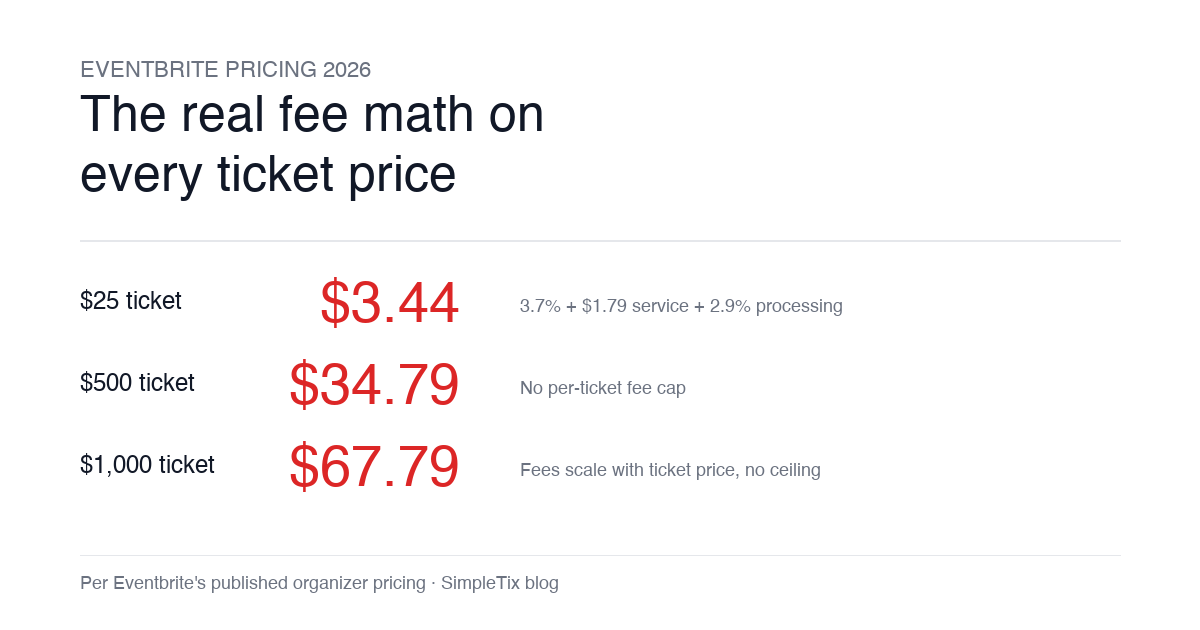
Eventbrite pricing 2026 is a lot for event organizers to sort through. There are longstanding policies that quietly cost paid-event operators real money, and there is genuine news under new ownership. This guide covers what the fees actually cost you today, what actually changed under the Bending Spoons acquisition, and how the alternatives compare on real numbers. Below is the honest breakdown, sourced to Eventbrite's own pricing page and SEC filings. Eventbrite pricing 2026: current fee structure As of 2026, Eventbrite charges 3.7% + $1.79 per paid ticket for the service fee, plus 2.9% for payment processing. In-person sales carry a $1 + 2.9% fee. There is no per-ticket fee cap. For a quick benchmark of total organizer-side fees: On a $25 ticket, fees total about $3.44 (13.8%) On a $50 ticket, fees total about $5.09 (10.2%) On a $100 ticket, fees total about $8.39 (8.4%) On a $500 ticket, fees total about $34.79 (7.0%) On a $1,000 ticket, fees total about $67.79 (6.8%) The fees scale with ticket price with no ceiling. That is the story for anyone selling premium tickets, season passes, VIP tiers, or corporate packages. Eventbrite pricing 2026: no per-ticket fee cap Eventbrite does not cap total ticket fees. This has been true since 2018, when Eventbrite removed the previous cap during its IPO. For most organizers selling everyday tickets ($20 to $50), the absence of a cap rarely comes up in the math. But for organizers selling premium tickets, the uncapped structure translates into real per-event cost. Take a conference selling three ticket tiers on Eventbrite: $150 general admission: fee about $12.34 (8.2%) $400 VIP ticket: fee about $27.09 (6.8%) $800 sponsor ticket: fee about $50.90 (6.4%) For a 200-person conference with a mix of GA and VIP tickets, that translates into hundreds of dollars...