Eventbrite Pricing 2026: Fees, Refunds & What’s Actually Changed
-
 by
by
Eventbrite pricing 2026 is a lot for event organizers to sort through. There are longstanding policies that quietly cost paid-event operators real money, and there is genuine news under new ownership. This guide covers what the fees actually cost you today, what actually changed under the Bending Spoons acquisition, and how the alternatives compare on real numbers.
Below is the honest breakdown, sourced to Eventbrite’s own pricing page and SEC filings.
Eventbrite pricing 2026: current fee structure
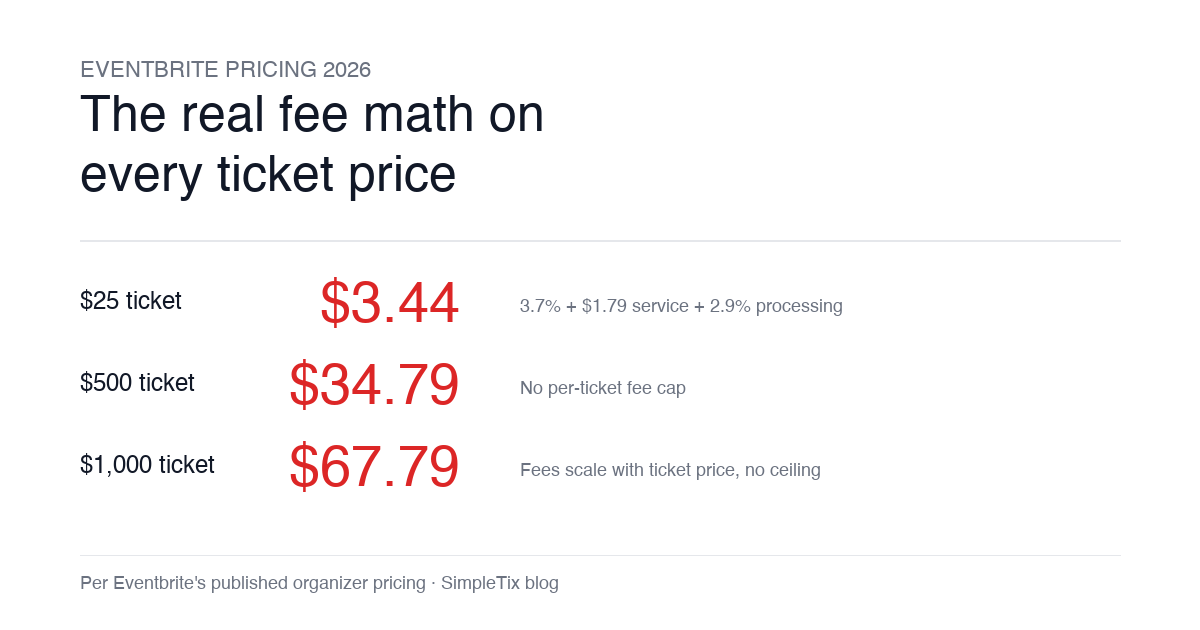
As of 2026, Eventbrite charges 3.7% + $1.79 per paid ticket for the service fee, plus 2.9% for payment processing. In-person sales carry a $1 + 2.9% fee. There is no per-ticket fee cap.
For a quick benchmark of total organizer-side fees:
- On a $25 ticket, fees total about $3.44 (13.8%)
- On a $50 ticket, fees total about $5.09 (10.2%)
- On a $100 ticket, fees total about $8.39 (8.4%)
- On a $500 ticket, fees total about $34.79 (7.0%)
- On a $1,000 ticket, fees total about $67.79 (6.8%)
The fees scale with ticket price with no ceiling. That is the story for anyone selling premium tickets, season passes, VIP tiers, or corporate packages.
Eventbrite pricing 2026: no per-ticket fee cap
Eventbrite does not cap total ticket fees. This has been true since 2018, when Eventbrite removed the previous cap during its IPO.
For most organizers selling everyday tickets ($20 to $50), the absence of a cap rarely comes up in the math. But for organizers selling premium tickets, the uncapped structure translates into real per-event cost.
Take a conference selling three ticket tiers on Eventbrite:
- $150 general admission: fee about $12.34 (8.2%)
- $400 VIP ticket: fee about $27.09 (6.8%)
- $800 sponsor ticket: fee about $50.90 (6.4%)
For a 200-person conference with a mix of GA and VIP tickets, that translates into hundreds of dollars per event in platform fees. The number scales with your ticket prices.
The fee cap history is well-documented. Eventbrite operated with a per-ticket cap for years before its IPO, most recently at around $19.99 to $24.95. That cap was removed in 2018. Since then, no ceiling has applied.
Source: TechCrunch’s August 27, 2018 coverage of the IPO-era fee changes documents the cap removal in real time.
Eventbrite pricing 2026: refund handling
Eventbrite’s default policy is to keep its service fee and payment processing fee when an organizer issues a ticket refund. For full event cancellations, organizers can request a fee credit by contacting Eventbrite with the receipt.
For most organizers, the practical effect is the same: every time you refund an attendee, Eventbrite’s fees on that ticket stay with the platform unless you take the extra step of asking for a credit.
Here is a real scenario. You run an outdoor event, and the forecast turns to a thunderstorm the night before. You cancel and refund 200 tickets at $30 each.
- Total ticket revenue: $6,000 (which you refund in full to attendees)
- Eventbrite platform and processing fees on that revenue: roughly $750 total
- Under Eventbrite’s cancellation policy, you can request that back as a credit, but the fee credit is not automatic
Also, this hits partial refunds by default. If a guest cancels a single $40 ticket, Eventbrite keeps that ticket’s fees (about $6) unless you contest it. Multiply by every partial refund and it adds up fast.
By contrast, SimpleTix refunds its platform fees automatically alongside any ticket refund, at no charge, with no credit request required.
Eventbrite pricing 2026: Pro plan and support paywall
Eventbrite has kept its human customer support behind the Pro plan since 2019. In 2026, the Pro plan itself was restructured around email marketing volume, priced at $15, $50, or $100 per month.
So if you were used to emailing Eventbrite when a ticket did not deliver or a payout was delayed, that channel remains conditional on a Pro subscription. Free-tier organizers get help center articles and chat bots.
For organizers running one or two events a year, paying $15+ per month just for support access is a real cost consideration. That is $180 to $1,200 per year on top of the per-ticket fees.
What actually changed at Eventbrite in 2026
Not all of the pricing dynamics above are new. But the ownership and product direction genuinely changed this year. Here is what actually shifted in 2026:
- Bending Spoons acquired Eventbrite for approximately $500 million. The deal was announced in December 2025 and closed in early 2026, per Eventbrite’s own SEC filings.
- Julia Hartz, co-founder and long-time CEO, departed following the acquisition.
- Andrea Parodi from Bending Spoons took over the general manager role and announced a smaller-team, faster-iteration plan.
- Significant staff reductions followed across engineering, marketing, and customer support.
- The Pro plan pricing structure was restructured around email marketing volume.
None of the underlying fee mechanics changed as a direct result of the acquisition. But the pattern of tightening monetization, cutting staff, and paywalling more features signals a shift in priorities from the previous ownership. For paid-event organizers, that is the context to understand when picking a platform for 2026.
What Eventbrite alternatives look like now
For organizers rethinking their platform, here is how SimpleTix compares on the same three axes.
Per-ticket fee (service + payment processing, all-in):
- Eventbrite: 3.7% + $1.79 service fee + 2.9% processing, no cap
- SimpleTix: $0.79 + 2% service fee (capped at $9.99 per ticket) + your own Stripe, Square, or PayPal at standard processing rates
Fee refunds:
- Eventbrite: fees are not refunded on individual ticket refunds by default; for full event cancellations, organizers can request a credit
- SimpleTix: refunds fees fully with any ticket refund at no charge
Customer support:
- Eventbrite: human support requires $15+ per month Pro plan
- SimpleTix: 7-day support included on every account, no paid support tier
How the fees actually compare
Because Eventbrite bundles processing into its bill and SimpleTix runs processing through your own Stripe/Square/PayPal, a fair comparison has to include payment processing on both sides. Below assumes a standard 2.9% + $0.30 processor rate (typical for Stripe/Square online) and US pricing:
- $25 ticket: SimpleTix $2.32 vs Eventbrite $3.44 (SimpleTix is roughly a third less)
- $50 ticket: SimpleTix $3.54 vs Eventbrite $5.09 (about 30% less)
- $100 ticket: SimpleTix $5.99 vs Eventbrite $8.39 (about 29% less)
- $250 ticket: SimpleTix $13.34 vs Eventbrite $18.29 (about 27% less)
- $500 ticket: SimpleTix $24.79 vs Eventbrite $34.79 (about 29% less)
- $1,000 ticket: SimpleTix $39.29 vs Eventbrite $67.79 (about 42% less)
So SimpleTix runs roughly 27 to 33 percent cheaper on typical ticket prices. The advantage widens sharply above ~$460 per ticket, where SimpleTix’s $9.99 service fee cap starts to bite while Eventbrite’s uncapped fee keeps scaling.
For an organizer running 5,000 tickets a year at $25 each, that translates into roughly $5,600 in retained revenue from the fee structure alone. Add another 200 season passes at $500 each, and the savings grow by another $2,000. The higher your average ticket price, the bigger the gap.
Should you switch platforms in 2026?
Yes if any of the following apply: you sell tickets above $50, you have ever refunded a ticket or canceled an event, you occasionally email support, or your event budget can absorb the difference between fees kept and fees returned.
Not urgent if: you only run free events (Eventbrite still has no fees on free tickets), you sell low volumes of low-priced tickets, or you have long-standing Eventbrite listings you would prefer not to migrate.
For most operators running paid events at scale, the math on switching favors moving. Yes, the switching cost is real. You have to replatform a live event, migrate attendee data, and update checkout links. But the platform economics have shifted enough that the break-even is quick.
Frequently asked questions
Does Eventbrite have a per-ticket fee cap in 2026?
No. Eventbrite has no per-ticket fee cap. Fees scale with ticket price with no upper limit. The previous cap was removed in 2018 during Eventbrite’s IPO. Since then, higher-priced tickets pay proportionally higher fees.
How much does Eventbrite cost on a $25 ticket in 2026?
Eventbrite fees on a $25 ticket total about $3.44 (roughly 13.8% of the ticket price). That includes the 3.7% + $1.79 service fee and the 2.9% payment processing fee, per Eventbrite’s published organizer pricing.
How much does Eventbrite cost on a $50 ticket in 2026?
Eventbrite fees on a $50 ticket total about $5.09 (roughly 10.2%). That includes the 3.7% + $1.79 service fee and the 2.9% payment processing fee.
Does Eventbrite refund fees when I cancel an event?
By default, no. Eventbrite keeps its service fee and payment processing fee on individual ticket refunds. For full event cancellations, organizers can request a fee credit by contacting Eventbrite with the receipt, but the credit is not automatic. Other platforms like SimpleTix refund platform fees automatically alongside the ticket refund.
Do I need to pay for Eventbrite Pro to get customer support?
Yes for human support. Eventbrite has kept its human customer support behind the Pro plan since 2019, and the plan restructured in 2026 to price at $15, $50, or $100 per month based on email marketing volume. Free-tier organizers receive help center articles and chat bots, but not direct human support.
What is the cheapest Eventbrite alternative in 2026?
SimpleTix at $0.79 + 2% per ticket (service fee capped at $9.99) is among the cheapest Eventbrite alternatives, with no monthly fee, no contracts, and no fees on free events. Ticket Tailor and TicketSpice are also low-fee options. Payment processing on SimpleTix runs at your own Stripe, Square, or PayPal standard rates rather than being bundled into the platform fee.
What did Bending Spoons change at Eventbrite in 2026?
Bending Spoons acquired Eventbrite for approximately $500 million per Eventbrite’s SEC filings, closing in early 2026. Following the deal, co-founder Julia Hartz departed, significant staff reductions followed, and the Pro plan pricing was restructured around email marketing volume. The underlying per-ticket fees (3.7% + $1.79 service fee, 2.9% processing) did not change as a direct result of the acquisition, but the pattern signals tightening monetization from the new ownership.
Can I switch from Eventbrite to another platform mid-event?
Yes, but the switch requires migrating existing sold tickets, updating checkout links on your marketing pages, and communicating the change to attendees. SimpleTix and Ticket Tailor both support event migration. Plan for a week or two of overlap.
The bottom line on Eventbrite pricing 2026
In short, Eventbrite is still Eventbrite. The brand recognition is real. The marketplace traffic is real. And for casual social events, the platform still works. But the current fee structure (no cap, refunds default to fees kept, human support paywalled) has meaningful cost implications for anyone running paid events at real scale, and the ownership change adds context to the picture.
If your operation has ever been affected by a canceled event, a partial refund, a premium ticket tier, or a support ticket, the fee dynamics above are real dollars out of your pocket every year.
Meanwhile, SimpleTix charges $0.79 + 2% per paid ticket, with the service fee capped at $9.99 no matter the ticket price. No contracts. No monthly fees. Refundable platform fees. And 7-day support included on every account. Compare it on your specific ticket volumes here: SimpleTix pricing.
Latest News
Related Articles

Season Ticket Software for Fall 2026: Subscriptions, Reserved Seating & Renewals
-
by
Fall subscription sales are the single biggest revenue moment for most performing arts organizations. Season packages, member renewals, and early access windows all open between July and September. So the season ticket software you pick this summer decides how the fall series actually sells. This guide covers what season ticket software needs to do in 2026, how to configure it for a theater, symphony, or concert series, and what SimpleTix costs for season-driven event programs. What season ticket software actually needs to do Selling season tickets is nothing like selling single-event tickets. First, one subscriber buys 4 to 20 events in a single package. Second, seats need to lock across the entire season. Third, renewals from prior subscribers happen weeks before the general public gets access. And fourth, add-ons like parking, pre-show dinner, and backstage passes attach to the subscription, not the event. So the operational checklist for season ticket software looks like this: Season pass or subscription products that group multiple events into one purchase Reserved seating with locked seats across the whole season, so the subscriber sits in the same seat every night Priority access windows for existing subscribers before general on-sale Payment plans or full-payment options so patrons can split large subscription costs Renewal workflows that let last year's subscribers re-up with one click Comp ticket management for donors, sponsors, and press seats Membership tiers with different pricing, benefits, and priority access Reporting by subscriber, not just by event If your current tool cannot handle these, you are probably running Excel spreadsheets on the side and losing renewals every year. What is season ticket software? Season ticket software is a ticketing platform designed to sell multi-event packages (season subscriptions) alongside individual tickets, with reserved seat continuity, subscriber priority access, and renewal workflows built in. The core difference...

Holiday Event Ticketing Software: Timed Entry, Reserved Seating & Capacity Control for...
-
by
If you run a holiday event, you are booking dates now. So the ticketing platform you pick this month determines how November and December actually go. This guide covers what holiday event ticketing software needs to do in 2026, how to configure it for the season crunch, and what SimpleTix costs for holiday events of any size. What holiday event ticketing software needs to do Holiday events compress a whole year of sales into six weeks. First, most tickets sell in a 4 to 8 week window between mid-November and January 1. Second, weather cancels outdoor events without warning. Third, family groups buy 4 to 8 tickets in one order, not 1. And fourth, capacity is measured per time slot, not per venue. So the ticketing checklist for holiday operators looks like this: Timed entry with per-slot capacity for drive-throughs, walk-throughs, and Santa visits Reserved seating for holiday theater, Nutcracker, and holiday concerts Group and family bundles so a family of six is one checkout, not six Fast scanning at the gate, including offline mode for cold outdoor venues Waitlists for when peak-hour slots sell out Add-ons for hot chocolate, photo packages, VIP tiers, and holiday merch Automated email reminders so guests do not forget their timed slot Same-day payouts to fund the season's operational costs If your current tool cannot do all of that, October is too late to switch. Move now. How do timed entry tickets work for holiday events? Timed entry lets you release a fixed number of tickets per time slot (typically every 15 or 30 minutes) so guests arrive in waves instead of one 6pm surge. For a Christmas light drive-through with a 45-minute route, that usually means 30 to 60 vehicles per 15-minute window. Over a 5-hour evening, you can process 600 to 1,200...
Haunted House Ticketing Software: Timed Entry, Scanning & Capacity Control for 2026
-
by
If you run a haunted attraction, October is your Super Bowl. So how you sell tickets from June through September decides how the whole season goes. This guide covers what haunted house ticketing software actually needs to do in 2026, how to pick one, and what SimpleTix costs for haunts of any size. What haunted house ticketing software needs to do Selling haunted house tickets is not like selling concert tickets. First, capacity is measured in throughput per hour, not in seats. Second, weather can shut you down without warning. Third, most of your revenue happens across three or four weekends. And fourth, your staff is often in costume at 9pm in a field with spotty cell service. So the ticketing software has to handle all of that. Here is the checklist most haunt operators use: Timed entry with per-slot capacity control so lines stay manageable Fast scanning at the gate, including offline mode for outdoor venues Re-entry passes for multi-attraction ticketing Add-ons for photos, upcharges, VIP fast-pass Group and family bundles so a family of five is one checkout, not five Waitlists for when peak-hour slots sell out Attendee wallet passes so guests are not fumbling for paper Same-day or fast payouts during the season crunch If your current tool cannot do all of that, it is worth switching now. The last thing you want is to be debugging your ticketing at 8pm on the first weekend of October. How does timed entry work for haunted houses? Timed entry lets you release a fixed number of tickets per time slot (typically every 15 or 30 minutes) so guests arrive in waves instead of a single 7pm crush. For a walkthrough haunt with a 45-minute experience, that usually means 20 to 40 guests per 15-minute window. So over a four-hour...