Eventbrite’s New Owner Just Cut Staff: What It Means for Event Organizers in 2026
-
 by
by

Eventbrite’s New Owner Just Cut Staff: What It Means for Event Organizers in 2026
If you run events and use Eventbrite, the last 30 days have been noisy.
In March 2026, Italian software holding company Bending Spoons completed its $500 million acquisition of Eventbrite, taking the platform private. In April, new leadership announced staff cuts and a shift to operating with what they called “a leaner team.”
Here’s what actually changed, what it could mean for your events, and why a lot of organizers are quietly evaluating their options.
The quick version of what happened
- December 2025: Bending Spoons announced the acquisition
- March 2026: Deal closed at roughly $500 million. Eventbrite is now a private company, no longer publicly traded
- April 13, 2026: New Eventbrite leader Andrea Parodi announced staff cuts and a new product roadmap
- Headcount trend: Eventbrite went from 866 employees at the end of 2023 to 636 at the end of 2025 — and the latest cuts bring it lower
Bending Spoons isn’t new to this playbook. They’ve acquired Vimeo, WeTransfer, Evernote, and AOL in recent years. Each acquisition has followed a similar pattern: buy the product, cut a significant portion of the workforce, consolidate operations.
That’s the backdrop. Now the organizer question: what does it mean for you?
What organizers should actually be watching
1. Support quality
Fewer people usually means slower replies. If you’ve ever been 48 hours out from doors opening and needed a fast answer from support, you know how much that matters.
Watch your response times on tickets opened after April 2026 and compare them to what you got in 2024-2025. If things slow down, that’s not a one-off — it’s the new steady state.
2. Product direction
New ownership always means a new roadmap. Parodi’s announcement talked about faster event creation, redesigned creator profiles, Apple Wallet and Google Wallet passes, and improved reliability.
Some of that is genuinely useful. Some of it is standard catch-up with what platforms like SimpleTix have had for years. The open question is which features currently used by small organizers might get deprioritized or removed.
3. Pricing
Bending Spoons hasn’t announced fee changes yet. But every past acquisition in this space — Eventbrite itself included when it absorbed Ticketfly, Picatic, and Ticketscript — has eventually involved price adjustments.
If you’re on Eventbrite today, assume nothing about fees is locked in beyond your next event.
4. Contracts and lock-in
Eventbrite doesn’t lock you into annual contracts, so you can technically leave whenever. But data exports, migrating past attendee lists, and rebuilding your event templates on another platform takes time. If you’re going to evaluate alternatives, do it before you’re under deadline pressure.
Why this matters more for small and mid-sized organizers
The organizers who feel acquisitions hardest are the ones running farms, haunted houses, wineries, community theaters, nonprofits, and schools — the people who do their own ticketing without a marketing team to absorb the chaos.
When staff get cut and product direction shifts toward “creator profiles” and discovery, the small organizer use cases usually get less attention. That’s just how it goes.
The case for a stable, predictable platform
This is where SimpleTix comes in. What matters to organizers isn’t who owns the company — it’s whether the pricing, the team, and the product keep working the way you expect them to.
A few things that have stayed consistent and aren’t changing:
- $0.79 + 2% per ticket. Same fee structure for years.
- No contracts, no subscriptions. You can leave anytime, though most organizers don’t.
- No fees on free events. Zero. For any event that doesn’t charge attendees.
- Same support team. Real people, same time zones, fast replies.
- Same integrations. Stripe, Square, PayPal, and Authorize.Net work the way they always have.
If you’re looking for predictability in a year when your ticketing platform’s roadmap is in flux, that’s the pitch.
What Eventbrite charges vs. what you’d pay on SimpleTix
For a concrete comparison on a $50 paid ticket:
| Platform | Per-ticket fee | Payment processing | Total to organizer |
|---|---|---|---|
| Eventbrite | 3.7% + $1.79 | 2.9% | $5.19 per ticket |
| SimpleTix | 2% | included via Stripe/Square | $1.79 per ticket |
On 500 tickets sold at $50 each, that’s a difference of roughly $1,700 that stays in your pocket with SimpleTix.
If you’re thinking about switching
The easiest way to test a new platform is to run one upcoming event on it. Nothing forces you to move everything at once.
Here’s how organizers typically do it without losing momentum:
- Pick your next mid-sized event — not your biggest, not your smallest
- Set it up in SimpleTix in parallel while your current event continues on Eventbrite
- Compare the setup time, checkout flow, and support responsiveness
- Decide based on actual experience, not a sales pitch
Our support team will help you import past event data, set up templates, and connect your Stripe or Square account. Most organizers are live with their first SimpleTix event within a few hours.
The bigger picture
Acquisitions aren’t inherently bad. Bending Spoons might turn Eventbrite into a better product five years from now. Or they might follow the Evernote trajectory, where a once-dominant platform became a shadow of itself after multiple rounds of restructuring.
The honest answer is: nobody knows yet.
What you can know is that your events are happening soon, your attendees expect a smooth experience, and your budget doesn’t have room for surprises. Choosing a platform that isn’t in the middle of a transition is a reasonable way to hedge.
Try SimpleTix
No contract. No subscription. No fees on free events. Same $0.79 + 2% pricing we’ve had for years — and the same support team organizers have been working with.
Start selling tickets on SimpleTix or book a demo if you want to walk through it with our team first.
Latest News
Related Articles

Season Ticket Software for Fall 2026: Subscriptions, Reserved Seating & Renewals
-
by
Fall subscription sales are the single biggest revenue moment for most performing arts organizations. Season packages, member renewals, and early access windows all open between July and September. So the season ticket software you pick this summer decides how the fall series actually sells. This guide covers what season ticket software needs to do in 2026, how to configure it for a theater, symphony, or concert series, and what SimpleTix costs for season-driven event programs. What season ticket software actually needs to do Selling season tickets is nothing like selling single-event tickets. First, one subscriber buys 4 to 20 events in a single package. Second, seats need to lock across the entire season. Third, renewals from prior subscribers happen weeks before the general public gets access. And fourth, add-ons like parking, pre-show dinner, and backstage passes attach to the subscription, not the event. So the operational checklist for season ticket software looks like this: Season pass or subscription products that group multiple events into one purchase Reserved seating with locked seats across the whole season, so the subscriber sits in the same seat every night Priority access windows for existing subscribers before general on-sale Payment plans or full-payment options so patrons can split large subscription costs Renewal workflows that let last year's subscribers re-up with one click Comp ticket management for donors, sponsors, and press seats Membership tiers with different pricing, benefits, and priority access Reporting by subscriber, not just by event If your current tool cannot handle these, you are probably running Excel spreadsheets on the side and losing renewals every year. What is season ticket software? Season ticket software is a ticketing platform designed to sell multi-event packages (season subscriptions) alongside individual tickets, with reserved seat continuity, subscriber priority access, and renewal workflows built in. The core difference...

Holiday Event Ticketing Software: Timed Entry, Reserved Seating & Capacity Control for...
-
by
If you run a holiday event, you are booking dates now. So the ticketing platform you pick this month determines how November and December actually go. This guide covers what holiday event ticketing software needs to do in 2026, how to configure it for the season crunch, and what SimpleTix costs for holiday events of any size. What holiday event ticketing software needs to do Holiday events compress a whole year of sales into six weeks. First, most tickets sell in a 4 to 8 week window between mid-November and January 1. Second, weather cancels outdoor events without warning. Third, family groups buy 4 to 8 tickets in one order, not 1. And fourth, capacity is measured per time slot, not per venue. So the ticketing checklist for holiday operators looks like this: Timed entry with per-slot capacity for drive-throughs, walk-throughs, and Santa visits Reserved seating for holiday theater, Nutcracker, and holiday concerts Group and family bundles so a family of six is one checkout, not six Fast scanning at the gate, including offline mode for cold outdoor venues Waitlists for when peak-hour slots sell out Add-ons for hot chocolate, photo packages, VIP tiers, and holiday merch Automated email reminders so guests do not forget their timed slot Same-day payouts to fund the season's operational costs If your current tool cannot do all of that, October is too late to switch. Move now. How do timed entry tickets work for holiday events? Timed entry lets you release a fixed number of tickets per time slot (typically every 15 or 30 minutes) so guests arrive in waves instead of one 6pm surge. For a Christmas light drive-through with a 45-minute route, that usually means 30 to 60 vehicles per 15-minute window. Over a 5-hour evening, you can process 600 to 1,200...
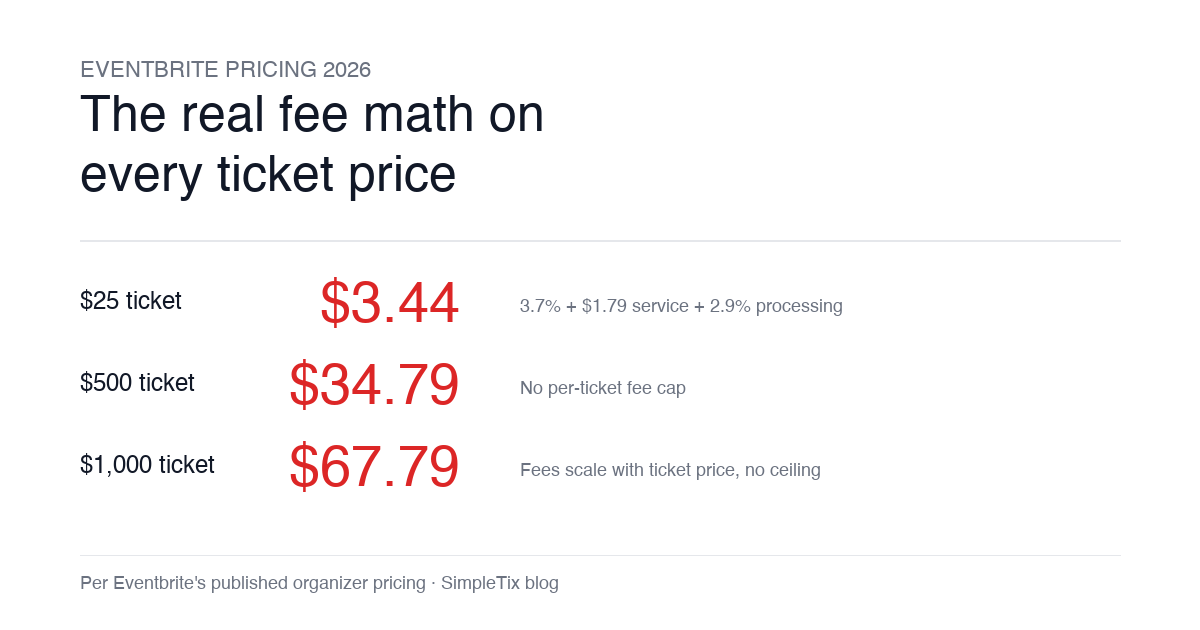
Eventbrite Pricing 2026: Fees, Refunds & What’s Actually Changed
-
by
Eventbrite pricing 2026 is a lot for event organizers to sort through. There are longstanding policies that quietly cost paid-event operators real money, and there is genuine news under new ownership. This guide covers what the fees actually cost you today, what actually changed under the Bending Spoons acquisition, and how the alternatives compare on real numbers. Below is the honest breakdown, sourced to Eventbrite's own pricing page and SEC filings. Eventbrite pricing 2026: current fee structure As of 2026, Eventbrite charges 3.7% + $1.79 per paid ticket for the service fee, plus 2.9% for payment processing. In-person sales carry a $1 + 2.9% fee. There is no per-ticket fee cap. For a quick benchmark of total organizer-side fees: On a $25 ticket, fees total about $3.44 (13.8%) On a $50 ticket, fees total about $5.09 (10.2%) On a $100 ticket, fees total about $8.39 (8.4%) On a $500 ticket, fees total about $34.79 (7.0%) On a $1,000 ticket, fees total about $67.79 (6.8%) The fees scale with ticket price with no ceiling. That is the story for anyone selling premium tickets, season passes, VIP tiers, or corporate packages. Eventbrite pricing 2026: no per-ticket fee cap Eventbrite does not cap total ticket fees. This has been true since 2018, when Eventbrite removed the previous cap during its IPO. For most organizers selling everyday tickets ($20 to $50), the absence of a cap rarely comes up in the math. But for organizers selling premium tickets, the uncapped structure translates into real per-event cost. Take a conference selling three ticket tiers on Eventbrite: $150 general admission: fee about $12.34 (8.2%) $400 VIP ticket: fee about $27.09 (6.8%) $800 sponsor ticket: fee about $50.90 (6.4%) For a 200-person conference with a mix of GA and VIP tickets, that translates into hundreds of dollars...