Tips to Avoid Pissing Off Police with this Event Ticketing System for Your Drive-In Theater
-
 by
by
Riley Manning has worked as a travel and entertainment writer for more than 10 years. Today, he writes about unique events and the technology that helps make them happen.

With the growth drive-in theaters have seen since the pandemic and the lines of cars waiting for entrance, it is no wonder that they came under the watchful eye of local police departments. The local police department might not care for your drive-in theater because of the safety concerns and the impact it can have on traffic when people are trying to enter your operation. And while drive-in theaters are facing plenty of challenges this year, adding pissed-off police officers to the mix won’t help. But by using the right event ticketing software or event registration tool, you can remedy some of the issues that the police might have with your drive-in theater, and you will likely increase customer loyalty in the process.
Use Your Event Ticketing & Event Registration Tool to Avoid Disgruntled Police

The law enforcement reaction to your business model is understandable with their concerns for local safety and preventing traffic back ups.
- Long lines into events can back up traffic on main roads and frustrate local police.
- These lines often require police to take time out of their schedules to direct traffic instead of doing other tasks related to public safety.
So rather than complain about these inevitable reactions from police, why not take a moment to see what solutions are offered by your event registration tool?
Event ticketing software like SimpleTix has several features built into the platform that can minimize some of the friction that officers face when dealing with the inevitabilities of drive-in theater operations. With timed entry, effective pre-sales, and deployment of mindful QR coding, you’ll be able to get your guest in the door faster, which will keep local law enforcement happy.
Here are some ways to improve your drive-in theater and avoid issues with your local law enforcement.
Get People in the Gate Faster with Pre-Sale Tickets or Flat-Rates

One of the easiest ways to reduce a police officer’s stress is to move people along the line more quickly. SimpleTix can help you reduce the friction of slow lines by getting people into the gate faster.
Pre-Sale Tickets
With SimpleTix as your event registration tool, marketing your movies and pre-selling tickets to those features is easier than ever. Pre-sale tickets allow entry lines to move more quickly because none of those attendees will be purchasing their tickets at the point of entry. There’s no time spent on the exchange of money, declined debit cards, or calculating the total. It is all taken care of at the point of sale.
Upsell options are also possible when you pre-sale tickets, which means more money in your pocket. In the point of sale, your guest can pre-purchase:
- Concessions, like popcorn and drinks delivered to their car.
- Merchandise, like t-shirts and souvenir cups.
- Reserved parking for prime moving viewing.
Flat-Rate Per Car
Different ticketing options also shorten your entry lines One option that gets people in the gate faster is charging a flat rate per car rather than per person in the car. This makes at-the-gate accounting easier and moves the waiting cars through the line faster.
Think about the different pricing tiers that might work best for your operation. Try some of these add-ons to entice vistors:
- A veteran’s or student discount
- Mondays-at-the-Movies off-peak pricing
- A VIP package with bottled water and the best parking spot
The SimpleTix event registration tool is robust enough to handle a myriad of selections with different pricing plans and is super easy to implement on the back end.
If you choose to go without a flat, per-car rate, the platform can be leveraged in different ways to get your customers through the gate faster. Leveraging an event registration tool like SimpleTix allows for bulk scanning, so one QR code can be presented to admit the entire family or group. By utilizing a single QR code for the entire car, the amount of customer time spent at the ticket gate is decreased, and police satisfaction with your theater is increased. It’s a win-win for everyone involved!
Use Timed Entry to Control Traffic Flow

Rather than have a line of cars appear at your drive-in just a few minutes before showtime, why not use the features of your event registration tool to encourage timed entry?
Timed entry ticketing lets you put attendees in specified time slots, so they don’t all come at once. Attendees can select arrival times in 10 or 15-minute intervals, making the entry process much easier on their schedule.
With this built-in flexibility, not only will they save time that they would have been waiting in their car, but they will have more time to leisurely walk to the refreshment stand to purchase their sodas and snacks, and they won’t have to rush through a maze of vehicles just as the picture is starting.
When properly implemented, timed entry can alleviate those long lines, so you can actually be more effective with your crowd control. SimpleTix can also generate a report showing these timed entry slots and the number of customers and cars in each, which allows you to demonstrate to local law enforcement that the entry process at your theater is organized and safe for patrons. Timed entry is also better for overall safety because it limits the number of people and cars in your location at one time.
Make Their Jobs Easier
Police officers’ efforts can better serve your community when they are focused on places other than the road and traffic leading to your drive-in theater. By taking the easy steps described above, you can work towards a more favorable relationship with your local law enforcement officers.
Obviously, these public safety concerns are not just limited to drive-in theaters.
Many different event operations (haunted houses, pumpkin patches, larger concert venues) can impact local traffic as well. It is important for every event planner to examine the friction points of their operations and see where they can proactively address these issues with the right event registration tool.
Limiting officials’ trepidations before they field a call from a concerned citizen is the best way to remove a potential police interaction. By deploying the proper event ticketing platform, you can preempt these unpleasant conversations while also ensuring that your guests get to the picture in a safe and timely manner.
SimpleTix has offered an affordable, premium event ticketing platform that outperforms Eventbrite and similar apps for over 12 years. Compared to the competition, SimpleTix offers better options at a better price point. To learn more, call us at +1 (855) 550-3670 or email us at support@simpletix.com.
Latest News
Related Articles

Season Ticket Software for Fall 2026: Subscriptions, Reserved Seating & Renewals
-
 by
by
Fall subscription sales are the single biggest revenue moment for most performing arts organizations. Season packages, member renewals, and early access windows all open between July and September. So the season ticket software you pick this summer decides how the fall series actually sells. This guide covers what season ticket software needs to do in 2026, how to configure it for a theater, symphony, or concert series, and what SimpleTix costs for season-driven event programs. What season ticket software actually needs to do Selling season tickets is nothing like selling single-event tickets. First, one subscriber buys 4 to 20 events in a single package. Second, seats need to lock across the entire season. Third, renewals from prior subscribers happen weeks before the general public gets access. And fourth, add-ons like parking, pre-show dinner, and backstage passes attach to the subscription, not the event. So the operational checklist for season ticket software looks like this: Season pass or subscription products that group multiple events into one purchase Reserved seating with locked seats across the whole season, so the subscriber sits in the same seat every night Priority access windows for existing subscribers before general on-sale Payment plans or full-payment options so patrons can split large subscription costs Renewal workflows that let last year's subscribers re-up with one click Comp ticket management for donors, sponsors, and press seats Membership tiers with different pricing, benefits, and priority access Reporting by subscriber, not just by event If your current tool cannot handle these, you are probably running Excel spreadsheets on the side and losing renewals every year. What is season ticket software? Season ticket software is a ticketing platform designed to sell multi-event packages (season subscriptions) alongside individual tickets, with reserved seat continuity, subscriber priority access, and renewal workflows built in. The core difference...

Holiday Event Ticketing Software: Timed Entry, Reserved Seating & Capacity Control for...
-
by
If you run a holiday event, you are booking dates now. So the ticketing platform you pick this month determines how November and December actually go. This guide covers what holiday event ticketing software needs to do in 2026, how to configure it for the season crunch, and what SimpleTix costs for holiday events of any size. What holiday event ticketing software needs to do Holiday events compress a whole year of sales into six weeks. First, most tickets sell in a 4 to 8 week window between mid-November and January 1. Second, weather cancels outdoor events without warning. Third, family groups buy 4 to 8 tickets in one order, not 1. And fourth, capacity is measured per time slot, not per venue. So the ticketing checklist for holiday operators looks like this: Timed entry with per-slot capacity for drive-throughs, walk-throughs, and Santa visits Reserved seating for holiday theater, Nutcracker, and holiday concerts Group and family bundles so a family of six is one checkout, not six Fast scanning at the gate, including offline mode for cold outdoor venues Waitlists for when peak-hour slots sell out Add-ons for hot chocolate, photo packages, VIP tiers, and holiday merch Automated email reminders so guests do not forget their timed slot Same-day payouts to fund the season's operational costs If your current tool cannot do all of that, October is too late to switch. Move now. How do timed entry tickets work for holiday events? Timed entry lets you release a fixed number of tickets per time slot (typically every 15 or 30 minutes) so guests arrive in waves instead of one 6pm surge. For a Christmas light drive-through with a 45-minute route, that usually means 30 to 60 vehicles per 15-minute window. Over a 5-hour evening, you can process 600 to 1,200...
Eventbrite Pricing 2026: Fees, Refunds & What’s Actually Changed
-
by
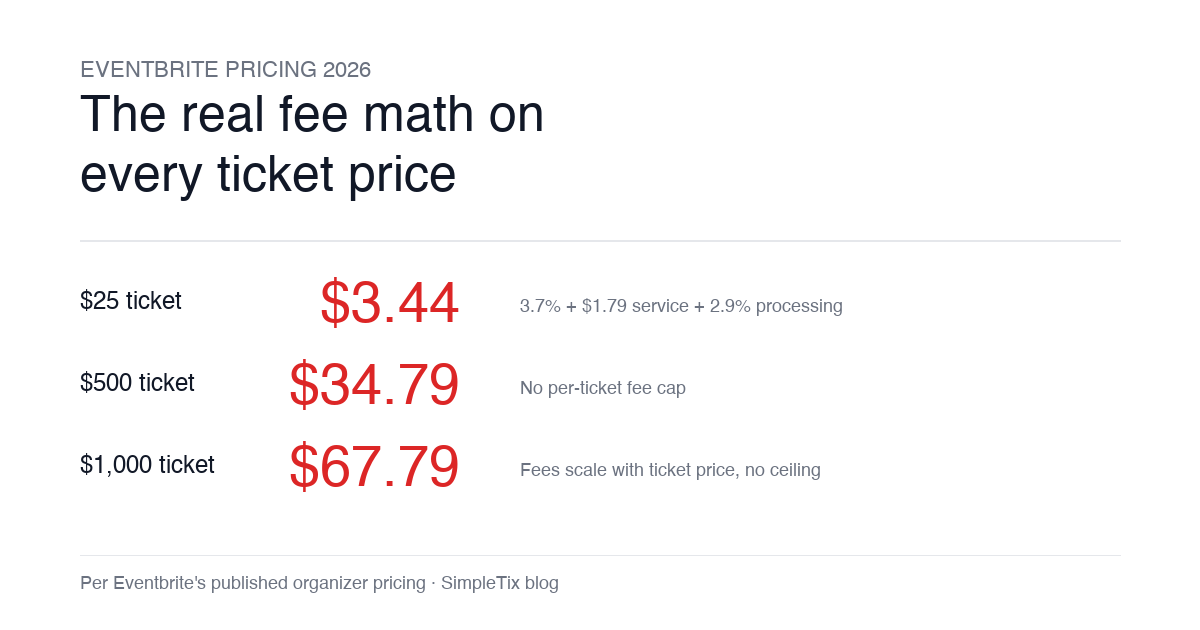
Eventbrite pricing 2026 is a lot for event organizers to sort through. There are longstanding policies that quietly cost paid-event operators real money, and there is genuine news under new ownership. This guide covers what the fees actually cost you today, what actually changed under the Bending Spoons acquisition, and how the alternatives compare on real numbers. Below is the honest breakdown, sourced to Eventbrite's own pricing page and SEC filings. Eventbrite pricing 2026: current fee structure As of 2026, Eventbrite charges 3.7% + $1.79 per paid ticket for the service fee, plus 2.9% for payment processing. In-person sales carry a $1 + 2.9% fee. There is no per-ticket fee cap. For a quick benchmark of total organizer-side fees: On a $25 ticket, fees total about $3.44 (13.8%) On a $50 ticket, fees total about $5.09 (10.2%) On a $100 ticket, fees total about $8.39 (8.4%) On a $500 ticket, fees total about $34.79 (7.0%) On a $1,000 ticket, fees total about $67.79 (6.8%) The fees scale with ticket price with no ceiling. That is the story for anyone selling premium tickets, season passes, VIP tiers, or corporate packages. Eventbrite pricing 2026: no per-ticket fee cap Eventbrite does not cap total ticket fees. This has been true since 2018, when Eventbrite removed the previous cap during its IPO. For most organizers selling everyday tickets ($20 to $50), the absence of a cap rarely comes up in the math. But for organizers selling premium tickets, the uncapped structure translates into real per-event cost. Take a conference selling three ticket tiers on Eventbrite: $150 general admission: fee about $12.34 (8.2%) $400 VIP ticket: fee about $27.09 (6.8%) $800 sponsor ticket: fee about $50.90 (6.4%) For a 200-person conference with a mix of GA and VIP tickets, that translates into hundreds of dollars...