Event Ticketing Software Check-In Speed
-
 by
by

When choosing an event ticketing software, check-in speed can make or break your attendee experience. Modern digital admission systems transform long entry lines into smooth, rapid check-ins. Here’s what successful event organizers are implementing in 2025.
Mobile Check-In Technology
Digital check-in solutions leverage mobile technology for faster entry processing. QR-based admission systems process attendees instantly, even without internet connection. This offline capability ensures continuous operation regardless of venue WiFi quality.
Event planners using modern entry management with timed-entry ticketing report processing times of under 10 seconds per guest, compared to 45-60 seconds with traditional methods. For a conference with 1,000 attendees, this efficiency saves over 12 hours of cumulative wait time, significantly enhancing the attendee experience.
Multiple Entry Point Management with Event Ticketing Software
Large-scale events demand multiple check-in stations. Advanced event ticketing software synchronizes attendance data across all entry points in real-time. Each station operates independently while maintaining a unified guest database, preventing unauthorized access.
Organizers optimize flow by establishing one entry station per 150-200 expected guests. Digital admission systems automatically balance loads across stations, directing attendees to the shortest lines through smart signage integration.
Entry Optimization:
- Real-time synchronization
- Load distribution
- Cross-point communication
- Unified tracking
- Dynamic flow adjustment
Group Processing Efficiency
Corporate gatherings and group bookings need specialized handling. Registration systems enable simultaneous group entry. A single scan verifies and admits groups of up to 50 people while maintaining individual attendance records.
Batch processing features reduce entry time by 80% compared to individual verification. Corporate events benefit from getting 200 guests through the door in under 10 minutes.
Peak Period Performance
Rush periods demand maximum efficiency from your event ticketing software. Smart queuing systems and express entry options maintain speed during high-volume periods. Leading platforms include features specifically designed for managing peak attendance.
Venues using advanced admission management tools report handling up to 900 guests per hour through a single entry point during rush periods.
Real-Time Analytics Without Slowdown
Digital general admission systems now provide real-time analytics on attendance without any delays. Each scan automatically records entry times, checks verification status, and tracks visitor traffic patterns, all without slowing down the check-in process. This real-time data allows organizers to adjust entry flow immediately, ensuring that no single entrance becomes overwhelmed.
Advanced monitoring dashboards in event ticketing software display live data on essential metrics, such as current entry rates, station performance, and predictions for peak times, making it easy for organizers to respond instantly. These dashboards also capture traffic patterns and staff efficiency metrics, allowing for continual adjustments that enhance the attendee experience and maintain smooth operations.
Staff Deployment Strategy
Effective staff allocation is key to managing large crowds and keeping entry lines moving smoothly. Modern admission systems now offer tools that recommend optimal staff deployment based on live data, helping venue managers place staff where they’re most needed. The software suggests the best entry points for staff allocation, taking into account expected traffic and peak times.
During high-traffic periods, these systems can also recommend opening backup stations or adjusting communication protocols to keep staff informed. By strategically planning staff distribution, venues can prevent bottlenecks, shorten wait times, and ensure that attendees experience a quick and organized check-in process.
Implementation Success Guide
To maximize check-in efficiency, many leading venues follow a proven setup routine before the event. For example, using event management software to run a spring event can greatly enhance check-in efficiency when combined with strategic pre-event preparation. Pre-event preparation often includes thorough equipment testing 24 hours before gates open to ensure all devices are functional and ready for high volume. Positioning entry points strategically throughout the venue minimizes crowding and directs traffic flow more evenly.
Training staff on both the standard and offline check-in modes is crucial, as it ensures that the event runs smoothly, even in the event of connectivity issues. Clear communication channels between staff and management, along with redundancy planning, such as backup equipment or entry points, add further resilience to the check-in process, keeping it efficient and uninterrupted.
ROI of Rapid Entry
Implementing a rapid entry system brings clear ROI by enhancing event efficiency and guest satisfaction. Event data shows a 75% drop in entry complaints and a 90% reduction in the number of staff required for check-in, streamlining operations and cutting costs. First-hour processing is 85% faster, reducing wait times significantly, while verification errors drop by 95%, minimizing logistical issues.
The system ensures 100% accuracy in attendance tracking, providing reliable data for future planning and customer insights. These improvements collectively enhance the event experience and operational efficiency, delivering substantial ROI.
Transform Your Event Entry Today
Want to optimize your check-in process? Start with a solution that delivers proven results.
Don’t let slow check-in hurt your next event.
- Full access to all features
- Unlimited test events
- Free staff training
- 24/7 setup support
Book a demo now!
Ready to Talk Numbers?
Our event speed specialists are here 24/7:
- Call: +1 (855) 550-3670
- Email: support@simpletix.com
Latest News
Related Articles

Season Ticket Software for Fall 2026: Subscriptions, Reserved Seating & Renewals
-
by
Fall subscription sales are the single biggest revenue moment for most performing arts organizations. Season packages, member renewals, and early access windows all open between July and September. So the season ticket software you pick this summer decides how the fall series actually sells. This guide covers what season ticket software needs to do in 2026, how to configure it for a theater, symphony, or concert series, and what SimpleTix costs for season-driven event programs. What season ticket software actually needs to do Selling season tickets is nothing like selling single-event tickets. First, one subscriber buys 4 to 20 events in a single package. Second, seats need to lock across the entire season. Third, renewals from prior subscribers happen weeks before the general public gets access. And fourth, add-ons like parking, pre-show dinner, and backstage passes attach to the subscription, not the event. So the operational checklist for season ticket software looks like this: Season pass or subscription products that group multiple events into one purchase Reserved seating with locked seats across the whole season, so the subscriber sits in the same seat every night Priority access windows for existing subscribers before general on-sale Payment plans or full-payment options so patrons can split large subscription costs Renewal workflows that let last year's subscribers re-up with one click Comp ticket management for donors, sponsors, and press seats Membership tiers with different pricing, benefits, and priority access Reporting by subscriber, not just by event If your current tool cannot handle these, you are probably running Excel spreadsheets on the side and losing renewals every year. What is season ticket software? Season ticket software is a ticketing platform designed to sell multi-event packages (season subscriptions) alongside individual tickets, with reserved seat continuity, subscriber priority access, and renewal workflows built in. The core difference...

Holiday Event Ticketing Software: Timed Entry, Reserved Seating & Capacity Control for...
-
by
If you run a holiday event, you are booking dates now. So the ticketing platform you pick this month determines how November and December actually go. This guide covers what holiday event ticketing software needs to do in 2026, how to configure it for the season crunch, and what SimpleTix costs for holiday events of any size. What holiday event ticketing software needs to do Holiday events compress a whole year of sales into six weeks. First, most tickets sell in a 4 to 8 week window between mid-November and January 1. Second, weather cancels outdoor events without warning. Third, family groups buy 4 to 8 tickets in one order, not 1. And fourth, capacity is measured per time slot, not per venue. So the ticketing checklist for holiday operators looks like this: Timed entry with per-slot capacity for drive-throughs, walk-throughs, and Santa visits Reserved seating for holiday theater, Nutcracker, and holiday concerts Group and family bundles so a family of six is one checkout, not six Fast scanning at the gate, including offline mode for cold outdoor venues Waitlists for when peak-hour slots sell out Add-ons for hot chocolate, photo packages, VIP tiers, and holiday merch Automated email reminders so guests do not forget their timed slot Same-day payouts to fund the season's operational costs If your current tool cannot do all of that, October is too late to switch. Move now. How do timed entry tickets work for holiday events? Timed entry lets you release a fixed number of tickets per time slot (typically every 15 or 30 minutes) so guests arrive in waves instead of one 6pm surge. For a Christmas light drive-through with a 45-minute route, that usually means 30 to 60 vehicles per 15-minute window. Over a 5-hour evening, you can process 600 to 1,200...
Eventbrite Pricing 2026: Fees, Refunds & What’s Actually Changed
-
by
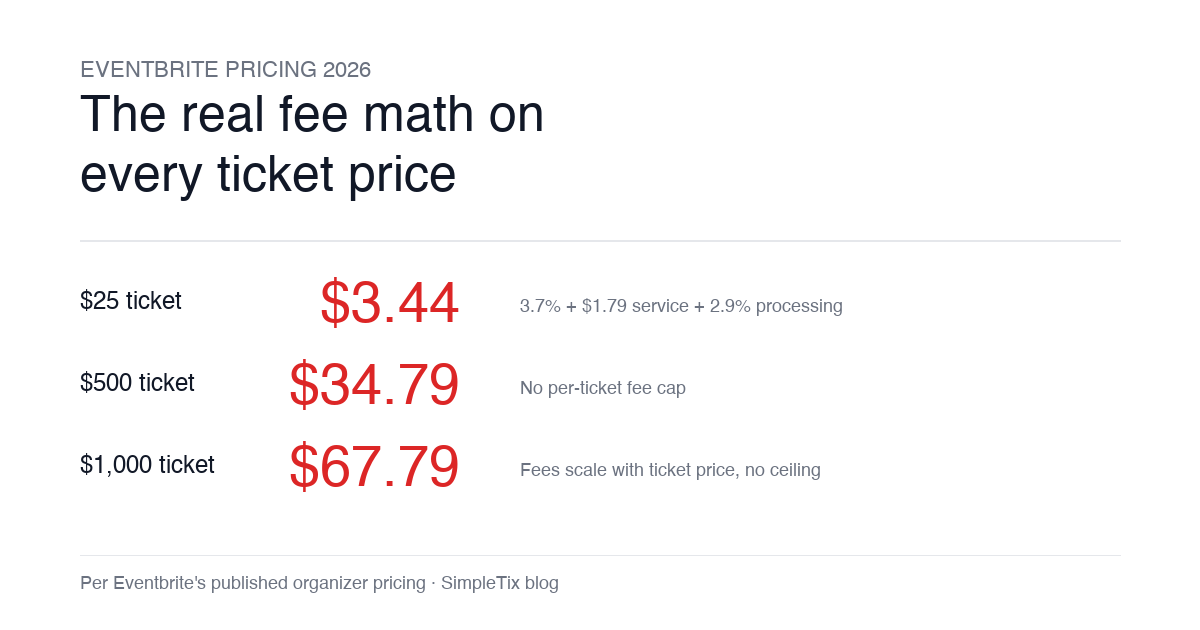
Eventbrite pricing 2026 is a lot for event organizers to sort through. There are longstanding policies that quietly cost paid-event operators real money, and there is genuine news under new ownership. This guide covers what the fees actually cost you today, what actually changed under the Bending Spoons acquisition, and how the alternatives compare on real numbers. Below is the honest breakdown, sourced to Eventbrite's own pricing page and SEC filings. Eventbrite pricing 2026: current fee structure As of 2026, Eventbrite charges 3.7% + $1.79 per paid ticket for the service fee, plus 2.9% for payment processing. In-person sales carry a $1 + 2.9% fee. There is no per-ticket fee cap. For a quick benchmark of total organizer-side fees: On a $25 ticket, fees total about $3.44 (13.8%) On a $50 ticket, fees total about $5.09 (10.2%) On a $100 ticket, fees total about $8.39 (8.4%) On a $500 ticket, fees total about $34.79 (7.0%) On a $1,000 ticket, fees total about $67.79 (6.8%) The fees scale with ticket price with no ceiling. That is the story for anyone selling premium tickets, season passes, VIP tiers, or corporate packages. Eventbrite pricing 2026: no per-ticket fee cap Eventbrite does not cap total ticket fees. This has been true since 2018, when Eventbrite removed the previous cap during its IPO. For most organizers selling everyday tickets ($20 to $50), the absence of a cap rarely comes up in the math. But for organizers selling premium tickets, the uncapped structure translates into real per-event cost. Take a conference selling three ticket tiers on Eventbrite: $150 general admission: fee about $12.34 (8.2%) $400 VIP ticket: fee about $27.09 (6.8%) $800 sponsor ticket: fee about $50.90 (6.4%) For a 200-person conference with a mix of GA and VIP tickets, that translates into hundreds of dollars...