Unexpected Ways You Can Save Money With SimpleTix
-
 by
by
Riley Manning has worked as a travel and entertainment writer for more than 10 years. Today, he writes about unique events and the technology that helps make them happen.

Have you ever been frustrated with online ticketing agencies that charge exorbitant service fees? Have you ever spent so much on concert ticket fees that you were unable to afford to purchase merchandise? If you’re an event organizer or merchandiser, have you ever lost money on gift cards for your event? If so, it might be time to abandon other online ticketing agencies and start saving money with SimpleTix, an Eventbrite alternative.
Unlike other Eventbrite competitors, SimpleTix is designed to streamline the event ticketing process by saving event organizers time, steps, and effort. SimpleTix has one of the lowest, most competitive, and most straightforward price points in the industry.
There are also special rates for agritourism venues, and there’s a fee cap of $9.99. There are no hidden fees, and their basic package is cheaper than the mid-level package that other Eventbrite competitors try to nudge consumers toward.
Maximize Your Pre-Sales

SimpleTix saves you money because it maximizes pre-sales. You won’t waste money overstocking, and you won’t lose sales because you’re understocked. The more tickets, merch, and concessions you’re able to sell beforehand, the easier it will be for you to order the exact amount you need. This minimizes waste, which means organizers will know how to plan exactly how much they will need to spend on drinks, food, parking, security staff, water stations, trash cans, and even portable restrooms.
If you’re a customer, ticket pre-sales allow you to have more financial freedom to spend on snacks, food, beer, and merchandise rather than see your hard-earned money squandered on fees. Pre-sale tickets also give you attendees’ information beforehand so that it’s easier to upsell products like merch, higher-value tickets, or season passes.
Pre-sale tickets are also easier to scan in–compared to selling tickets at the gate, which means less staff is required for the event. You’re able to save money on staff training because SimpleTix is a faster, cheaper, and more streamlined alternative to other online ticketing agencies.
You also save money on staffing because selling tickets 24/7 online using the SimpleTix event page or widget means that customers can buy tickets any time, at their own convenience, without the assistance of a staff member. This allows staff to sell the tickets, merch, and concessions all from one platform with the use of Square.
The SimpleTix interface is also easy to train someone to use. Many companies are choosing to operate with a smaller staff, and SimpleTix makes it easier to have fewer employees on the payroll. In addition, having a smaller staff means less employee turnover, which means you won’t have to pay to train an employee who, for whatever reason, won’t stick around for your next event.
Benefit from SimpleTix’s Partnership with Square

The SimpleTix partnership with Square sets them apart from other Eventbrite competitors and provides another way to save money because there is less shrinkage; employees are not handling as much cash, which prevents the unfortunate occurrence of employee theft.
It’s a big hassle for staff to run around between booths and vendors to get change, and using cash at the entrance gate or concession stands can result in bottlenecked lines. With other Eventbrite competitors, getting ahold of cash post-event from employees who have been making the sales is also a huge hassle.
Using SimpleTix will help reduce the capacity for human error and put an end to the frustration of having to gather cash from different vendors during and after the event. The more you’re able to sell online ahead of the event, the better it is for you and for your customers, who will be able to show up to the event and get everything they paid for without having to buy it on the spot.
SimpleTix is the first to offer Square gift cards which allows venues to keep initial revenue by offering refunds in the form of a gift card. Issuing refunds can be a nightmare, especially bulk refunds due to cancellations, but refunds are instantaneous with SimpleTix. Issuing a refund instantly with Square gift cards allows you the ticket revenue to pay overhead costs.
SimpleTix also saves money and generates revenue by collecting customer contact info so that event organizers can build interest for their next event, send out email blasts about upcoming events, and retain customer interest and business.
Unlike many other Eventbrite competitors, there is an instant payout with SimpleTix. They don’t hold on to revenue for days or even weeks after an event, which allows organizers to turn a profit in a much more timely fashion. This also allows the organizer to fund other aspects of an event without having to go through a lender or a bank for financing.
Customize for Peak and Off-Peak Ticketing
SimpleTix can also help save when it comes to peak and off-peak ticketing days. With SimpleTix, the organizer can set certain dates or date ranges where only peak-price tickets are allowed. For example, if weekends are set as peak days, and a holiday–usually a peak day—happens to fall on a weekday, you will not miss out on any revenue by declaring that holiday as a peak ticketing day. Another feature SimpleTix offers is season passes that require a selfie.
People often share season passes, which may seem victimless, but it ends up hurting the venue and costing money. With SimpleTix, you can require the pass holder to upload a selfie that can only be changed by the venue’s staff.
Staff can see the photo upon check-in and verify that the visitor is actually the pass holder. If the purchaser doesn’t upload a photo themselves or takes a photo that they’re unhappy with, the gate staff can take one on-site the first time the purchaser uses the season pass.
An Eventbrite Competitor That Puts Attendees First

SimpleTix can also help save you money through their Attendee App, which is unique from other Eventbrite competitors. The Attendee App also integrates with many software platforms to reduce manual data replication, which eliminates the need for attendees to repeatedly enter a great deal of their personal information.
Furthermore, attendees can scan tickets instead of spending money to print them out. However, if an attendee decided to print tickets and forgot them at home, the organizers can check them in through the Organizer App, which also means organizers can save money on staffing costs.
Another way SimpleTix helps save you money is by removing advertising clutter on event pages, which detracts from the main objective of ticket sales. If your customers have issues purchasing tickets, SimpleTix has a very “hands-on” approach to customer service.
Unlike many Eventbrite competitors, SimpleTix will not limit you to customer service chats or force you to spend hours on the phone trying to get a real, live person on the other line. SimpleTix will respond promptly to emails, talk over the phone, or even conduct a live troubleshooting session over a video platform–whichever you prefer!
Whether you are an event organizer or a ticket purchaser, SimpleTix is guaranteed to help save you time and money so that you can focus on what really matters–enjoying your event!
SimpleTix has offered an affordable, premium event ticketing platform that outperforms Eventbrite and similar apps for over 12 years. Compared to the competition, SimpleTix offers better options at a better price point. To learn more, call us at +1 (855) 550-3670 or email us at support@simpletix.com.
Latest News
Related Articles

Season Ticket Software for Fall 2026: Subscriptions, Reserved Seating & Renewals
-
 by
by
Fall subscription sales are the single biggest revenue moment for most performing arts organizations. Season packages, member renewals, and early access windows all open between July and September. So the season ticket software you pick this summer decides how the fall series actually sells. This guide covers what season ticket software needs to do in 2026, how to configure it for a theater, symphony, or concert series, and what SimpleTix costs for season-driven event programs. What season ticket software actually needs to do Selling season tickets is nothing like selling single-event tickets. First, one subscriber buys 4 to 20 events in a single package. Second, seats need to lock across the entire season. Third, renewals from prior subscribers happen weeks before the general public gets access. And fourth, add-ons like parking, pre-show dinner, and backstage passes attach to the subscription, not the event. So the operational checklist for season ticket software looks like this: Season pass or subscription products that group multiple events into one purchase Reserved seating with locked seats across the whole season, so the subscriber sits in the same seat every night Priority access windows for existing subscribers before general on-sale Payment plans or full-payment options so patrons can split large subscription costs Renewal workflows that let last year's subscribers re-up with one click Comp ticket management for donors, sponsors, and press seats Membership tiers with different pricing, benefits, and priority access Reporting by subscriber, not just by event If your current tool cannot handle these, you are probably running Excel spreadsheets on the side and losing renewals every year. What is season ticket software? Season ticket software is a ticketing platform designed to sell multi-event packages (season subscriptions) alongside individual tickets, with reserved seat continuity, subscriber priority access, and renewal workflows built in. The core difference...

Holiday Event Ticketing Software: Timed Entry, Reserved Seating & Capacity Control for...
-
by
If you run a holiday event, you are booking dates now. So the ticketing platform you pick this month determines how November and December actually go. This guide covers what holiday event ticketing software needs to do in 2026, how to configure it for the season crunch, and what SimpleTix costs for holiday events of any size. What holiday event ticketing software needs to do Holiday events compress a whole year of sales into six weeks. First, most tickets sell in a 4 to 8 week window between mid-November and January 1. Second, weather cancels outdoor events without warning. Third, family groups buy 4 to 8 tickets in one order, not 1. And fourth, capacity is measured per time slot, not per venue. So the ticketing checklist for holiday operators looks like this: Timed entry with per-slot capacity for drive-throughs, walk-throughs, and Santa visits Reserved seating for holiday theater, Nutcracker, and holiday concerts Group and family bundles so a family of six is one checkout, not six Fast scanning at the gate, including offline mode for cold outdoor venues Waitlists for when peak-hour slots sell out Add-ons for hot chocolate, photo packages, VIP tiers, and holiday merch Automated email reminders so guests do not forget their timed slot Same-day payouts to fund the season's operational costs If your current tool cannot do all of that, October is too late to switch. Move now. How do timed entry tickets work for holiday events? Timed entry lets you release a fixed number of tickets per time slot (typically every 15 or 30 minutes) so guests arrive in waves instead of one 6pm surge. For a Christmas light drive-through with a 45-minute route, that usually means 30 to 60 vehicles per 15-minute window. Over a 5-hour evening, you can process 600 to 1,200...
Eventbrite Pricing 2026: Fees, Refunds & What’s Actually Changed
-
by
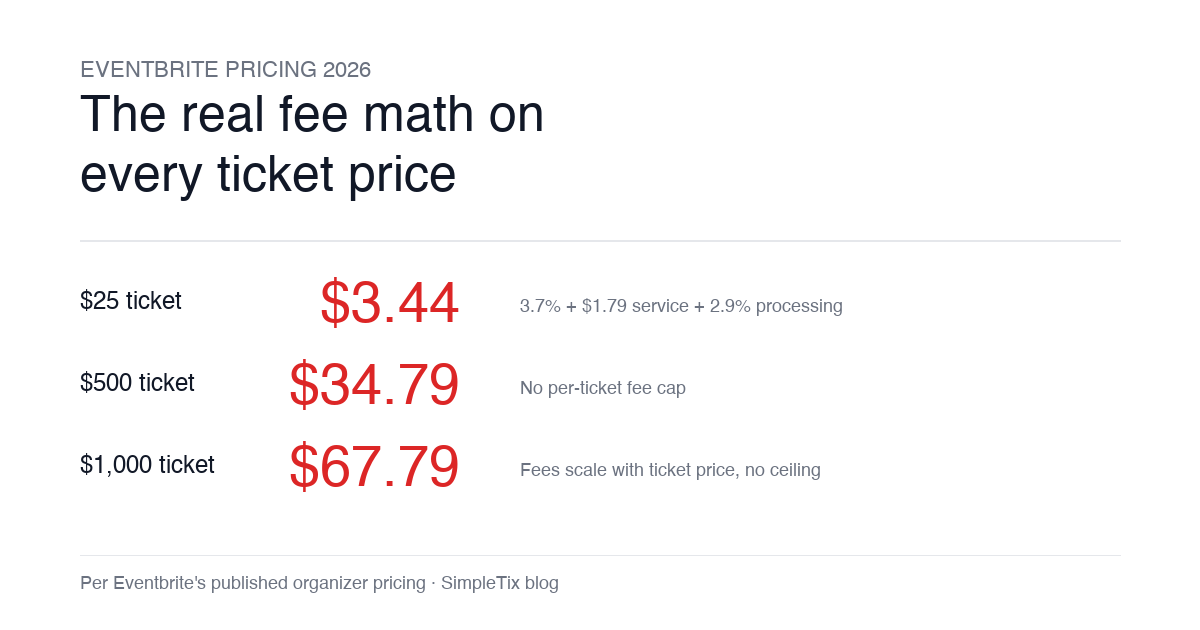
Eventbrite pricing 2026 is a lot for event organizers to sort through. There are longstanding policies that quietly cost paid-event operators real money, and there is genuine news under new ownership. This guide covers what the fees actually cost you today, what actually changed under the Bending Spoons acquisition, and how the alternatives compare on real numbers. Below is the honest breakdown, sourced to Eventbrite's own pricing page and SEC filings. Eventbrite pricing 2026: current fee structure As of 2026, Eventbrite charges 3.7% + $1.79 per paid ticket for the service fee, plus 2.9% for payment processing. In-person sales carry a $1 + 2.9% fee. There is no per-ticket fee cap. For a quick benchmark of total organizer-side fees: On a $25 ticket, fees total about $3.44 (13.8%) On a $50 ticket, fees total about $5.09 (10.2%) On a $100 ticket, fees total about $8.39 (8.4%) On a $500 ticket, fees total about $34.79 (7.0%) On a $1,000 ticket, fees total about $67.79 (6.8%) The fees scale with ticket price with no ceiling. That is the story for anyone selling premium tickets, season passes, VIP tiers, or corporate packages. Eventbrite pricing 2026: no per-ticket fee cap Eventbrite does not cap total ticket fees. This has been true since 2018, when Eventbrite removed the previous cap during its IPO. For most organizers selling everyday tickets ($20 to $50), the absence of a cap rarely comes up in the math. But for organizers selling premium tickets, the uncapped structure translates into real per-event cost. Take a conference selling three ticket tiers on Eventbrite: $150 general admission: fee about $12.34 (8.2%) $400 VIP ticket: fee about $27.09 (6.8%) $800 sponsor ticket: fee about $50.90 (6.4%) For a 200-person conference with a mix of GA and VIP tickets, that translates into hundreds of dollars...