Labor shortage leaving you short-handed? SimpleTix helps you cover the gaps.
-
 by
by
Riley Manning has worked as a travel and entertainment writer for more than 10 years. Today, he writes about unique events and the technology that helps make them happen.
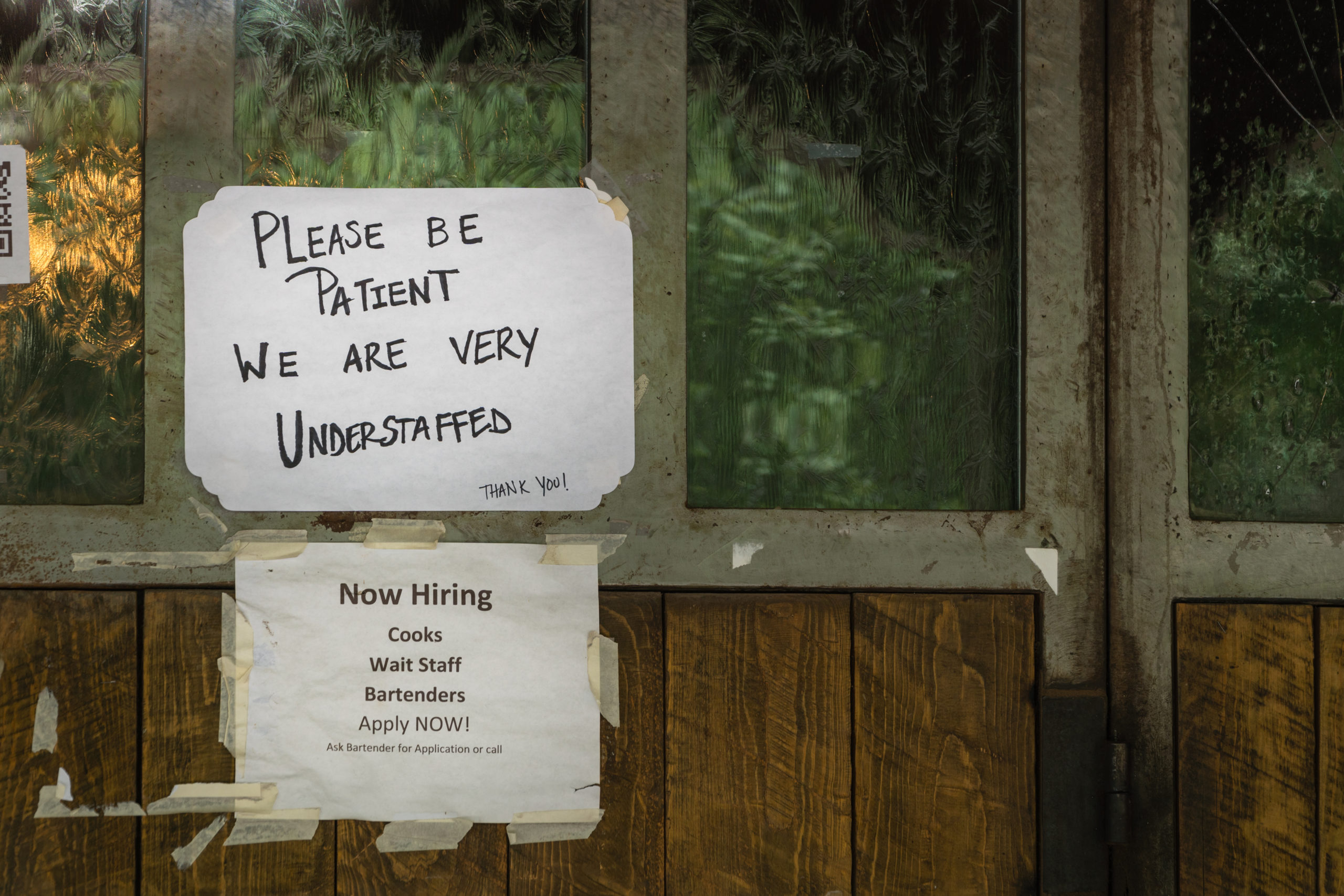
If you’ve driven past a strip of fast food restaurants lately, you’ve probably noticed how many of them have “HIRING NOW” signs in the window. Some may have even reduced their operating hours due to being so short-staffed.
The restaurant industry isn’t alone. According to the Bureau of Labor and Statistics, the number of job openings in America hit an all-time high of 9.1 million in June. Trucking companies, farms, manufacturers, retail stores —businesses of all types are struggling to attract workers following the COVID-19 pandemic.
Colin Davis helps run the Chico Hot Springs Resort, just north of Yellowstone National Park. During the pandemic, he was forced to shut down the resort for three months and lay off 150 of his 180 employees. As the world opens up again, the boom season he looked forward to has become a challenge all its own.
“The stats from Yellowstone National Park pointed to probably the best financial year we would have ever had. I was like, ‘Wow, we’re going to come back rolling out of this’ and we’re just going to crush it… Everyone needed a win, then we phased into this labor crisis, Davis told The Daily podcast for its August 3 episode. “It’s honestly more stressful and harder to manage than COVID was.“
Shannen Tune, chef and owner of Craft Burger in Houston, has had to re-think his business model to survive the changing dynamics of his industry. Before the pandemic, Tune paid inexperienced, entry-level staff $12 per hour. Now applicants want $20.
“I’m not a big corporate restaurant. I don’t have the funding and backing to where I can offer people $500 for interviewing or taking a job,” he said, in the same podcast. “One thing the pandemic taught a lot of restaurant owners is that your margins are not OK. We can’t get by on 10% – 15% profit anymore. We have to increase our prices and we have to educate our customers that this is part of the process.”
Odds are, the labor shortage has affected you, as well. If you’re an event organizer, you may have found it difficult to hire enough day-of staff for your event. If you run an attraction, like a zoo, pumpkin patch, or performing arts center, you may have very few openings of your own.
As you search for the right additions to your team, rethink your business model, or adapt to the new normal, SimpleTix can help lessen the workload and make the most of your existing staff as they hustle to cover the gaps.
Lessen the Load For Your Staff
Driving revenue is key for your organization, but could you manage higher business volume with your current staff?
At the Chico Hot Springs Resort, Davis has more work than he and his staff can handle. From busing tables to cleaning dishes to tending the garden and cleaning rooms, it’s all hands on deck, forcing him to leave money on the table.
“There’s 20 rooms per night that I can’t rent because I can’t keep them clean. That’s 600 rooms per month. That’s a phenomenal amount of money, and that’s hurting us,” he said.
If the whiplash of scaling down, then scaling back up is running you ragged and costing you money, minimizing your staff’s workload is crucial to staying above water.
SimpleTix can remove a huge amount of the managerial burden that your staff must wade through every day.
Customers can change their own ticket details
If a customer wants to change their ticket date, time slot, or some other detail, you or your staff must field a call or email and make the change to the customer’s ticket status manually in your system.
You don’t have to sell many tickets for this type of work to become overwhelming. It isn’t cost-effective to your operation, and it distracts your staff from more important objectives.
With SimpleTix, customers can make changes to their tickets on their own. They can alter their ticket for another time or day. For a multi-day event, they can change their selection of which events they want to attend.
They can even give their ticket to someone else, if they like. SimpleTix will give the new ticket holder a new unique QR code and update personal information attached to the ticket.
Any changes your customers make will be automatically updated in your SimpleTix platform, removing virtually all of the manual work.
Not only does this functionality lessen the work for your staff, it’s more convenient for your customer, too. They don’t have to call and reach your staff during business hours, or wait for an email response from you to solidify their plans.
Streamline check-ins
Nothing frustrates attendees more than a long line at the gate. They want to get in and start having fun as soon as possible. But if your gate or admissions staff has to handle cash or check attendees in manually, you’ll need more staff to keep the line moving.
SimpleTix gives your attendees a scan-and-go ticket that they can store on their phone or print out. At the gate, your staff can simply and quickly scan that ticket with their own mobile device using the SimpleTix Organizer app.
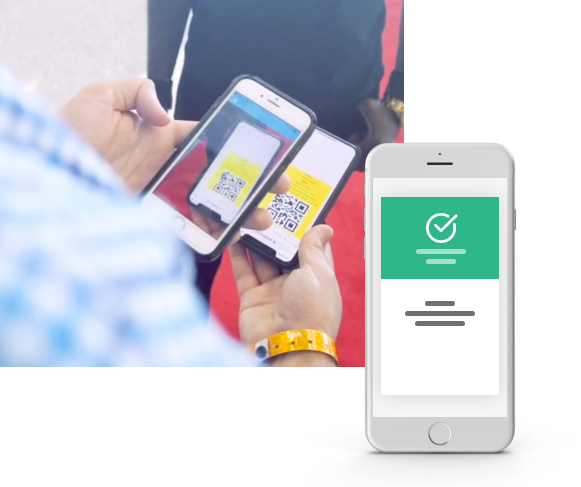
By making check-ins as frictionless as possible, you won’t need as much staff at the gate or check-in counter.
SimpleTix gives your frontline staff the power to handle other admissions tasks, too.
If a customer forgets their ticket, your gate staff can check them in manually through the Organizer app in no time.
SimpleTix even makes at-the-gate purchases faster. We’re one of the only ticketing platforms with a Square partnership, so your gate staff can execute a sale almost as quickly as checking in a pre-sale ticket.
Do you use a different payment processor like Stripe? No problem. SimpleTix also integrates with over a dozen other payment gateways, so you can use SimpleTix with your existing payment processing solution.
Automatic reminders
Keeping attendees in the loop can be a battle in itself. Sending emails, managing contacts, texting, posting to social media — these tasks can chew away at your staff’s efficiency.
SimpleTix lets you schedule automatic reminders, so you can set it and forget it. You could use reminders to reinforce details about where to park, what entrance to use, what to bring, and other information that will help side-step hang-ups at your event or attraction.
Intelligent integration
According to a study by Asana, Americans spend almost five hours per week on manual, duplicative tasks. How much money does five hours of employee time cost you? How much more money could you make if every employee could work five more hours per week?
That’s why we built SimpleTix to be as integratable as possible.
By integrating SimpleTix with Zapier, MailChimp, SalesForce, and hundreds of other platforms and apps, you can ensure a seamless automatic flow of information.
For example. SimpleTix can automatically add attendees’ contact information to your MailChimp audience or automatically generate a new lead in SalesForce.
If your staff has to manually duplicate data across multiple systems, you’re not taking full advantage of your software. SimpleTix helps relieve your staff of the meticulous task of data entry around your ticketing.
Increase revenue with online sales
Once your staff has the bandwidth to accommodate more business, you can focus on increasing business traffic.
Online ticket sales are a must in today’s digital economy, especially if you plan to make up for higher staffing costs by selling more tickets.
Online ticket sales let customers buy tickets on their own time without any assistance from a staff member. For the customer, online sales makes it easier to plan their visit, and less likely they will change their minds and visit a different attraction instead.
Without online sales, customers have to either call and buy tickets during operating hours, or show up and hope tickets haven’t sold out.
No one makes online ticket sales simpler than SimpleTix. When you create an event with us, you’ll get a clean, simple website to sell tickets and give more details about your event.
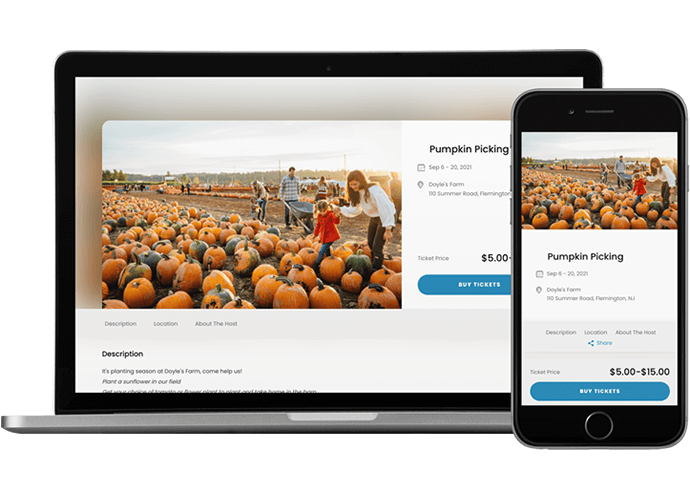
In fact, it’s free to create your SimpleTix event website or embed the SimpleTix widget into your existing site. We don’t charge any fees until you sell your first ticket.
By selling tickets 24/7, you will almost certainly sell more tickets than before. Imagine waking up to a few hundred dollars in sales before your day even gets started. That may sound like a fantasy, but it’s a regular reality for SimpleTix users.
Pre-sale tickets also let you anticipate how many attendees you can expect at your event or attraction. It’s hard to allocate budget, staff, and other resources when you don’t know if you’ll have 50 attendees or 500.
It doesn’t have to be complicated with SimpleTix
SimpleTix can help you pull of your event with a skeleton crew or give your staff more breathing room in their daily operations, all without costing you an arm and a leg.
Our rate is one of the best in the industry: $0.79 per ticket + 2% of your ticket price.
Meanwhile, Eventbrite charges $1.59 per ticket + 3.5% of your ticket price.
At SimpleTix, our goal isn’t just to make money off ticket fees. We want to give you what you need to be successful. Our YouTube channel shows you tons of ways you can use SimpleTix to make it easier to run your show.
Try creating your own SimpleTix event page to see just how simple ticketing can be.
Latest News
Related Articles

Season Ticket Software for Fall 2026: Subscriptions, Reserved Seating & Renewals
-
 by
by
Fall subscription sales are the single biggest revenue moment for most performing arts organizations. Season packages, member renewals, and early access windows all open between July and September. So the season ticket software you pick this summer decides how the fall series actually sells. This guide covers what season ticket software needs to do in 2026, how to configure it for a theater, symphony, or concert series, and what SimpleTix costs for season-driven event programs. What season ticket software actually needs to do Selling season tickets is nothing like selling single-event tickets. First, one subscriber buys 4 to 20 events in a single package. Second, seats need to lock across the entire season. Third, renewals from prior subscribers happen weeks before the general public gets access. And fourth, add-ons like parking, pre-show dinner, and backstage passes attach to the subscription, not the event. So the operational checklist for season ticket software looks like this: Season pass or subscription products that group multiple events into one purchase Reserved seating with locked seats across the whole season, so the subscriber sits in the same seat every night Priority access windows for existing subscribers before general on-sale Payment plans or full-payment options so patrons can split large subscription costs Renewal workflows that let last year's subscribers re-up with one click Comp ticket management for donors, sponsors, and press seats Membership tiers with different pricing, benefits, and priority access Reporting by subscriber, not just by event If your current tool cannot handle these, you are probably running Excel spreadsheets on the side and losing renewals every year. What is season ticket software? Season ticket software is a ticketing platform designed to sell multi-event packages (season subscriptions) alongside individual tickets, with reserved seat continuity, subscriber priority access, and renewal workflows built in. The core difference...

Holiday Event Ticketing Software: Timed Entry, Reserved Seating & Capacity Control for...
-
by
If you run a holiday event, you are booking dates now. So the ticketing platform you pick this month determines how November and December actually go. This guide covers what holiday event ticketing software needs to do in 2026, how to configure it for the season crunch, and what SimpleTix costs for holiday events of any size. What holiday event ticketing software needs to do Holiday events compress a whole year of sales into six weeks. First, most tickets sell in a 4 to 8 week window between mid-November and January 1. Second, weather cancels outdoor events without warning. Third, family groups buy 4 to 8 tickets in one order, not 1. And fourth, capacity is measured per time slot, not per venue. So the ticketing checklist for holiday operators looks like this: Timed entry with per-slot capacity for drive-throughs, walk-throughs, and Santa visits Reserved seating for holiday theater, Nutcracker, and holiday concerts Group and family bundles so a family of six is one checkout, not six Fast scanning at the gate, including offline mode for cold outdoor venues Waitlists for when peak-hour slots sell out Add-ons for hot chocolate, photo packages, VIP tiers, and holiday merch Automated email reminders so guests do not forget their timed slot Same-day payouts to fund the season's operational costs If your current tool cannot do all of that, October is too late to switch. Move now. How do timed entry tickets work for holiday events? Timed entry lets you release a fixed number of tickets per time slot (typically every 15 or 30 minutes) so guests arrive in waves instead of one 6pm surge. For a Christmas light drive-through with a 45-minute route, that usually means 30 to 60 vehicles per 15-minute window. Over a 5-hour evening, you can process 600 to 1,200...
Eventbrite Pricing 2026: Fees, Refunds & What’s Actually Changed
-
by
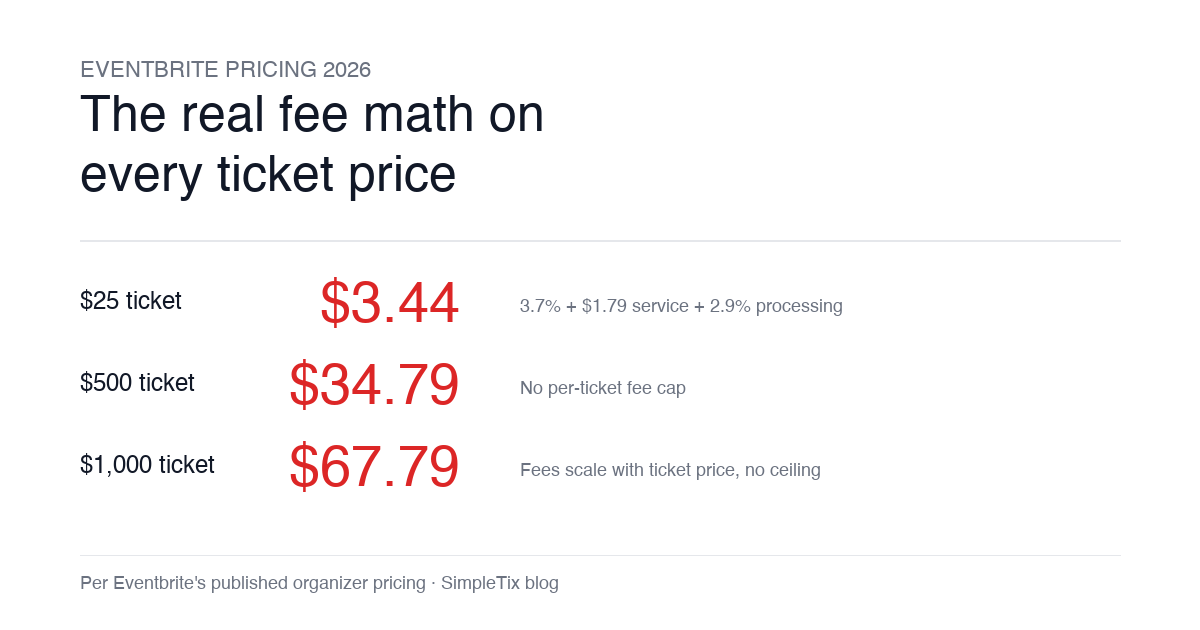
Eventbrite pricing 2026 is a lot for event organizers to sort through. There are longstanding policies that quietly cost paid-event operators real money, and there is genuine news under new ownership. This guide covers what the fees actually cost you today, what actually changed under the Bending Spoons acquisition, and how the alternatives compare on real numbers. Below is the honest breakdown, sourced to Eventbrite's own pricing page and SEC filings. Eventbrite pricing 2026: current fee structure As of 2026, Eventbrite charges 3.7% + $1.79 per paid ticket for the service fee, plus 2.9% for payment processing. In-person sales carry a $1 + 2.9% fee. There is no per-ticket fee cap. For a quick benchmark of total organizer-side fees: On a $25 ticket, fees total about $3.44 (13.8%) On a $50 ticket, fees total about $5.09 (10.2%) On a $100 ticket, fees total about $8.39 (8.4%) On a $500 ticket, fees total about $34.79 (7.0%) On a $1,000 ticket, fees total about $67.79 (6.8%) The fees scale with ticket price with no ceiling. That is the story for anyone selling premium tickets, season passes, VIP tiers, or corporate packages. Eventbrite pricing 2026: no per-ticket fee cap Eventbrite does not cap total ticket fees. This has been true since 2018, when Eventbrite removed the previous cap during its IPO. For most organizers selling everyday tickets ($20 to $50), the absence of a cap rarely comes up in the math. But for organizers selling premium tickets, the uncapped structure translates into real per-event cost. Take a conference selling three ticket tiers on Eventbrite: $150 general admission: fee about $12.34 (8.2%) $400 VIP ticket: fee about $27.09 (6.8%) $800 sponsor ticket: fee about $50.90 (6.4%) For a 200-person conference with a mix of GA and VIP tickets, that translates into hundreds of dollars...