Employing Waiver Best Practices With Apps Like Eventbrite
-
 by
by
Riley Manning has worked as a travel and entertainment writer for more than 10 years. Today, he writes about unique events and the technology that helps make them happen.

Things like insurance, liability, and risk management comprise the less fun aspects of throwing an event. They’re not only essential to the safety of your guests at your event, but they also protect your organization from legal entanglements. Waivers are a major component of this aspect of event planning.
Many event organizers require their guests to sign waivers before they can enter the premises due to any inherent risks involved in the event. Requiring a waiver has become more prevalent throughout the COVID-19 pandemic as events became possible transmission hotspots.
Asking your guests to sign a waiver may seem like a hassle, but collecting digital signatures on e-waivers can ease the burden of requiring this documentation. Often apps like Eventbrite allow you to easily wrangle digital waivers for your event.
There are many factors to consider when adding a waiver to your event. Using an Eventbrite alternative like SimpleTix to distribute your electronic waivers facilitates a smooth process for both you and your guests.
Table of Contents:
What is a waiver?
Why should I incorporate waivers into my event?
How can apps like Eventbrite facilitate the waiver process?
What is a waiver?

A waiver, also known as a release form, is a legally binding agreement between two parties. In the context of an event, this document outlines the possibility of risks at the event and explains that by signing the document, the event attendee understands these possibilities and agrees not to sue should any damages occur.
For example, an event organizer may ask guests to sign a waiver at a haunted hayride on a farm. The event organizers there will be lots of children running and jumping around hay bales. If a child is injured while playing, the waiver protects the event organizer from any litigation surrounding the child’s injury.
There are many ways to word and organize your waiver. If you’re already working with a lawyer for other aspects of your event, they should also be able to advise you on the contents of a waiver for your specific event. All waivers do require basic information such as:
- Date of the event
- Signature of the event host
- Signature of the event guest (or guardian for underage guests)
- Details of the event
- List of possible risks at the event
While waivers release you from any liability should an accident out of your control happen, they don’t protect you from all legal action. You are still responsible for providing a safe environment for your guests.
Why should I incorporate waivers into my event?
Litigation is not only stressful, but it is also disruptive to your normal operations and can possibly bankrupt your organization. Asking your guests to sign waivers before entering your event ensures they assume responsibility for their actions while on the premises, in addition to having awareness of the potential risks.
If you’re wondering if your event needs a waiver, generally consider the following questions:
- Will children be present?
- Is the event located in an outdoor space?
- Will guests participate in physical activities while at the event?
If you have answered yes to one or more of these questions, you should seriously consider using a waiver at your event. These are all high risk factors at an event, and thus, it’s better to protect your business with a waiver.
You may also anticipate commissioning professional photos at your premises to promote future events. In this instance, it’s very common to ask guests to sign a waiver to release the use of their photos on your organization’s social media or website. This is a common practice at music festivals, where attendees sign away the rights to their likeness when they purchase a ticket.
Requiring a waiver is not necessary for all events and attendees. If you’re unsure, consulting a lawyer familiar with event liability experience can point you in the right direction. You may also have insurance that covers accidents, rendering a waiver obsolete.
How can apps like Eventbrite facilitate the waiver process?

If you’ve deemed a waiver necessary at your event, it can be a headache trying to discern the process. Using electronic waivers instead of paper copies eliminates much of the hassle associated with this requirement.
Paper copies should be avoided at all costs. You have to wait until your guests arrive to pass them out and receive their signatures. You’ll need to provide guests with a copy of the waiver, a pen, and something hard to sign on, like a clipboard.
Each guest then has to read the waiver, digest the information, and sign to waive their rights. They may have questions or concerns with the terms outlined in the contracts. A guest could slip in without signing or walk off with their waiver in hand. Plus, handwriting can be difficult to read. If you’re doing this at check-in, paper waivers can create a huge mess at the gate of your event.
Sending your guests a digital waiver to sign before the event streamlines this process and makes it easier for both you and your guests. You don’t have to worry about a backed-up check-in line or collecting papers from everyone.
If you use Eventbrite alternative SimpleTix, you can distribute the waiver to guests by including the waiver in their ticket purchase confirmation email. By doing this, guests can read and sign the waiver at their leisure. If they have questions or concerns, they have plenty of time to ask them before the event.
You’ll also be able to track who has and hasn’t signed the waiver before the event in your event organizer app, and then send reminders to those who haven’t, asking them to fill them out.
It’s no problem if attendees forget to sign their waiver and show up to the event anyway. For these guests and any walk-ins, you can set up a digital waiver and send the link to their smartphone, or set up iPads so guests can read and sign away from the front gate.
Some apps like Eventbrite offer integrations with waiver services. These services will handle the entire waiver process, including storing them. If you don’t use a waiver service, saving the files in a safe, backed-up location ensures they’re easily accessible.
Once the event is over, there’s no need to keep waivers on file for at least three years. This is one of the many reasons digital waivers are more convenient than asking your guests to sign hard copies. Digital waivers take up less physical space than paper waivers, are less likely to go missing, and are easier to retrieve.
Using apps like Eventbrite to distribute waivers creates a seamless experience for your guests, while not adding too much stress on your event staff. By asking guests to sign a waiver before attending your event, you can focus on creating a safe environment instead of any potential accidents.
SimpleTix has offered an affordable, premium event ticketing platform that outperforms Eventbrite and similar apps for over 12 years. Compared to the competition, SimpleTix offers better options at a better price point. To learn more, call us at +1 (855) 550-3670 or email us at support@simpletix.com.
Latest News
Related Articles

Season Ticket Software for Fall 2026: Subscriptions, Reserved Seating & Renewals
-
 by
by
Fall subscription sales are the single biggest revenue moment for most performing arts organizations. Season packages, member renewals, and early access windows all open between July and September. So the season ticket software you pick this summer decides how the fall series actually sells. This guide covers what season ticket software needs to do in 2026, how to configure it for a theater, symphony, or concert series, and what SimpleTix costs for season-driven event programs. What season ticket software actually needs to do Selling season tickets is nothing like selling single-event tickets. First, one subscriber buys 4 to 20 events in a single package. Second, seats need to lock across the entire season. Third, renewals from prior subscribers happen weeks before the general public gets access. And fourth, add-ons like parking, pre-show dinner, and backstage passes attach to the subscription, not the event. So the operational checklist for season ticket software looks like this: Season pass or subscription products that group multiple events into one purchase Reserved seating with locked seats across the whole season, so the subscriber sits in the same seat every night Priority access windows for existing subscribers before general on-sale Payment plans or full-payment options so patrons can split large subscription costs Renewal workflows that let last year's subscribers re-up with one click Comp ticket management for donors, sponsors, and press seats Membership tiers with different pricing, benefits, and priority access Reporting by subscriber, not just by event If your current tool cannot handle these, you are probably running Excel spreadsheets on the side and losing renewals every year. What is season ticket software? Season ticket software is a ticketing platform designed to sell multi-event packages (season subscriptions) alongside individual tickets, with reserved seat continuity, subscriber priority access, and renewal workflows built in. The core difference...

Holiday Event Ticketing Software: Timed Entry, Reserved Seating & Capacity Control for...
-
by
If you run a holiday event, you are booking dates now. So the ticketing platform you pick this month determines how November and December actually go. This guide covers what holiday event ticketing software needs to do in 2026, how to configure it for the season crunch, and what SimpleTix costs for holiday events of any size. What holiday event ticketing software needs to do Holiday events compress a whole year of sales into six weeks. First, most tickets sell in a 4 to 8 week window between mid-November and January 1. Second, weather cancels outdoor events without warning. Third, family groups buy 4 to 8 tickets in one order, not 1. And fourth, capacity is measured per time slot, not per venue. So the ticketing checklist for holiday operators looks like this: Timed entry with per-slot capacity for drive-throughs, walk-throughs, and Santa visits Reserved seating for holiday theater, Nutcracker, and holiday concerts Group and family bundles so a family of six is one checkout, not six Fast scanning at the gate, including offline mode for cold outdoor venues Waitlists for when peak-hour slots sell out Add-ons for hot chocolate, photo packages, VIP tiers, and holiday merch Automated email reminders so guests do not forget their timed slot Same-day payouts to fund the season's operational costs If your current tool cannot do all of that, October is too late to switch. Move now. How do timed entry tickets work for holiday events? Timed entry lets you release a fixed number of tickets per time slot (typically every 15 or 30 minutes) so guests arrive in waves instead of one 6pm surge. For a Christmas light drive-through with a 45-minute route, that usually means 30 to 60 vehicles per 15-minute window. Over a 5-hour evening, you can process 600 to 1,200...
Eventbrite Pricing 2026: Fees, Refunds & What’s Actually Changed
-
by
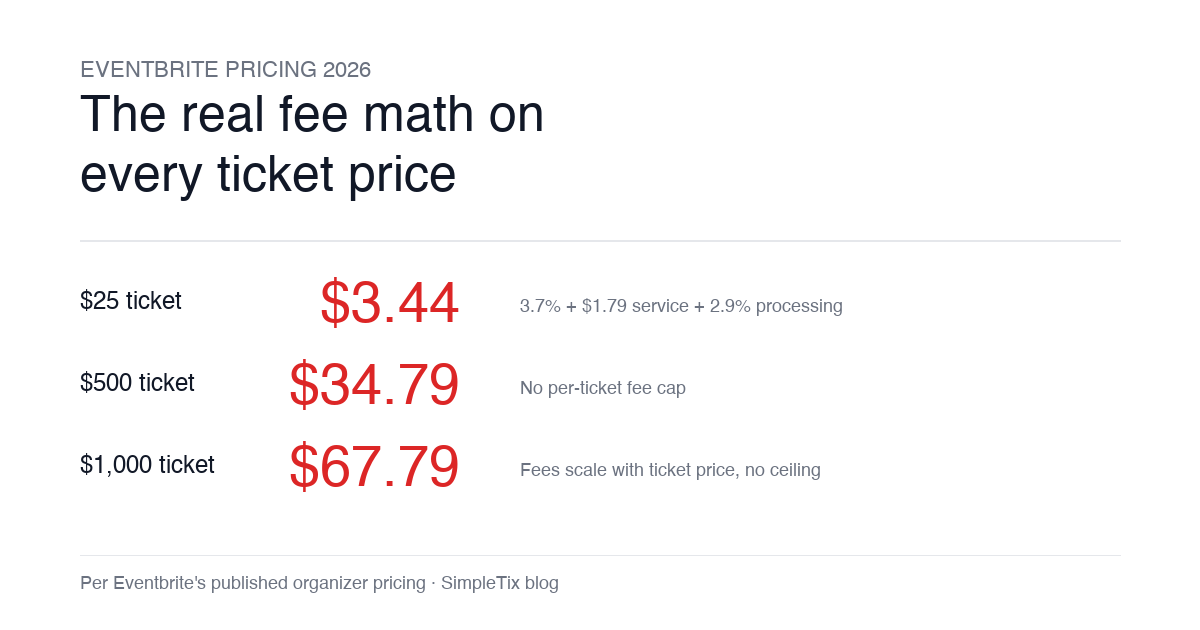
Eventbrite pricing 2026 is a lot for event organizers to sort through. There are longstanding policies that quietly cost paid-event operators real money, and there is genuine news under new ownership. This guide covers what the fees actually cost you today, what actually changed under the Bending Spoons acquisition, and how the alternatives compare on real numbers. Below is the honest breakdown, sourced to Eventbrite's own pricing page and SEC filings. Eventbrite pricing 2026: current fee structure As of 2026, Eventbrite charges 3.7% + $1.79 per paid ticket for the service fee, plus 2.9% for payment processing. In-person sales carry a $1 + 2.9% fee. There is no per-ticket fee cap. For a quick benchmark of total organizer-side fees: On a $25 ticket, fees total about $3.44 (13.8%) On a $50 ticket, fees total about $5.09 (10.2%) On a $100 ticket, fees total about $8.39 (8.4%) On a $500 ticket, fees total about $34.79 (7.0%) On a $1,000 ticket, fees total about $67.79 (6.8%) The fees scale with ticket price with no ceiling. That is the story for anyone selling premium tickets, season passes, VIP tiers, or corporate packages. Eventbrite pricing 2026: no per-ticket fee cap Eventbrite does not cap total ticket fees. This has been true since 2018, when Eventbrite removed the previous cap during its IPO. For most organizers selling everyday tickets ($20 to $50), the absence of a cap rarely comes up in the math. But for organizers selling premium tickets, the uncapped structure translates into real per-event cost. Take a conference selling three ticket tiers on Eventbrite: $150 general admission: fee about $12.34 (8.2%) $400 VIP ticket: fee about $27.09 (6.8%) $800 sponsor ticket: fee about $50.90 (6.4%) For a 200-person conference with a mix of GA and VIP tickets, that translates into hundreds of dollars...