Winery Event Ticketing: How to Sell Tastings, Clubs, and Timed Entry
-
 by
by
Winery Event Ticketing: How to Sell Tastings, Clubs, and Timed Entry
If you run a winery, ticketing can get messy fast.
You’re not just selling one event. You’re juggling tasting flights, weekend live music, club perks, seasonal releases, private experiences, and guests who all want to arrive at 2:00 PM. Good winery event ticketing should do more than process payments — it should help control flow, protect capacity, and keep checkout simple enough that people finish buying.
Here’s how to set up winery event ticketing so your spring and summer events run smoother.
Start with the right event structure
A lot of ticketing problems start with the wrong setup.
If you list every tasting, patio event, and release weekend as a generic ticket, you create confusion for guests and extra work for staff. Before you build anything, decide what you’re actually selling.
For many wineries, that often breaks down into four buckets:
- Timed tastings
- Special events
- Wine club or membership offers
- Add-ons and upsells
Each one needs a slightly different setup.
Timed tastings
For standard tasting room traffic, use timed entry with capacity management.
This lets you sell specific arrival windows — like 12:00 PM, 1:30 PM, or 3:00 PM — instead of letting everyone show up whenever they want. That can matter on busy weekends when one crowded hour can throw off the guest experience.
A simple starting point many wineries use:
- 90-minute tasting blocks
- Capacity based on seats, staff, or service stations
- Small buffer between slots if your team needs reset time
If your patio fits 40 seated guests comfortably, don’t sell 60 spots because it looks good on paper. Build to the experience you can actually deliver.
Special events
Live music nights, release parties, vineyard dinners, and food pairings may work better as general admission or reserved seating, depending on the format.
Use general admission if guests are buying access to the event as a whole. Use reserved seating if table location matters, like for a winemaker dinner or a premium pairing event.
Clubs and memberships
If you have a wine club, don’t treat it like an afterthought.
Memberships should have their own structure, pricing, and benefits. If you offer tiered club levels, set those up clearly so guests can see what they get at each level — whether that’s discounted tastings, complimentary tickets, or access to member-only events.
Add-ons and upsells
A lot of wineries bring in extra revenue from small add-ons during checkout.
Think:
- Cheese boards
- Charcuterie
- Souvenir glasses
- Bottle bundles
- Picnic packages
- Early access tastings
These work best when they’re offered as part of the buying flow, not buried in a follow-up email.
Use timed entry to fix weekend crowding
Timed entry is a practical tool for wineries.
It helps spread arrivals, manage staffing, and avoid the classic problem of many guests showing up in the same short window. It also gives customers a clearer expectation of what they booked.
A few setup tips:
1. Keep arrival windows clear
Label time slots in plain language.
“Saturday Tasting – 1:00 PM Entry” is better than “Session B.” Guests shouldn’t have to decode your schedule.
2. Add capacity limits to each slot
Every time slot should have its own cap.
That cap might be based on:
– seated tasting capacity
– standing room
– available staff
– parking limits
– kitchen throughput if food is involved
If your 1:00 PM slot can handle 24 people and your 2:30 PM slot can handle 16 because of staffing, set them differently.
3. Ask the questions staff actually need
Custom attendee questions at checkout can save your front-of-house team a lot of back-and-forth.
Useful questions for wineries include:
– “Will your group want indoor or outdoor seating if available?”
– “Are there any accessibility needs?”
– “Is anyone in your party celebrating a birthday or anniversary?”
– “Are you bringing guests under 21 where permitted?”
Don’t ask for information you won’t use. Keep it practical.
4. Build in waitlists for popular weekends
If Mother’s Day weekend or a release event sells out, a waitlist gives you another way to fill spots.
People cancel. Weather changes plans. A waitlist helps you recover sales without making staff manage names manually.
Make checkout faster, not fancier
Most wineries don’t need a complicated checkout. They need a short one.
Every extra click gives a guest another chance to abandon the purchase. Your goal is to get them from “that sounds fun” to “order confirmed” with as little friction as possible.
Here’s what helps:
Offer familiar payment options
Offering familiar payment options can reduce friction.
SimpleTix supports Stripe, Square, PayPal, and Venmo checkout. If you also sell in person, Square integration can help connect POS, gift cards, and catalog upsells.
Send mobile-friendly tickets
Guests are often buying on their phones, often while making weekend plans with friends.
Mobile tickets, PDF e-tickets, and Apple Wallet or Google Wallet passes make it easier for them to find the ticket later instead of digging through email at your entrance.
Recover abandoned carts
Not every lost sale is really lost.
Abandoned cart recovery emails can bring back guests who got distracted halfway through checkout. For wineries selling weekend tastings and seasonal events, that can be especially useful during busy planning periods.
Use add-ons without slowing down the sale
Add-ons work best when they feel relevant and easy.
A $28 charcuterie board for a Saturday tasting makes sense. A wall of unrelated upgrade options does not. Pick one to three strong add-ons per event and keep the choices simple.
Good winery add-ons usually fit one of these categories:
- Food — cheese plates, charcuterie, dessert pairings
- Take-home items — bottle bundles, logo glasses
- Experience upgrades — premium flight, cellar tasting, guided tour
- Convenience — group package, reserved table, early entry
The key is matching the add-on to the event. A release party might need bottle pre-orders. A sunset tasting might do better with a picnic add-on.
Set up memberships so they actually drive repeat visits
A wine club should be more than a page labeled “Join Our Club.”
If memberships matter to your business, make them part of your event sales flow. Someone buying a tasting or release event ticket may already be interested in what you offer, which makes that a good time to present membership benefits clearly.
What to include in a winery membership setup
At minimum, define:
- whether the membership is one-time or recurring
- whether it auto-renews
- what each tier includes
- whether members get special pricing
- whether members get complimentary tickets
- how member communication will work
SimpleTix supports one-time and recurring memberships, tiered membership levels, member-only pricing, and complimentary tickets. You can also sell memberships online and at the box office.
Keep the value obvious
“Gold Club” doesn’t mean much by itself.
“Gold Club: 4 complimentary tasting tickets per year, 15% off bottle purchases, and early access to release weekends” is much easier to understand. Spell out the perks in plain English.
Make day-of check-in easy for staff
Your entrance process matters more than most wineries think.
If check-in is slow, guests start the experience annoyed. If staff are confused about who has a member perk, an add-on, or a valid ticket time, lines build fast.
A better setup:
Use mobile scanning
SimpleTix has an Organizer mobile app for iOS and Android for check-in and scanning. That’s useful for tasting rooms, patios, vineyards, and pop-up event spaces where you may not have a fixed box office.
Prepare for spotty service
Outdoor winery properties don’t always have perfect connectivity.
Offline scanning mode helps staff keep moving even if service drops. That’s a practical feature for vineyard events, overflow parking check-in, or remote areas on the property.
Limit staff access where needed
Not every team member needs full admin access.
If you have seasonal staff or volunteers helping with entry, scan-only mode and user role management can help keep permissions tighter while still letting people do their jobs.
Handle group arrivals faster
Groups rarely walk in one by one in a neat line.
If one guest bought for six people, group admit can speed up batch check-in instead of making staff scan each person separately while a line forms behind them.
Connect ticketing to your website and marketing
Your ticketing page shouldn’t feel disconnected from the rest of your winery brand.
If guests bounce from your site to a third-party page that looks unrelated, the experience can feel disjointed. A cleaner setup can feel more consistent with your brand.
SimpleTix offers embeddable widgets for external websites, plus custom CSS for checkout and event pages. That gives wineries a way to keep ticket sales closer to their own site experience.
On the marketing side, a few basics go a long way:
- send automated reminder emails before the event
- use promo codes for slower dates or club offers
- track conversions with Google or Facebook pixels
- connect your list through Mailchimp, Constant Contact, or HubSpot if that’s already part of your workflow
You do not need a huge campaign for every tasting. You need consistent reminders and a checkout flow that doesn’t lose people.
Don’t forget the in-person sales piece
A lot of wineries sell online and on-site.
Maybe a walk-in guest wants to join the next tasting. Maybe someone at a pickup party wants tickets to next month’s release event. Maybe your staff needs to sell a membership right at the counter.
That’s where box office and point-of-sale tools matter. SimpleTix supports point-of-sale mode for in-person sales, staff permissions, and works with Square hardware.
That gives you a way to handle both online and in-person sales in one platform.
Keep reporting simple and useful
For winery event ticketing, the most useful things to track are usually:
- Which tasting slots sell out first
- Which events drive the most add-on revenue
- How many attendees are members vs. non-members
- Which promo codes actually move slow dates
- Where abandoned carts are happening
SimpleTix includes an interactive analytics dashboard plus sales, scan, and attendee reports. Start there, then adjust your schedule, staffing, and offers based on what people are actually buying.
A simple setup beats a clever one
The best winery event ticketing setup is the one your guests understand and your staff can run without a long explanation.
Use timed entry to control flow. Keep checkout short. Offer a few smart add-ons. Make memberships clear. And make sure day-of scanning works wherever your guests arrive.
If you want a way to sell winery tastings, club memberships, and timed-entry events, SimpleTix supports those workflows with pricing at $0.79 + 2% per ticket. Learn more.
Latest News
Related Articles

Season Ticket Software for Fall 2026: Subscriptions, Reserved Seating & Renewals
-
by
Fall subscription sales are the single biggest revenue moment for most performing arts organizations. Season packages, member renewals, and early access windows all open between July and September. So the season ticket software you pick this summer decides how the fall series actually sells. This guide covers what season ticket software needs to do in 2026, how to configure it for a theater, symphony, or concert series, and what SimpleTix costs for season-driven event programs. What season ticket software actually needs to do Selling season tickets is nothing like selling single-event tickets. First, one subscriber buys 4 to 20 events in a single package. Second, seats need to lock across the entire season. Third, renewals from prior subscribers happen weeks before the general public gets access. And fourth, add-ons like parking, pre-show dinner, and backstage passes attach to the subscription, not the event. So the operational checklist for season ticket software looks like this: Season pass or subscription products that group multiple events into one purchase Reserved seating with locked seats across the whole season, so the subscriber sits in the same seat every night Priority access windows for existing subscribers before general on-sale Payment plans or full-payment options so patrons can split large subscription costs Renewal workflows that let last year's subscribers re-up with one click Comp ticket management for donors, sponsors, and press seats Membership tiers with different pricing, benefits, and priority access Reporting by subscriber, not just by event If your current tool cannot handle these, you are probably running Excel spreadsheets on the side and losing renewals every year. What is season ticket software? Season ticket software is a ticketing platform designed to sell multi-event packages (season subscriptions) alongside individual tickets, with reserved seat continuity, subscriber priority access, and renewal workflows built in. The core difference...
Holiday Event Ticketing Software: Timed Entry, Reserved Seating & Capacity Control for...
-
by
If you run a holiday event, you are booking dates now. So the ticketing platform you pick this month determines how November and December actually go. This guide covers what holiday event ticketing software needs to do in 2026, how to configure it for the season crunch, and what SimpleTix costs for holiday events of any size. What holiday event ticketing software needs to do Holiday events compress a whole year of sales into six weeks. First, most tickets sell in a 4 to 8 week window between mid-November and January 1. Second, weather cancels outdoor events without warning. Third, family groups buy 4 to 8 tickets in one order, not 1. And fourth, capacity is measured per time slot, not per venue. So the ticketing checklist for holiday operators looks like this: Timed entry with per-slot capacity for drive-throughs, walk-throughs, and Santa visits Reserved seating for holiday theater, Nutcracker, and holiday concerts Group and family bundles so a family of six is one checkout, not six Fast scanning at the gate, including offline mode for cold outdoor venues Waitlists for when peak-hour slots sell out Add-ons for hot chocolate, photo packages, VIP tiers, and holiday merch Automated email reminders so guests do not forget their timed slot Same-day payouts to fund the season's operational costs If your current tool cannot do all of that, October is too late to switch. Move now. How do timed entry tickets work for holiday events? Timed entry lets you release a fixed number of tickets per time slot (typically every 15 or 30 minutes) so guests arrive in waves instead of one 6pm surge. For a Christmas light drive-through with a 45-minute route, that usually means 30 to 60 vehicles per 15-minute window. Over a 5-hour evening, you can process 600 to 1,200...
Eventbrite Pricing 2026: Fees, Refunds & What’s Actually Changed
-
by
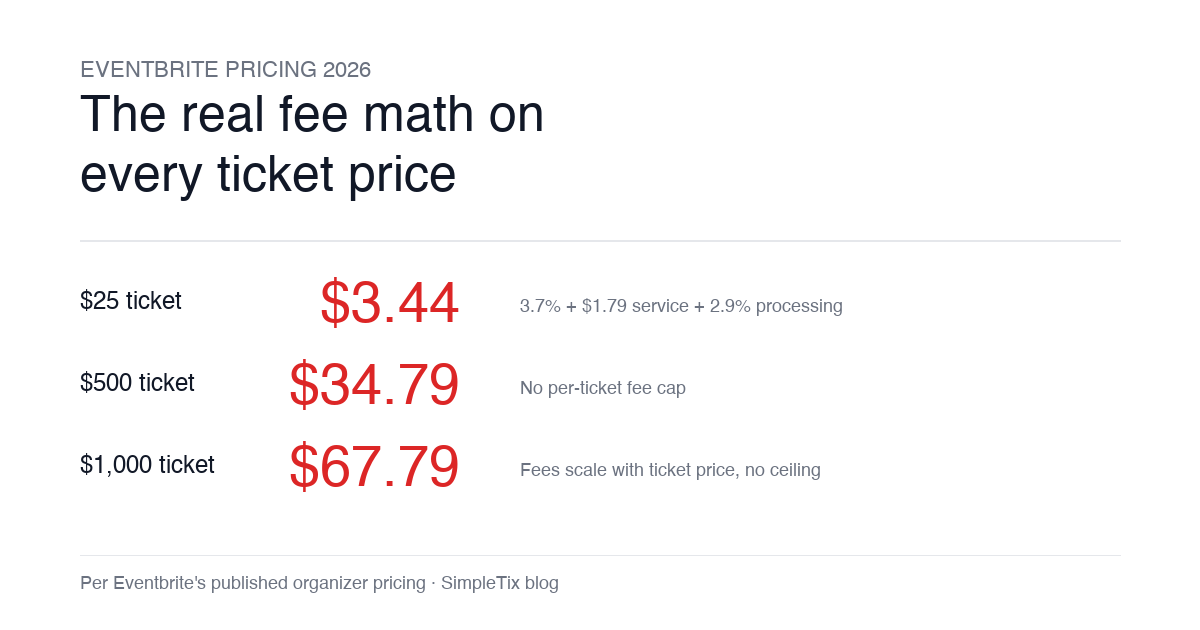
Eventbrite pricing 2026 is a lot for event organizers to sort through. There are longstanding policies that quietly cost paid-event operators real money, and there is genuine news under new ownership. This guide covers what the fees actually cost you today, what actually changed under the Bending Spoons acquisition, and how the alternatives compare on real numbers. Below is the honest breakdown, sourced to Eventbrite's own pricing page and SEC filings. Eventbrite pricing 2026: current fee structure As of 2026, Eventbrite charges 3.7% + $1.79 per paid ticket for the service fee, plus 2.9% for payment processing. In-person sales carry a $1 + 2.9% fee. There is no per-ticket fee cap. For a quick benchmark of total organizer-side fees: On a $25 ticket, fees total about $3.44 (13.8%) On a $50 ticket, fees total about $5.09 (10.2%) On a $100 ticket, fees total about $8.39 (8.4%) On a $500 ticket, fees total about $34.79 (7.0%) On a $1,000 ticket, fees total about $67.79 (6.8%) The fees scale with ticket price with no ceiling. That is the story for anyone selling premium tickets, season passes, VIP tiers, or corporate packages. Eventbrite pricing 2026: no per-ticket fee cap Eventbrite does not cap total ticket fees. This has been true since 2018, when Eventbrite removed the previous cap during its IPO. For most organizers selling everyday tickets ($20 to $50), the absence of a cap rarely comes up in the math. But for organizers selling premium tickets, the uncapped structure translates into real per-event cost. Take a conference selling three ticket tiers on Eventbrite: $150 general admission: fee about $12.34 (8.2%) $400 VIP ticket: fee about $27.09 (6.8%) $800 sponsor ticket: fee about $50.90 (6.4%) For a 200-person conference with a mix of GA and VIP tickets, that translates into hundreds of dollars...