4 Things to Look For in an Event Registration Tool
-
 by
by
Riley Manning has worked as a travel and entertainment writer for more than 10 years. Today, he writes about unique events and the technology that helps make them happen.

Your festival will be the most talked about event this spring. Don’t let a clunky event registration tool, high costs, and unnecessarily challenging event ticketing slow down your guests’ path toward enjoyment.
Events like Charlotte Beer Collective’s The Beer Event are coming up on the calendar. How will you plan your event? Once planned, how will you get your coveted tickets out to your intended crowd? And how much will it cost you? If you choose the right event registration tool, you can streamline your organizational process and save money along the way, while putting an amazing event on the calendar.

As you organize your event, be on the lookout for the 4 things below in an event registration tool:
- Low price, instant payouts
- A straightforward event page to sell tickets
- A smooth user experience
- Human support
1. Low price, instant payouts.
You’ve invested your time and energy into planning an awesome event, now how will you bring a crowd to your event? Keeping the price of your festival tickets in your intended range is essential to bringing out your targeted audience to enjoy the event. Make sure that your event registration tool doesn’t force your ticket price to go up, making the event cost-prohibitive for some of your potential attendees. Your event registration tool should offer a low price per ticket, while offering all of the features you need in order to pull off a successful event.
Instant Payouts
Pre-sales of tickets are crucial for building the revenue needed to cover your initial expenses. Many event registration tool apps hang onto your proceeds for a period of time after the sale. This can hold you back as you attempt to schedule and pay for entertainment and vendors. Digital payments happen in an instant, why don’t you receive the money from your sale in an instant? Make sure the event ticketing app you choose offers instant payouts from each sale you make. With an event registration tool like SimpleTix, the money from your sales goes directly into your account. This way, as you sell tickets in advance, you are also able to prepare by covering the cost of the services you have to use. This benefit comes directly from their partnership with Square, an affiliation very few ticketing apps can claim. Receiving these funds instantly will relieve potential gridlock in your event budget and avoid the pitfalls of any unexpected, but sometimes unavoidable, expenses.

Lower fees
As you plan your event, you may want to be able to project out your potential budget and potential revenue. To do this, you will need clarity on what expenses you can anticipate. Your event registration tool should offer clear, straightforward pricing that allows you to understand where your money will be allocated. Some event ticketing apps are expensive or can even sneak in additional fees on your per ticket price. This can amount to big losses on your potential revenue per ticket, and ultimately, for your event. You need to be able to hang onto more of your hard-earned dollars.
With event registration tools, generally the fees come as a flat rate per ticket, plus a percentage of the total ticket price. Be aware that some event management tools have a very high cost per ticket.
An example of an event ticketing app with one of the best rates out there is SimpleTix. The SimpleTix rate of $.79 per ticket plus 2% of the ticket price is tough to beat. Plus, there is no upfront cost to get set up with your event website. You aren’t charged until you are selling tickets. They even have a cap on fees. Any ticket over $200 will never cost more than $9.99. With their straightforward pricing, anticipating your potential revenue picture becomes much more clear. Simply put, you get to keep more of your money per ticket sold. Other event registration tools charge significantly more. Eventbrite, another event ticketing app, charges $1.59 per ticket and 3.5% of the ticket’s total price.
2. A straightforward event page to sell tickets.
Ditch the cashbox. With an event registration tool, you should be able to sell tickets in your sleep, 24/7, via your custom webpage. Most event registration tools offer a custom page that you can tailor to your needs. However, be on the lookout for the dreaded webpage branding clutter. Whose branding is more important in selling tickets? That’s right, yours. Event registration tools like Eventbrite are covered in their branding. Your event branding becomes secondary on your custom page.
Avoid the clutter and use an event registration tool that is clean and offers up your branding as the primary focus. With SimpleTix you can even embed a sales widget on your existing site. Ensure that your app also allows you to use a QR code designated for your event that can send your customers directly to your ticket sales page.

3. A smooth user experience.
A smooth registration experience matters. Most customers will give your site and your event a few precious clicks. But how can you ensure an easy user experience? Find an event you would like to register for, and test out that event’s registration process. It should be easy to navigate, and the check-out should be seamless. You should be able to purchase tickets and merchandise for the event in the same transaction. If you can’t, it’s not that smooth.
SimpleTix continues to ensure that their customer-facing experience is as seamless and smooth as possible. Merchandise and tickets in a single purchase? Check. Festival and class-pack modes for multi-day events? They’ve got you covered.
4. Human support.
Your event registration tool should be with you from the inception of your event idea all the way through to its successful culmination. While some ticketing apps may leave you hanging once the sales are finished, SimpleTix wants to ensure the success of your event. They want you to host another. Your guests should want you to host another, and you will want to host another after it goes so smoothly. SimpleTix will have a team member walk you through the set-up of your custom site and event. You won’t be lost in the endless hold cycle some event registration tools offer on their help line. The assistance you receive from SimpleTix comes from humans, and they are available when you need them. SimpleTix even offers a dedicated YouTube channel filled with videos of “how to’s” for customizing your experience for nearly any event you can think of to host.
If you keep your eye on the above your choice for an event registration tool should come quickly into focus. Design an awesome event, keep your costs low, help your audience have the smoothest experience possible, and use an event registration tool that will work to make your event a success from start to finish.
SimpleTix has offered an affordable, premium event ticketing platform that outperforms Eventbrite and similar apps for over 12 years. Compared to the competition, SimpleTix offers better options at a better price point. To learn more, call us at +1 (855) 550-3670 or email us at support@simpletix.com.
Latest News
Related Articles

Season Ticket Software for Fall 2026: Subscriptions, Reserved Seating & Renewals
-
 by
by
Fall subscription sales are the single biggest revenue moment for most performing arts organizations. Season packages, member renewals, and early access windows all open between July and September. So the season ticket software you pick this summer decides how the fall series actually sells. This guide covers what season ticket software needs to do in 2026, how to configure it for a theater, symphony, or concert series, and what SimpleTix costs for season-driven event programs. What season ticket software actually needs to do Selling season tickets is nothing like selling single-event tickets. First, one subscriber buys 4 to 20 events in a single package. Second, seats need to lock across the entire season. Third, renewals from prior subscribers happen weeks before the general public gets access. And fourth, add-ons like parking, pre-show dinner, and backstage passes attach to the subscription, not the event. So the operational checklist for season ticket software looks like this: Season pass or subscription products that group multiple events into one purchase Reserved seating with locked seats across the whole season, so the subscriber sits in the same seat every night Priority access windows for existing subscribers before general on-sale Payment plans or full-payment options so patrons can split large subscription costs Renewal workflows that let last year's subscribers re-up with one click Comp ticket management for donors, sponsors, and press seats Membership tiers with different pricing, benefits, and priority access Reporting by subscriber, not just by event If your current tool cannot handle these, you are probably running Excel spreadsheets on the side and losing renewals every year. What is season ticket software? Season ticket software is a ticketing platform designed to sell multi-event packages (season subscriptions) alongside individual tickets, with reserved seat continuity, subscriber priority access, and renewal workflows built in. The core difference...

Holiday Event Ticketing Software: Timed Entry, Reserved Seating & Capacity Control for...
-
by
If you run a holiday event, you are booking dates now. So the ticketing platform you pick this month determines how November and December actually go. This guide covers what holiday event ticketing software needs to do in 2026, how to configure it for the season crunch, and what SimpleTix costs for holiday events of any size. What holiday event ticketing software needs to do Holiday events compress a whole year of sales into six weeks. First, most tickets sell in a 4 to 8 week window between mid-November and January 1. Second, weather cancels outdoor events without warning. Third, family groups buy 4 to 8 tickets in one order, not 1. And fourth, capacity is measured per time slot, not per venue. So the ticketing checklist for holiday operators looks like this: Timed entry with per-slot capacity for drive-throughs, walk-throughs, and Santa visits Reserved seating for holiday theater, Nutcracker, and holiday concerts Group and family bundles so a family of six is one checkout, not six Fast scanning at the gate, including offline mode for cold outdoor venues Waitlists for when peak-hour slots sell out Add-ons for hot chocolate, photo packages, VIP tiers, and holiday merch Automated email reminders so guests do not forget their timed slot Same-day payouts to fund the season's operational costs If your current tool cannot do all of that, October is too late to switch. Move now. How do timed entry tickets work for holiday events? Timed entry lets you release a fixed number of tickets per time slot (typically every 15 or 30 minutes) so guests arrive in waves instead of one 6pm surge. For a Christmas light drive-through with a 45-minute route, that usually means 30 to 60 vehicles per 15-minute window. Over a 5-hour evening, you can process 600 to 1,200...
Eventbrite Pricing 2026: Fees, Refunds & What’s Actually Changed
-
by
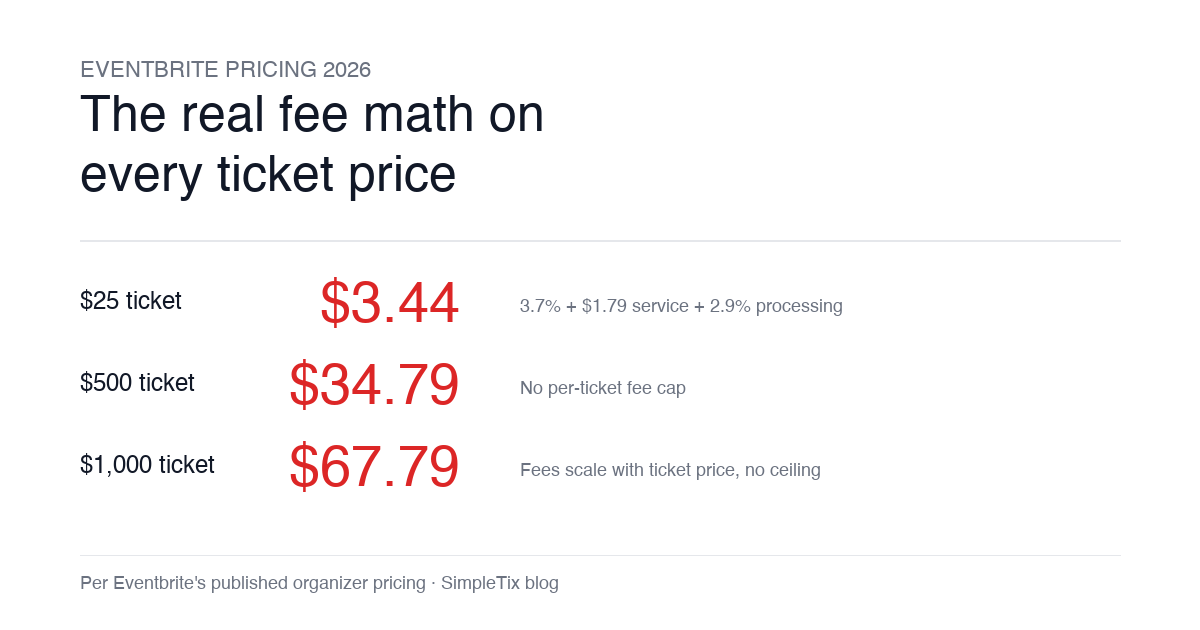
Eventbrite pricing 2026 is a lot for event organizers to sort through. There are longstanding policies that quietly cost paid-event operators real money, and there is genuine news under new ownership. This guide covers what the fees actually cost you today, what actually changed under the Bending Spoons acquisition, and how the alternatives compare on real numbers. Below is the honest breakdown, sourced to Eventbrite's own pricing page and SEC filings. Eventbrite pricing 2026: current fee structure As of 2026, Eventbrite charges 3.7% + $1.79 per paid ticket for the service fee, plus 2.9% for payment processing. In-person sales carry a $1 + 2.9% fee. There is no per-ticket fee cap. For a quick benchmark of total organizer-side fees: On a $25 ticket, fees total about $3.44 (13.8%) On a $50 ticket, fees total about $5.09 (10.2%) On a $100 ticket, fees total about $8.39 (8.4%) On a $500 ticket, fees total about $34.79 (7.0%) On a $1,000 ticket, fees total about $67.79 (6.8%) The fees scale with ticket price with no ceiling. That is the story for anyone selling premium tickets, season passes, VIP tiers, or corporate packages. Eventbrite pricing 2026: no per-ticket fee cap Eventbrite does not cap total ticket fees. This has been true since 2018, when Eventbrite removed the previous cap during its IPO. For most organizers selling everyday tickets ($20 to $50), the absence of a cap rarely comes up in the math. But for organizers selling premium tickets, the uncapped structure translates into real per-event cost. Take a conference selling three ticket tiers on Eventbrite: $150 general admission: fee about $12.34 (8.2%) $400 VIP ticket: fee about $27.09 (6.8%) $800 sponsor ticket: fee about $50.90 (6.4%) For a 200-person conference with a mix of GA and VIP tickets, that translates into hundreds of dollars...