7 Easiest Social Distancing-Friendly Community Events
-
 by
by
Riley Manning has worked as a travel and entertainment writer for more than 10 years. Today, he writes about unique events and the technology that helps make them happen.

As a community or nonprofit event organizer, you’re aware of all the types of virtual events available to your organization, from livestreamed concerts to remote auctions and more. However, the pandemic conditions in your area might allow for some modified in-person events. Because of this, you may be interested in exploring your options for socially-distanced events that are safe and engaging.
Along with enforcing masking and hand-washing guidelines, the CDC recommends that when hosting a gathering of people from different households, organizations should remind attendees to remain six feet apart from those who aren’t in their household.
Plus, indoor venues pose a greater risk than outdoor gatherings. This means that you’ll likely want to focus your event planning efforts on creating an event that takes place mostly outdoors.
We’ve compiled the top seven ideas for events that adhere to these guidelines, keep staff members, volunteers, and attendees safe, and help raise support for your organization or cause:
- Festival
- Concert
- Walk-a-thon
- Color run
- Art class
- Drive-in movie
- Craft fair
Most of these event ideas require a streamlined way to promote your experience and sell tickets. Investigate your options for a robust ticketing platform to help manage these tasks smoothly.
Also, if you’re working with a school, nonprofit, or other fundraising organization, many of these event ideas can easily include fundraising aspects. We’ll intersperse this article with fundraising tips if you’re seeking to raise money for a worthy cause during your socially distanced event.

1. Festivals
Do you have a large, open field somewhere in your community? Or maybe a bustling downtown square with plenty of space? If so, you could be in a great position to host a festival!
There’s no shortage of ideas to choose from when it comes to picking a festival theme. Depending on your organization’s interests or the time of year, you can host a cultural festival, fall festival, or a carnival. You can host a wacky event or a festival specific to your hometown. Draw inspirations from events like the Atlanta Grilled Cheese Festival or the Twins Days Festival held in Twinsburg, Ohio.
A festival can bring the community together in a safe, socially distanced environment. Encourage attendees to maintain social distancing, wear masks, wash their hands frequently, and stay home if they feel ill. These guidelines will help mitigate risk throughout the event.
Remember to invest in festival ticketing software to help streamline the ticketing process so that your festival entrance doesn’t experience a crowd build-up. This will help promote social distancing and keep people moving so that everyone stays safe.
Pro tip: If you’d like to turn your festival into a fundraising opportunity, you’ll need a way to promote your fundraising page and collect donations. Check out Double the Donation’s guide to online donation tools to find the right platform for your organization. These tools range from platforms that help create online donation pages to peer-to-peer fundraising software.
2. Concerts
One of the most longed-for experiences during 2020 was having the ability to go to a concert. You can bring the music back to your audience members in a safe environment by hosting a socially distanced concert.
Invite one or many musicians to play at your concert. Depending on your budget, these might be locally, nationally, or internationally-known performers.
You might even decide to take your concert a step further and host a mini, one-day music festival. Invite food trucks to sell concessions and keep the music going all day long on multiple stages.
Promote social distancing by hosting the concert or music festival in an outdoor arena or stadium. Sell tickets in pods by household so that only members of the same household sit together. Also, ensure the distance between pods is at least six feet to adhere to CDC recommendations.
Pro tip: To open your concert to a wider audience, consider livestreaming it. This can open your event to those who aren’t comfortable attending in person or who live further away. Use your Facebook or YouTube pages to host the livestream.

3. Walk-a-thons
A walk-a-thon is a great event idea if you’re hoping to raise some money for your community organization or a charitable cause.
Here’s how these events work:
- Participants gather pledges from their family members and friends that correspond to a certain distance walked.
- Your organization collects the pledged donations after participants finish the walk-a-thon.
According to 99Pledges’ article on walk-a-thons, these are effective community events because they engage multiple groups of people, from participants to event organizers and the supporters who pledge donations. Also, these fundraisers engage people of all ages and are especially good for school groups, student clubs, and other children’s organizations.
Pro tip: Since the participants themselves are the ones who will conduct the bulk of the fundraising, equip them with the proper tools and strategies to reach their fundraising goals. Be sure to choose a fundraising software that allows you to automatically create a fundraising page for each participant. Then, remind participants to continually share their pages ahead of the event to gather a wide range of pledges.
4. Color runs
Color runs are becoming increasingly popular as a fun alternative to a typical 5K race. In a color run, participants are doused in different colors of powder at regular intervals throughout the race. Encourage participants to wear white shirts to the event — by the end of the race, their shirts will be multi-colored masterpieces!
To promote social distancing, stagger your race start times to ensure participants don’t get bunched up at the starting line.
A color run is an especially fun event idea for a younger audience. For instance, if you’re looking for school fundraising ideas, invite your students and their families to get involved in the run, along with the community at large.
Pro tip: Offer sunglasses to your participants so they don’t get any powder in their eyes while they’re running. You can partner with a merchandising company to create branded sunglasses with your organization’s logo or the event name to turn them into a promotional tool.
5. Art classes
Find out who the budding artists or hidden Picassos are in your community by hosting an art class.
Ask a locally-known artist to host the class. The class can be focused on pottery, drawing, painting, sculpture, or any other medium. Make the event social-distancing friendly by ensuring participants are spaced out throughout the room, or by hosting the event outside.
Add a unique element to the event by making it a paint-and-sip, where participants can sample local wines or coffees while they create their masterpieces. Ensure that participants are sufficiently spaced out so they can safely take off their masks to sip.
Pro tip: Make your event a fundraiser by asking participants to submit a donation before joining the class. Make sure participants know exactly what their contributions will be used for. After your event, send a follow-up email detailing how much you were able to raise. This makes participants feel a sense of accomplishment, and makes them more likely to support your organization the next time you host a fundraiser!

6. Drive-in movies
Give your community members a blast from the past by hosting a drive-in movie! Drive-in movies are naturally socially distanced since everyone tunes in from the comfort of their own cars.
See if you can play a recently-released movie to provide something new and intriguing for attendees. You’ll also never go wrong by choosing a classic film. Just remember to consider your audience — if you’re hosting a family movie night, you probably don’t want to show the latest Purge movie.
You can also generate intrigue by hosting your drive-in movie at a unique location, such as your local zoo. Or, you can host a socially-distanced “film on the green” where attendees can set up a picnic blanket and watch the movie at a local stadium or golf course.
Pro tip: Make sure participants know how to tune into the movie, especially if you’ll be transmitting the film’s audio using radio. While some people may be familiar with how a drive-in movie works, others may need instructions on how to tune their radios to the current frequency.
7. Craft fairs
Bring the artists in your community and surrounding communities together to host a craft fair. Encourage them to bring an assortment of crafts and works of art to sell at your event. Then, invite all community members to browse the options.
Keep your event safe by reminding participants to stay six feet apart, wear their masks when necessary, and sanitize their hands frequently.
Use your event to provide opportunities for local businesses to get involved as well. For example, you can ask businesses to sponsor your event or see if any local restaurants would like to host concession stands.
Pro tip: Use your organization’s social media pages to promote the art that will be for sale ahead of time. This boosts excitement and gets attendees thinking about what they might want to buy.
Whether you’re hosting a fundraiser or simply an event to bring your community together, there are plenty of experiences that facilitate both social distancing and fun. No matter what type of event you choose, remember to streamline the process using event planning and ticketing software, as well as donation tools if your event is a fundraiser. Have fun and stay safe!
Latest News
Related Articles

Season Ticket Software for Fall 2026: Subscriptions, Reserved Seating & Renewals
-
 by
by
Fall subscription sales are the single biggest revenue moment for most performing arts organizations. Season packages, member renewals, and early access windows all open between July and September. So the season ticket software you pick this summer decides how the fall series actually sells. This guide covers what season ticket software needs to do in 2026, how to configure it for a theater, symphony, or concert series, and what SimpleTix costs for season-driven event programs. What season ticket software actually needs to do Selling season tickets is nothing like selling single-event tickets. First, one subscriber buys 4 to 20 events in a single package. Second, seats need to lock across the entire season. Third, renewals from prior subscribers happen weeks before the general public gets access. And fourth, add-ons like parking, pre-show dinner, and backstage passes attach to the subscription, not the event. So the operational checklist for season ticket software looks like this: Season pass or subscription products that group multiple events into one purchase Reserved seating with locked seats across the whole season, so the subscriber sits in the same seat every night Priority access windows for existing subscribers before general on-sale Payment plans or full-payment options so patrons can split large subscription costs Renewal workflows that let last year's subscribers re-up with one click Comp ticket management for donors, sponsors, and press seats Membership tiers with different pricing, benefits, and priority access Reporting by subscriber, not just by event If your current tool cannot handle these, you are probably running Excel spreadsheets on the side and losing renewals every year. What is season ticket software? Season ticket software is a ticketing platform designed to sell multi-event packages (season subscriptions) alongside individual tickets, with reserved seat continuity, subscriber priority access, and renewal workflows built in. The core difference...

Holiday Event Ticketing Software: Timed Entry, Reserved Seating & Capacity Control for...
-
by
If you run a holiday event, you are booking dates now. So the ticketing platform you pick this month determines how November and December actually go. This guide covers what holiday event ticketing software needs to do in 2026, how to configure it for the season crunch, and what SimpleTix costs for holiday events of any size. What holiday event ticketing software needs to do Holiday events compress a whole year of sales into six weeks. First, most tickets sell in a 4 to 8 week window between mid-November and January 1. Second, weather cancels outdoor events without warning. Third, family groups buy 4 to 8 tickets in one order, not 1. And fourth, capacity is measured per time slot, not per venue. So the ticketing checklist for holiday operators looks like this: Timed entry with per-slot capacity for drive-throughs, walk-throughs, and Santa visits Reserved seating for holiday theater, Nutcracker, and holiday concerts Group and family bundles so a family of six is one checkout, not six Fast scanning at the gate, including offline mode for cold outdoor venues Waitlists for when peak-hour slots sell out Add-ons for hot chocolate, photo packages, VIP tiers, and holiday merch Automated email reminders so guests do not forget their timed slot Same-day payouts to fund the season's operational costs If your current tool cannot do all of that, October is too late to switch. Move now. How do timed entry tickets work for holiday events? Timed entry lets you release a fixed number of tickets per time slot (typically every 15 or 30 minutes) so guests arrive in waves instead of one 6pm surge. For a Christmas light drive-through with a 45-minute route, that usually means 30 to 60 vehicles per 15-minute window. Over a 5-hour evening, you can process 600 to 1,200...
Eventbrite Pricing 2026: Fees, Refunds & What’s Actually Changed
-
by
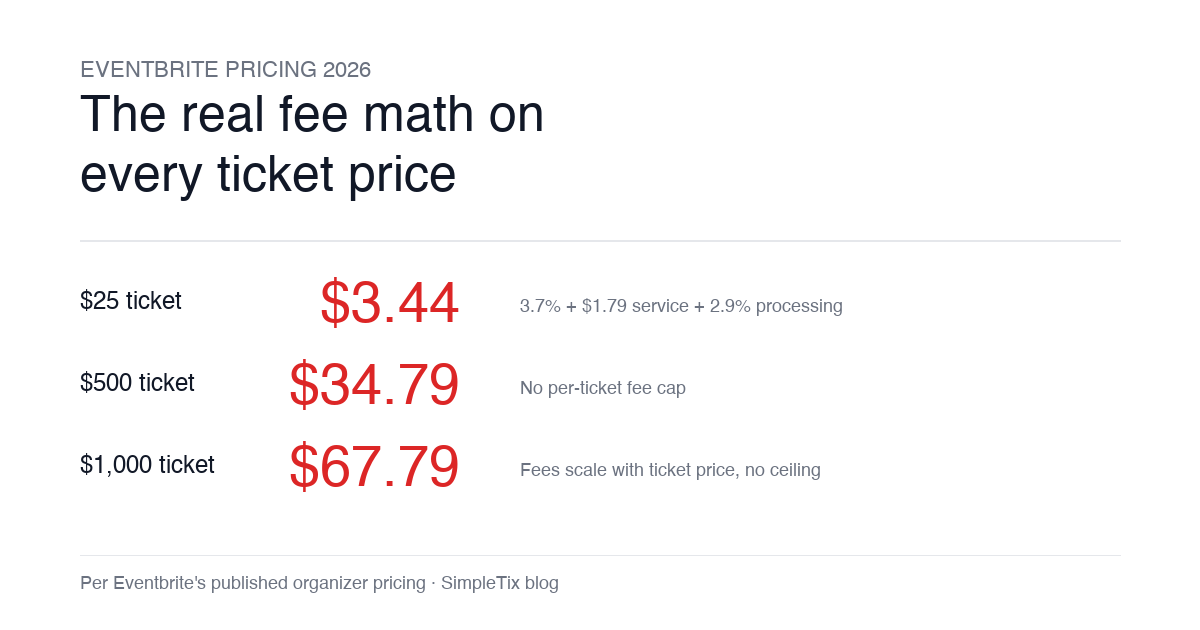
Eventbrite pricing 2026 is a lot for event organizers to sort through. There are longstanding policies that quietly cost paid-event operators real money, and there is genuine news under new ownership. This guide covers what the fees actually cost you today, what actually changed under the Bending Spoons acquisition, and how the alternatives compare on real numbers. Below is the honest breakdown, sourced to Eventbrite's own pricing page and SEC filings. Eventbrite pricing 2026: current fee structure As of 2026, Eventbrite charges 3.7% + $1.79 per paid ticket for the service fee, plus 2.9% for payment processing. In-person sales carry a $1 + 2.9% fee. There is no per-ticket fee cap. For a quick benchmark of total organizer-side fees: On a $25 ticket, fees total about $3.44 (13.8%) On a $50 ticket, fees total about $5.09 (10.2%) On a $100 ticket, fees total about $8.39 (8.4%) On a $500 ticket, fees total about $34.79 (7.0%) On a $1,000 ticket, fees total about $67.79 (6.8%) The fees scale with ticket price with no ceiling. That is the story for anyone selling premium tickets, season passes, VIP tiers, or corporate packages. Eventbrite pricing 2026: no per-ticket fee cap Eventbrite does not cap total ticket fees. This has been true since 2018, when Eventbrite removed the previous cap during its IPO. For most organizers selling everyday tickets ($20 to $50), the absence of a cap rarely comes up in the math. But for organizers selling premium tickets, the uncapped structure translates into real per-event cost. Take a conference selling three ticket tiers on Eventbrite: $150 general admission: fee about $12.34 (8.2%) $400 VIP ticket: fee about $27.09 (6.8%) $800 sponsor ticket: fee about $50.90 (6.4%) For a 200-person conference with a mix of GA and VIP tickets, that translates into hundreds of dollars...