Event Ticketing Websites to Help Boost Sales and Attendance
-
 by
by
Vikram, Head of Growth and Co-Owner at SimpleTix, brings a performance marketing background from SeatGeek and early stage startups to SimpleTix’s partnership and growth efforts. A lifelong live event enthusiast, he’s focused on expanding the tools organizers rely on to connect with their audiences.
Event planning is a tactical challenge – similar to conducting an orchestra where every note matters – and event ticketing websites have changed how organizers manage attendees and track sales. Let’s explore how these platforms not only simplify ticket distribution but also amplify your event’s reach, ensuring no seat is left unfilled.
How Event Ticketing Websites Benefit Organizers
Event ticketing websites provide a centralized platform for organizers to manage their events effectively, offering a suite of ticketing features that enhance the attendee experience while simplifying administrative tasks. These platforms support customizable event pages that align with the organizer’s branding, ensuring a consistent and professional look for potential attendees.
Furthermore, organizers can set up various ticket types, from general admission to VIP packages, with the flexibility of pricing tiers to accommodate different customer segments. Additionally, promotional tools such as discount codes can be seamlessly integrated to incentivize early purchases or reward loyal attendees.
One of the most valuable aspects of event ticketing websites is the ability to process payments securely. Attendees can purchase tickets using their credit card directly through the event ticketing platform, streamlining the transaction process. Once a sale is made, organizers benefit from real-time sales analytics, allowing them to monitor the success of their event against established KPIs.
Event ticketing websites often charge a ticketing fee, but they offer a cost-effective pricing structure that can adapt to the scope and budget of the event. Moreover, mobile apps and social media integration further extend the capabilities of these platforms, facilitating online ticket sales and enhancing event registrations.
In essence, by utilizing an online ticketing platform, organizers gain access to a powerful toolset that simplifies event management and enhances attendee engagement, all while keeping a close eye on sales performance.
Frequently Used Event Ticketing Websites
Event ticketing websites have become an integral part of event management for organizers across industries. With the rise of online ticket sales, these platforms offer not simply a means to sell event tickets but also a full array of services designed to streamline event registrations and attendee management. These platforms often include mobile apps for on-the-go management, social media integration for marketing purposes, and customizable event pages to maintain brand consistency. They cater to a variety of needs, from small gatherings to enterprise-level conferences, ensuring that there’s a solution for every type of event.
SimpleTix: Streamlined, Right-Sized Event Management
In today’s digital age, event management has become a breeze with platforms like SimpleTix, which provides a streamlined and customizable event ticketing platform. Aimed at simplifying the event registrations process, SimpleTix comes equipped with user-friendly Ticketing Features that allow organizers to efficiently manage attendee information and keep the lines of communication open.
Affordability is key with SimpleTix, as the platform ensures an economic pricing structure tailored for event organizers of all sizes. Organizers can take advantage of different pricing tiers, minimizing Ticketing Fees while maximizing the event’s outreach.
Creating an event page is as simple as can be with SimpleTix. Organizers can swiftly establish password-protected and custom event pages that cater to their aesthetic and functional needs. Moreover, SimpleTix flourishes in payment flexibility, integrating with reputable payment processing companies like PayPal, Stripe, and Braintree. This ensures a secure transaction for every ticket type purchased using a credit card.
Moreover, SimpleTix isn’t just about online ticket sales; it enhances the event experience with mobile apps designed for on-the-go management and ticket scanning.
With a keen eye for details, SimpleTix infuses its approach with features essential in today’s event ticketing scenario, including Social media integration, lending a helping hand in marketing and audience engagement.
Ticketleap: Create Customized Ticketing Experiences
TicketLeap steps into the scene with an affordable online ticketing platform known for its ease of use and comprehensive feature set. Users can set up events, design visually appealing event pages to match their brand, and harness built-in tools to manage promotions and attendee admissions, including integrated scanning for a seamless check-in process.
Despite some critiques from users on various fronts, TicketLeap’s strength lies in its ability to provide a tailored ticketing experience. Organizers can tap into its robust promotion and analytics tools to keep track of online ticket sales and fine-tune their marketing efforts. Coupled with various ticketing features and a favorable pricing model, TicketLeap remains a choice for organizers who prioritize user experience and convenience in their event management practices.
Cvent: Enterprise-Level Event Management Solution
Cvent offers a robust solution tailored to larger organizations requiring enterprise-level event management capabilities. Recognized for its comprehensive suite of services, Cvent facilitates organizers with customizable event pages, sophisticated ticketing options, and advanced attendee management and marketing tools.
While the platform is lauded for its detailed reporting and extensive customization options, some users encounter a steep learning curve due to the complexities and depth of its features. Additionally, Cvent often necessitates third-party data integration to harness its full potential which may present challenges for some users. Nevertheless, for those who navigate its intricacies, Cvent delivers unparalleled control over every aspect of the event ticketing and management process, making it an ideal choice for large-scale, complex events with specific needs.
Finding the Right Event Ticketing Website for You
These are just a few of the event ticketing websites and solutions available. Finding the right fit can take time, and SimpleTix can help you speed up the process with a transparent conversation and a demo to see how your organization can leverage an event ticketing partner for success. Contact us today for more information about improving ticket sales and boosting attendance to your events.
Latest News
Related Articles

Season Ticket Software for Fall 2026: Subscriptions, Reserved Seating & Renewals
-
by
Fall subscription sales are the single biggest revenue moment for most performing arts organizations. Season packages, member renewals, and early access windows all open between July and September. So the season ticket software you pick this summer decides how the fall series actually sells. This guide covers what season ticket software needs to do in 2026, how to configure it for a theater, symphony, or concert series, and what SimpleTix costs for season-driven event programs. What season ticket software actually needs to do Selling season tickets is nothing like selling single-event tickets. First, one subscriber buys 4 to 20 events in a single package. Second, seats need to lock across the entire season. Third, renewals from prior subscribers happen weeks before the general public gets access. And fourth, add-ons like parking, pre-show dinner, and backstage passes attach to the subscription, not the event. So the operational checklist for season ticket software looks like this: Season pass or subscription products that group multiple events into one purchase Reserved seating with locked seats across the whole season, so the subscriber sits in the same seat every night Priority access windows for existing subscribers before general on-sale Payment plans or full-payment options so patrons can split large subscription costs Renewal workflows that let last year's subscribers re-up with one click Comp ticket management for donors, sponsors, and press seats Membership tiers with different pricing, benefits, and priority access Reporting by subscriber, not just by event If your current tool cannot handle these, you are probably running Excel spreadsheets on the side and losing renewals every year. What is season ticket software? Season ticket software is a ticketing platform designed to sell multi-event packages (season subscriptions) alongside individual tickets, with reserved seat continuity, subscriber priority access, and renewal workflows built in. The core difference...

Holiday Event Ticketing Software: Timed Entry, Reserved Seating & Capacity Control for...
-
by
If you run a holiday event, you are booking dates now. So the ticketing platform you pick this month determines how November and December actually go. This guide covers what holiday event ticketing software needs to do in 2026, how to configure it for the season crunch, and what SimpleTix costs for holiday events of any size. What holiday event ticketing software needs to do Holiday events compress a whole year of sales into six weeks. First, most tickets sell in a 4 to 8 week window between mid-November and January 1. Second, weather cancels outdoor events without warning. Third, family groups buy 4 to 8 tickets in one order, not 1. And fourth, capacity is measured per time slot, not per venue. So the ticketing checklist for holiday operators looks like this: Timed entry with per-slot capacity for drive-throughs, walk-throughs, and Santa visits Reserved seating for holiday theater, Nutcracker, and holiday concerts Group and family bundles so a family of six is one checkout, not six Fast scanning at the gate, including offline mode for cold outdoor venues Waitlists for when peak-hour slots sell out Add-ons for hot chocolate, photo packages, VIP tiers, and holiday merch Automated email reminders so guests do not forget their timed slot Same-day payouts to fund the season's operational costs If your current tool cannot do all of that, October is too late to switch. Move now. How do timed entry tickets work for holiday events? Timed entry lets you release a fixed number of tickets per time slot (typically every 15 or 30 minutes) so guests arrive in waves instead of one 6pm surge. For a Christmas light drive-through with a 45-minute route, that usually means 30 to 60 vehicles per 15-minute window. Over a 5-hour evening, you can process 600 to 1,200...
Eventbrite Pricing 2026: Fees, Refunds & What’s Actually Changed
-
by
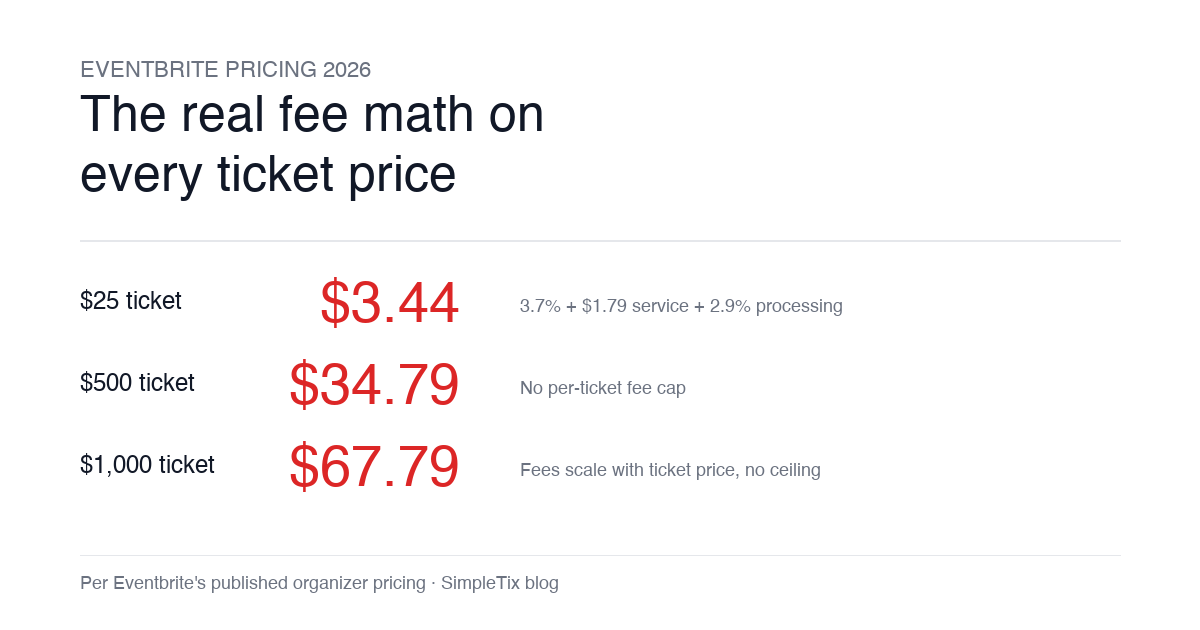
Eventbrite pricing 2026 is a lot for event organizers to sort through. There are longstanding policies that quietly cost paid-event operators real money, and there is genuine news under new ownership. This guide covers what the fees actually cost you today, what actually changed under the Bending Spoons acquisition, and how the alternatives compare on real numbers. Below is the honest breakdown, sourced to Eventbrite's own pricing page and SEC filings. Eventbrite pricing 2026: current fee structure As of 2026, Eventbrite charges 3.7% + $1.79 per paid ticket for the service fee, plus 2.9% for payment processing. In-person sales carry a $1 + 2.9% fee. There is no per-ticket fee cap. For a quick benchmark of total organizer-side fees: On a $25 ticket, fees total about $3.44 (13.8%) On a $50 ticket, fees total about $5.09 (10.2%) On a $100 ticket, fees total about $8.39 (8.4%) On a $500 ticket, fees total about $34.79 (7.0%) On a $1,000 ticket, fees total about $67.79 (6.8%) The fees scale with ticket price with no ceiling. That is the story for anyone selling premium tickets, season passes, VIP tiers, or corporate packages. Eventbrite pricing 2026: no per-ticket fee cap Eventbrite does not cap total ticket fees. This has been true since 2018, when Eventbrite removed the previous cap during its IPO. For most organizers selling everyday tickets ($20 to $50), the absence of a cap rarely comes up in the math. But for organizers selling premium tickets, the uncapped structure translates into real per-event cost. Take a conference selling three ticket tiers on Eventbrite: $150 general admission: fee about $12.34 (8.2%) $400 VIP ticket: fee about $27.09 (6.8%) $800 sponsor ticket: fee about $50.90 (6.4%) For a 200-person conference with a mix of GA and VIP tickets, that translates into hundreds of dollars...