Online Ticketing Platform Comparison: What to Look For in 2026
-
 by
by

Online Ticketing Platform Comparison: What to Look For in 2026
If you’re comparing online ticketing platforms, the hard part isn’t finding options. It’s figuring out which one won’t create extra work after you launch. Pricing, payouts, check-in, seating, marketing, and support all matter more than a flashy homepage.
Organizers often evaluate platforms based on pricing, check-in, reporting, and payment flexibility. So this guide breaks down what to look for in online ticketing platforms in 2026, with a practical lens: what actually helps you sell tickets and run the door without chaos.
Start with pricing before you compare features
Most platforms look affordable until you do the math. That’s why pricing should be your first filter, not your last.
Look at the per-ticket fee, percentage fee, and whether there are monthly charges. Also check if the platform charges for free events. That matters if you run community events, classes, fundraisers, or RSVP-based programs.
SimpleTix keeps this part simple: $0.79 + 2% per ticket, with no contracts, no subscriptions, and no fees on free events. In addition, organizers can choose to pass fees to attendees or absorb them. You can see the full breakdown here: SimpleTix pricing.
If you’re reviewing online ticketing platforms, ask these questions first:
- What do I pay per paid ticket?
- Are there monthly or annual platform fees?
- Do free events stay free?
- Can I pass fees to buyers?
- Are payouts fast enough for my cash flow?
Those five answers can help you rule out poor fits quickly.
Online ticketing platforms should match your event format
Not every event needs the same setup. A film screening has different needs than a festival, winery tour, or museum pass.
So, before you compare tools, list your event types. Specifically, think about whether you need general admission, timed entry, reserved seating, season tickets, or multi-use passes.
SimpleTix supports:
- General admission with timed entry and capacity management
- Reserved seating with interactive seat maps
- Season tickets for GA and reserved seating
- Flex Passes with re-entry and attendee photo verification
That range matters because some organizers may outgrow basic ticket types as their events expand. For example, a venue may start with GA shows and later need reserved seating. A farm may need timed entry this fall, then memberships in winter. You can explore broader setup options on the ticketing features page and industry use cases on who we serve.
Check payment options and payout speed
This is where some online ticketing platforms create friction. Buyers want to pay with methods they already trust. Meanwhile, organizers need reliable payouts and easy in-person selling.
Look for online and box office flexibility. In other words, don’t just ask, “Can this take payments?” Ask, “Can this handle online checkout, day-of sales, and different processors without a mess?”
SimpleTix supports Stripe, Square, PayPal, and Venmo checkout. It also supports same-day payouts. For in-person sales, it offers point-of-sale mode and works with Square hardware.
Many organizers also look for support for mobile tickets, PDF e-tickets, Apple Wallet passes, and Google Wallet passes. SimpleTix supports all four.
The best online ticketing platforms should help you sell more tickets
A platform should be useful beyond order processing. For many organizers, that means tools that support promotion and help recover missed sales.
For instance, abandoned cart recovery emails may help bring back buyers who started checkout and left. Promo codes, BOGO offers, and quantity discounts can help fill slower dates. Waitlists help you capture demand even after an event sells out.
SimpleTix includes those tools, plus automated reminder emails, attendee email blasts, customizable email templates, affiliate marketing tools, and conversion tracking with Google and Facebook pixels.
If you want a good benchmark for what modern checkout and event pages should support, review accessibility and user experience guidance from the Nielsen Norman Group. Clear flows and fewer steps usually support a better buyer experience.
Don’t ignore check-in, scanning, and box office tools
A smooth checkout means nothing if the line backs up at the door. That’s why check-in deserves just as much attention as the sales page.
Good online ticketing platforms should support fast scanning, staff permissions, and offline use. Specifically, ask what happens if Wi-Fi drops. Also ask whether temporary staff can scan without getting full admin access.
SimpleTix offers an Organizer app for iOS and Android, offline scanning mode, scan-only mode for staff, group admit for batch check-in, and hardware scanner support. It also supports ticket printing from the mobile app.
If you run larger or more complex events, this matters even more. Festivals, for example, may need fast entry lanes and flexible staffing. Farms and agritourism operators often need timed entry and seasonal traffic control.
Reporting, integrations, and admin controls matter more as events get more complex
Basic sales totals only go so far. Organizers often need better visibility and cleaner operations as teams and event setups grow.
So look for dashboards, attendee reports, scan reports, scheduled reporting, and account audit logs. In addition, check whether the platform supports user roles and multi-factor authentication. If multiple staff members touch your account, those controls can be important.
SimpleTix includes an interactive analytics dashboard, sales and attendee reports, scheduled reports, audit logs, multi-factor authentication, user role management, and webhook notifications. It also connects with Zoom, Mailchimp, Constant Contact, HubSpot, Zapier, Make, Integrately, SmartWaiver, and Square.
That means your ticketing system can fit into the rest of your workflow instead of becoming a silo.
How to compare online ticketing platforms without wasting a month
Comparison gets easier if you use the same checklist for every platform. Otherwise, every demo sounds good.
Use this simple process:
- Price out a real event.
Don’t use a sample with 10 tickets. Use your actual average ticket price and attendance. - Test the buyer flow on mobile.
Most buyers won’t use a desktop. So buy a test ticket on your phone. - Review the day-of workflow.
Check scanning, offline mode, staff permissions, and box office sales. - List the ticket types you need this year.
Then add the ones you may need next year, too. - Check integrations before migration.
Email, CRM, waiver tools, and payment processors should be confirmed early. - Ask support one real question.
The response speed tells you a lot.
The right choice is the platform that removes friction
The best online ticketing platforms don’t just sell tickets. They reduce admin work, support your event format, and make entry smoother for staff and guests.
That usually means transparent pricing, flexible payments, strong check-in tools, useful reporting, and support that answers real questions. SimpleTix checks those boxes without contracts or subscriptions, which is why it fits a wide range of organizers.
If you want a simpler option, take a look at SimpleTix.
Latest News
Related Articles

Season Ticket Software for Fall 2026: Subscriptions, Reserved Seating & Renewals
-
by
Fall subscription sales are the single biggest revenue moment for most performing arts organizations. Season packages, member renewals, and early access windows all open between July and September. So the season ticket software you pick this summer decides how the fall series actually sells. This guide covers what season ticket software needs to do in 2026, how to configure it for a theater, symphony, or concert series, and what SimpleTix costs for season-driven event programs. What season ticket software actually needs to do Selling season tickets is nothing like selling single-event tickets. First, one subscriber buys 4 to 20 events in a single package. Second, seats need to lock across the entire season. Third, renewals from prior subscribers happen weeks before the general public gets access. And fourth, add-ons like parking, pre-show dinner, and backstage passes attach to the subscription, not the event. So the operational checklist for season ticket software looks like this: Season pass or subscription products that group multiple events into one purchase Reserved seating with locked seats across the whole season, so the subscriber sits in the same seat every night Priority access windows for existing subscribers before general on-sale Payment plans or full-payment options so patrons can split large subscription costs Renewal workflows that let last year's subscribers re-up with one click Comp ticket management for donors, sponsors, and press seats Membership tiers with different pricing, benefits, and priority access Reporting by subscriber, not just by event If your current tool cannot handle these, you are probably running Excel spreadsheets on the side and losing renewals every year. What is season ticket software? Season ticket software is a ticketing platform designed to sell multi-event packages (season subscriptions) alongside individual tickets, with reserved seat continuity, subscriber priority access, and renewal workflows built in. The core difference...

Holiday Event Ticketing Software: Timed Entry, Reserved Seating & Capacity Control for...
-
by
If you run a holiday event, you are booking dates now. So the ticketing platform you pick this month determines how November and December actually go. This guide covers what holiday event ticketing software needs to do in 2026, how to configure it for the season crunch, and what SimpleTix costs for holiday events of any size. What holiday event ticketing software needs to do Holiday events compress a whole year of sales into six weeks. First, most tickets sell in a 4 to 8 week window between mid-November and January 1. Second, weather cancels outdoor events without warning. Third, family groups buy 4 to 8 tickets in one order, not 1. And fourth, capacity is measured per time slot, not per venue. So the ticketing checklist for holiday operators looks like this: Timed entry with per-slot capacity for drive-throughs, walk-throughs, and Santa visits Reserved seating for holiday theater, Nutcracker, and holiday concerts Group and family bundles so a family of six is one checkout, not six Fast scanning at the gate, including offline mode for cold outdoor venues Waitlists for when peak-hour slots sell out Add-ons for hot chocolate, photo packages, VIP tiers, and holiday merch Automated email reminders so guests do not forget their timed slot Same-day payouts to fund the season's operational costs If your current tool cannot do all of that, October is too late to switch. Move now. How do timed entry tickets work for holiday events? Timed entry lets you release a fixed number of tickets per time slot (typically every 15 or 30 minutes) so guests arrive in waves instead of one 6pm surge. For a Christmas light drive-through with a 45-minute route, that usually means 30 to 60 vehicles per 15-minute window. Over a 5-hour evening, you can process 600 to 1,200...
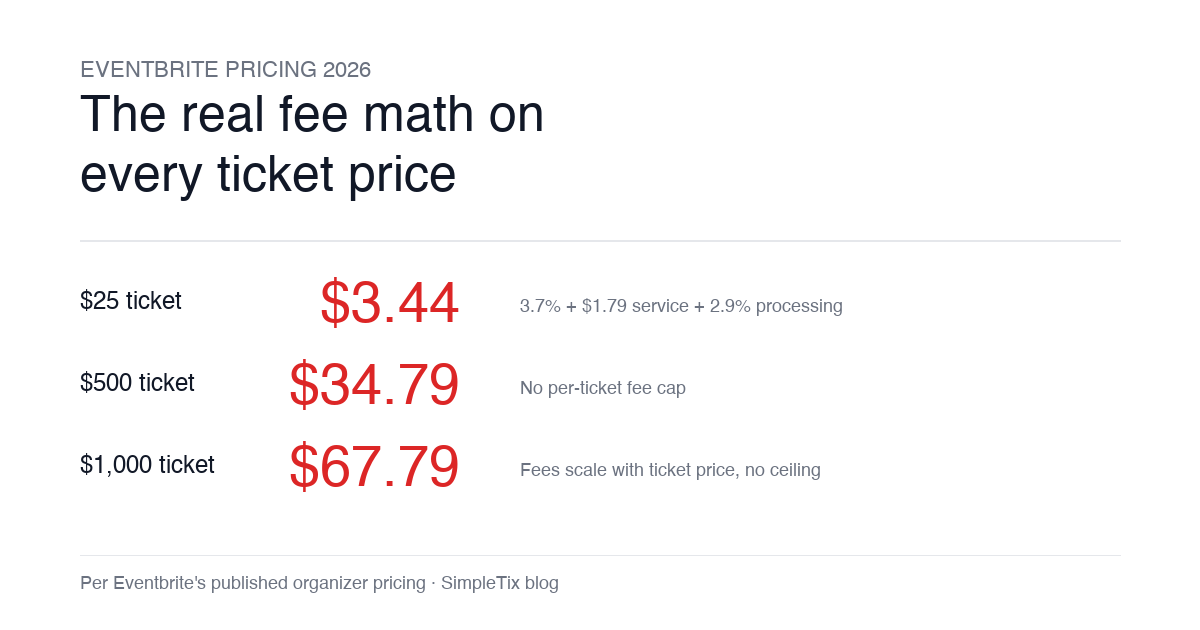
Eventbrite Pricing 2026: Fees, Refunds & What’s Actually Changed
-
by
Eventbrite pricing 2026 is a lot for event organizers to sort through. There are longstanding policies that quietly cost paid-event operators real money, and there is genuine news under new ownership. This guide covers what the fees actually cost you today, what actually changed under the Bending Spoons acquisition, and how the alternatives compare on real numbers. Below is the honest breakdown, sourced to Eventbrite's own pricing page and SEC filings. Eventbrite pricing 2026: current fee structure As of 2026, Eventbrite charges 3.7% + $1.79 per paid ticket for the service fee, plus 2.9% for payment processing. In-person sales carry a $1 + 2.9% fee. There is no per-ticket fee cap. For a quick benchmark of total organizer-side fees: On a $25 ticket, fees total about $3.44 (13.8%) On a $50 ticket, fees total about $5.09 (10.2%) On a $100 ticket, fees total about $8.39 (8.4%) On a $500 ticket, fees total about $34.79 (7.0%) On a $1,000 ticket, fees total about $67.79 (6.8%) The fees scale with ticket price with no ceiling. That is the story for anyone selling premium tickets, season passes, VIP tiers, or corporate packages. Eventbrite pricing 2026: no per-ticket fee cap Eventbrite does not cap total ticket fees. This has been true since 2018, when Eventbrite removed the previous cap during its IPO. For most organizers selling everyday tickets ($20 to $50), the absence of a cap rarely comes up in the math. But for organizers selling premium tickets, the uncapped structure translates into real per-event cost. Take a conference selling three ticket tiers on Eventbrite: $150 general admission: fee about $12.34 (8.2%) $400 VIP ticket: fee about $27.09 (6.8%) $800 sponsor ticket: fee about $50.90 (6.4%) For a 200-person conference with a mix of GA and VIP tickets, that translates into hundreds of dollars...