4 use cases for timed entry ticketing that have nothing to do with COVID
-
 by
by
Riley Manning has worked as a travel and entertainment writer for more than 10 years. Today, he writes about unique events and the technology that helps make them happen.

The event ticketing industry has undergone fundamental changes since March 2020. The way people interacted with each other during the pandemic brought to light new ways of thinking about how we gather together, and as a society, we have shifted some of these interactions. Some of these changes—remote work is an obvious example—‚are here to stay. Many of these modifications were for health and safety concerns, but two and a half years later, a few of these adaptations have morphed how we gather for our leisure or lifestyle pursuits. Timed entry event ticketing is one of these examples.
As we move into the “new normal” of running events after COVID, expect some of these changes to our industry to stick around. Your attendees became used to timed entry as the “business as usual” way of attending gatherings during COVID, and many of them now still enjoy the benefits that these ticket types bring to their lifestyle.
Timed entry ticketing makes your event workflow easier and your attendees happier.
Some cultural institutions and other event venues are ending their timed entry ticketing options, but other operations are leaning into this option to make improvements in their workflow and customer experience. Timed entry ticketing seems like an obvious solution for drive-in theaters, museum exhibitions, and farm and agritourism events. Event managers that operate seasonal events like haunted houses or holiday light exhibitions will benefit from this ticketing category as well. Think about this solution the next time you see the line stretching down the block from your ticket gate right before your event starts. Timed entry removes friction points from almost every type of event.
Timed entry is not as restricting as you might think. While you have ultimate control over the flexibility of your event ticketing software, your customers don’t have to be married to a specific time, even after they have purchased their tickets. If an attendee wants to change their time slot, they can do so all on their own, as changing an event time is super easy! This doesn’t have to be a process that bogs down your ticket sales department – the application can take care of it all and send your staff the proper reporting and notifications.
While timed entry is still a Center for Disease Control and Prevention recommendation for events in 2022, COVID isn’t the only reason you should consider this event ticketing category. Timed entry can make your operation workflow so much easier in so many ways. It’s all about how you choose to leverage your event ticketing software. Below are four use cases to keep in mind when you consider how timed entry ticketing might improve your event workflow.
Use Case 1: Crowd Control

Crowds can be a problem at many events. A surge in event attendees can cause parking issues, long lines for entry to your event, traffic issues near your operation, and difficulties for security personnel to keep everyone safe. This is pretty typical for most events like drive-in theaters or concert venues; 15 minutes before event time always seems to be the worst! By minimizing this crush, you can remove some of these headaches while also extending better service to your event customers!
Timed entry ticketing lets you assign attendees to specific time slots, typically at 15-minute increments or whatever increment best fits your event. With these selected time slots, your attendees don’t all arrive at once, so you can ensure a better experience for them! Your guests can enjoy their event better when there are shorter lines and the event venue isn’t overly packed. They have more time to stop off and purchase some tasty snacks at the concessions stand or look over your cool merch before leisurely moving to their assigned seating. Time entry ticketing allows you to mitigate the rush that the crowd typically brings, which ensures your attendees will have a more relaxed experience at your event.
Use Case 2: Designate windows of time for specific age groups

Not every event is appropriate for children, as we all know, but it’s nice to have options in your event ticketing platform. Some events might benefit from the kid-friendly slot or adult-only time periods. Timed entry allows you to set different categories in your ticketing options.
Let’s say you run a haunted house attraction, and you want to have the corn maze/ pumpkin ride for the families with children but also the creepy guts and gore splatter fest for the late teens and adults. With timed entry ticketing, you can create both types of events and ensure that you keep your segmented markets equally happy—and one with less fake blood on their shirts…
And this type of ticketing categorization has tons of flexibility built into the workflow. You don’t have to block out entire days or create special ticket types to host those specific times for these disparate events. Timed entry ticketing makes it easy for your customers to select the right event for their group and presents a user-friendly interface for the back of the house, too.
Use Case 3: Alleviate the burdens of inventory management

Running out of popcorn, t-shirts, rentals, or other concessions and merchandise is never something your event staff wants to experience. This leads to unhappy guests, long lines waiting for the experiences, and catty reviews left after the event.
By implementing SimpleTix as your event ticketing solution, you can guarantee that you don’t run out of rentals or other upsells for your guests. Timed entry ticketing lets your staff know exactly how many guests they can expect at each designated time slot, so they can ensure they have enough popcorn popped, foot longs on the hot dog roller, and appropriately stocked merch tables.
Timed entry ticketing affords you the flexibility to limit the number of tickets for a specific time slot so that you won’t run out of ice skates, wagons, etc., for your guests. By building in the appropriate inventory ahead of time and reflecting this number in your time slots, you avoid a negative customer interaction at your event.
Use Case 4: Better Staffing Allocation

With timed entry, you need to staff fewer employees at the gate to check people into your event. The entry lines will reflect the appropriate time slot, so they won’t be overly long, and you might not even need a full complement of staff at the gate for the entire event timeline.
With staffing challenges removed by timed entry ticketing, you can use that staff that would have been at the entry gate for other aspects of your event operations (cleaning, concessions, alcohol monitors, etc.). With more staff on the floor, interacting with attendees and addressing their needs, you’ll build better customer satisfaction and customer loyalty to your future events.
When you compile the data generated from your event ticket sales, a timed entry paradigm will naturally evolve in your reports. You’ll have real-time data to analyze your entry rush, such as what time and on which specific days of the week event attendance is highest. This data helps you determine time slots for your next event. With this functionality, you can control attendee capacity and prevent overwhelming your event staff. When properly implemented, you can do more with less staff, which increases your operation’s productivity and profitability. Timed entry ticketing is a win-win ticketing category.
Let us know how we might be able to help you implement timed entry options into your event ticketing operation.
SimpleTix has offered an affordable, premium event ticketing platform that outperforms Eventbrite and similar apps for over 12 years. Compared to the competition, SimpleTix offers better options at a better price point. To learn more, call us at +1 (855) 550-3670 or email us at support@simpletix.com.
Latest News
Related Articles

Season Ticket Software for Fall 2026: Subscriptions, Reserved Seating & Renewals
-
 by
by
Fall subscription sales are the single biggest revenue moment for most performing arts organizations. Season packages, member renewals, and early access windows all open between July and September. So the season ticket software you pick this summer decides how the fall series actually sells. This guide covers what season ticket software needs to do in 2026, how to configure it for a theater, symphony, or concert series, and what SimpleTix costs for season-driven event programs. What season ticket software actually needs to do Selling season tickets is nothing like selling single-event tickets. First, one subscriber buys 4 to 20 events in a single package. Second, seats need to lock across the entire season. Third, renewals from prior subscribers happen weeks before the general public gets access. And fourth, add-ons like parking, pre-show dinner, and backstage passes attach to the subscription, not the event. So the operational checklist for season ticket software looks like this: Season pass or subscription products that group multiple events into one purchase Reserved seating with locked seats across the whole season, so the subscriber sits in the same seat every night Priority access windows for existing subscribers before general on-sale Payment plans or full-payment options so patrons can split large subscription costs Renewal workflows that let last year's subscribers re-up with one click Comp ticket management for donors, sponsors, and press seats Membership tiers with different pricing, benefits, and priority access Reporting by subscriber, not just by event If your current tool cannot handle these, you are probably running Excel spreadsheets on the side and losing renewals every year. What is season ticket software? Season ticket software is a ticketing platform designed to sell multi-event packages (season subscriptions) alongside individual tickets, with reserved seat continuity, subscriber priority access, and renewal workflows built in. The core difference...

Holiday Event Ticketing Software: Timed Entry, Reserved Seating & Capacity Control for...
-
by
If you run a holiday event, you are booking dates now. So the ticketing platform you pick this month determines how November and December actually go. This guide covers what holiday event ticketing software needs to do in 2026, how to configure it for the season crunch, and what SimpleTix costs for holiday events of any size. What holiday event ticketing software needs to do Holiday events compress a whole year of sales into six weeks. First, most tickets sell in a 4 to 8 week window between mid-November and January 1. Second, weather cancels outdoor events without warning. Third, family groups buy 4 to 8 tickets in one order, not 1. And fourth, capacity is measured per time slot, not per venue. So the ticketing checklist for holiday operators looks like this: Timed entry with per-slot capacity for drive-throughs, walk-throughs, and Santa visits Reserved seating for holiday theater, Nutcracker, and holiday concerts Group and family bundles so a family of six is one checkout, not six Fast scanning at the gate, including offline mode for cold outdoor venues Waitlists for when peak-hour slots sell out Add-ons for hot chocolate, photo packages, VIP tiers, and holiday merch Automated email reminders so guests do not forget their timed slot Same-day payouts to fund the season's operational costs If your current tool cannot do all of that, October is too late to switch. Move now. How do timed entry tickets work for holiday events? Timed entry lets you release a fixed number of tickets per time slot (typically every 15 or 30 minutes) so guests arrive in waves instead of one 6pm surge. For a Christmas light drive-through with a 45-minute route, that usually means 30 to 60 vehicles per 15-minute window. Over a 5-hour evening, you can process 600 to 1,200...
Eventbrite Pricing 2026: Fees, Refunds & What’s Actually Changed
-
by
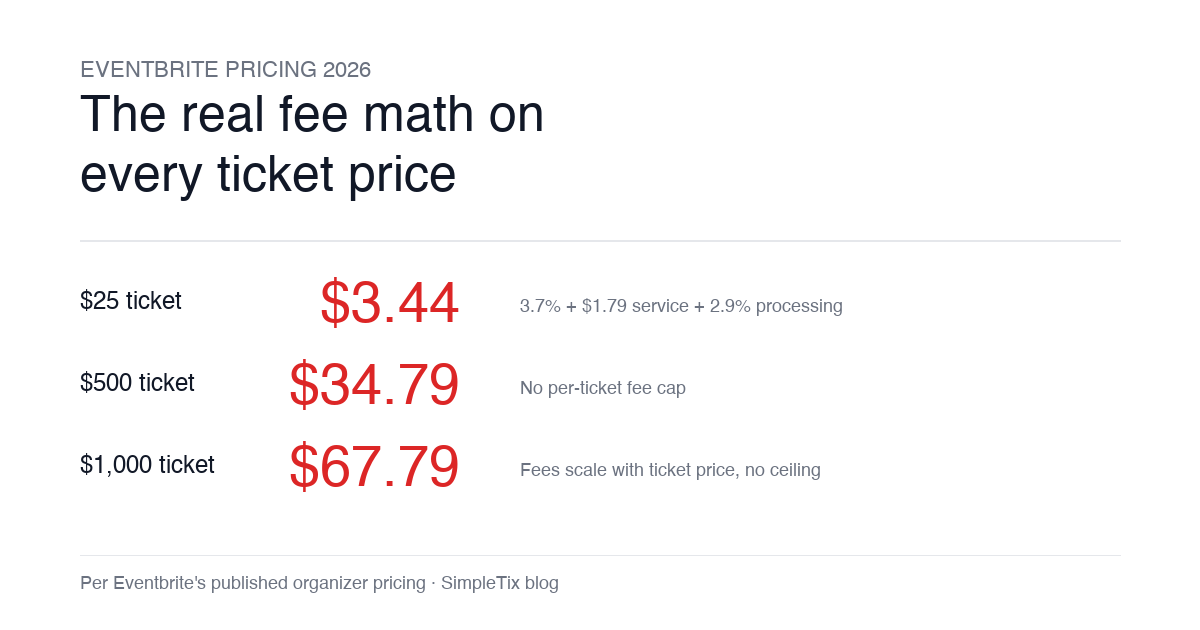
Eventbrite pricing 2026 is a lot for event organizers to sort through. There are longstanding policies that quietly cost paid-event operators real money, and there is genuine news under new ownership. This guide covers what the fees actually cost you today, what actually changed under the Bending Spoons acquisition, and how the alternatives compare on real numbers. Below is the honest breakdown, sourced to Eventbrite's own pricing page and SEC filings. Eventbrite pricing 2026: current fee structure As of 2026, Eventbrite charges 3.7% + $1.79 per paid ticket for the service fee, plus 2.9% for payment processing. In-person sales carry a $1 + 2.9% fee. There is no per-ticket fee cap. For a quick benchmark of total organizer-side fees: On a $25 ticket, fees total about $3.44 (13.8%) On a $50 ticket, fees total about $5.09 (10.2%) On a $100 ticket, fees total about $8.39 (8.4%) On a $500 ticket, fees total about $34.79 (7.0%) On a $1,000 ticket, fees total about $67.79 (6.8%) The fees scale with ticket price with no ceiling. That is the story for anyone selling premium tickets, season passes, VIP tiers, or corporate packages. Eventbrite pricing 2026: no per-ticket fee cap Eventbrite does not cap total ticket fees. This has been true since 2018, when Eventbrite removed the previous cap during its IPO. For most organizers selling everyday tickets ($20 to $50), the absence of a cap rarely comes up in the math. But for organizers selling premium tickets, the uncapped structure translates into real per-event cost. Take a conference selling three ticket tiers on Eventbrite: $150 general admission: fee about $12.34 (8.2%) $400 VIP ticket: fee about $27.09 (6.8%) $800 sponsor ticket: fee about $50.90 (6.4%) For a 200-person conference with a mix of GA and VIP tickets, that translates into hundreds of dollars...