How Vala’s Pumpkin Patch Scaled to 100K+ Visitors with SimpleTix
-
 by
by
How Vala’s Pumpkin Patch Scaled to 100K+ Visitors with SimpleTix
If you run a busy fall attraction, you already know the pressure: ticketing has to keep up when demand spikes, guests arrive in waves, and lines move fast. That is exactly what Vala’s Pumpkin Patch faced as it grew into Nebraska’s premier fall destination with more than 100,000 visitors each season.
Founded in 1984, Vala’s Pumpkin Patch now draws huge crowds across 50+ attractions and multiple food stands. However, growth exposed weak spots in its old setup. Peak-morning surges strained the system, one technical admin became a bottleneck, and layered tools made operations harder than they needed to be.
For Vala’s, the move to SimpleTix was about getting one reliable system for admissions, season passes, bookings, and on-site sales.
Why Vala’s needed better farm ticketing software
Dan McDonald, MS, PMP, IT Manager at Vala’s Pumpkin Patch, put it plainly: “We originally used a ticketing platform that served us well in our early years, but as our guest volume grew, it could no longer scale to meet demand.”
That issue showed up in a few clear ways.
First, the system struggled during peak-morning ticket surges. In other words, the exact time the platform mattered most was the time it became risky.
Second, operations depended too heavily on one technical administrator. As a result, routine changes and troubleshooting could pile up around one person.
Third, the team had to work across multiple layered applications. That created extra steps, more training, and more chances for something to break during the busiest weeks of the season.
Finally, outdoor hardware added another challenge. Farm attractions do not run in perfect indoor conditions, so tools need to work in real weather and real crowds.
The bottlenecks were operational, not just technical
Vala’s wasn’t just trying to sell more tickets. It needed to move large crowds through the gates, manage different admission types, and reduce friction for staff.
Specifically, the team was dealing with:
- Peak traffic that overwhelmed the old system.
- Duplicate QR code risk.
- Too many disconnected tools.
- Limited flexibility for staff at the box office.
- Hardware headaches in an outdoor setting.
Those problems stack up fast. Guests do not care which system caused the delay. They just remember the line.
How SimpleTix became the farm ticketing software Vala’s could scale with
Vala’s moved key admissions operations into SimpleTix so the team could manage more from one place. That included mobile tickets and QR code scanning, Square payment integration, box office access for multiple staff members, season passes, bookings, and timed entry.
That combination matters for farms. You usually are not selling one simple product. Instead, you may be selling daily admission, add-on experiences, season access, and special bookings all at once.
With SimpleTix, Vala’s could bring those pieces together into one platform. As a result, admissions became easier to manage for both guests and staff.
Dan McDonald summed up the shift this way: “SimpleTix turned our admissions process from a technical vulnerability into an operational strength.”
What Vala’s used inside the platform
The strongest case studies are practical ones. So here is what Vala’s actually used.
Mobile tickets and QR code scanning
Guests could use mobile tickets for faster entry. That helped reduce gate friction, especially during busy arrival windows.
In addition, QR code scanning gave the team a cleaner admissions process.
Timed entry
Timed entry helped Vala’s spread arrivals more evenly.
For seasonal attractions with heavy traffic, that can make a real difference before guests even reach the gate.
Season passes and bookings
Vala’s needed more than daily admission. The team also needed to manage season passes, campfire bookings, and special events in one system.
Instead of jumping between tools, staff could manage multiple revenue streams in one place.
Square integration and box office access for staff
SimpleTix also supported Square payment integration for Vala’s. That matters for attractions that need smooth in-person sales during a rush.
At the same time, box office access for multiple staff members reduced reliance on a single administrator. More team members could work in the system, which cut down on bottlenecks.
You can also review ticketing features and pricing.
The results of switching farm ticketing software
The biggest result was consolidation. Vala’s moved to a single platform for admissions instead of relying on multiple systems layered together.
That led to faster gate entry with mobile tickets. It also made it easier to manage season passes, campfire bookings, and special events without creating extra work behind the scenes.
Dan McDonald said, “We’ve been able to handle larger crowds more efficiently than ever before.”
He also made the guest impact clear: “SimpleTix has given us the tools we need to scale while keeping our guests happy.”
Good farm ticketing software should help your team move faster, but it also has to make the day feel easier for guests.
What other agritourism operators can learn from Vala’s
If you run a pumpkin patch, corn maze, orchard, or other seasonal attraction, Vala’s story offers a few useful lessons.
1. Build for your busiest hour, not your average day
A slow Tuesday does not test your system. Opening weekend at 10 a.m. does.
If your platform struggles during a traffic spike, that is the real issue to solve first. Timed entry and mobile scanning can help keep lines from getting out of hand.
2. Consolidate before you complicate
Many farms add tools one by one over time. However, layered systems often create more staff confusion and more failure points.
Vala’s improved operations by bringing admissions functions together. That is often a smarter move than adding yet another app.
3. Reduce single-person dependency
When too much depends on one person, the process gets harder to manage. In contrast, broader staff access gives your team more flexibility during the season.
That matters even more during fall events, where staffing changes happen fast and weekends are intense.
4. Think beyond admission
The best setup should support more than gate sales. It should also help you manage season passes, timed entry, and special experiences.
That broader setup gives you room to grow. Vala’s is already exploring VIP experiences and expanded programming, which is easier to do when the platform can support it.
A partner, not just software
One of the strongest parts of this case study is not a feature list. It is how Vala’s describes the working relationship.
Dan McDonald said, “SimpleTix collaborates with us like a partner, not just a vendor. They actively listen to feedback and work with us to improve the product for all their customers.”
That matters for seasonal businesses. Your calendar is tight, your peaks are intense, and you do not have months to babysit a complicated rollout.
SimpleTix keeps things simple on the pricing side too: $0.79 + 2% per ticket, no contracts, no subscriptions, and no fees on free events. You can also see who SimpleTix serves.
For broader context on managing timed entry and visitor flow at attractions, the U.S. Small Business Administration offers practical operational planning resources here.
Read the full Vala’s story
If you are evaluating farm ticketing software, this case is worth your time because it is grounded in real operational pressure. Vala’s needed to handle 100K+ visitors, cut bottlenecks, and simplify admissions without hurting the guest experience.
You can read the full case study here: Vala’s Pumpkin Patch case study.
If you need ticketing for a busy seasonal attraction, take a look at SimpleTix.
Latest News
Related Articles

Season Ticket Software for Fall 2026: Subscriptions, Reserved Seating & Renewals
-
by
Fall subscription sales are the single biggest revenue moment for most performing arts organizations. Season packages, member renewals, and early access windows all open between July and September. So the season ticket software you pick this summer decides how the fall series actually sells. This guide covers what season ticket software needs to do in 2026, how to configure it for a theater, symphony, or concert series, and what SimpleTix costs for season-driven event programs. What season ticket software actually needs to do Selling season tickets is nothing like selling single-event tickets. First, one subscriber buys 4 to 20 events in a single package. Second, seats need to lock across the entire season. Third, renewals from prior subscribers happen weeks before the general public gets access. And fourth, add-ons like parking, pre-show dinner, and backstage passes attach to the subscription, not the event. So the operational checklist for season ticket software looks like this: Season pass or subscription products that group multiple events into one purchase Reserved seating with locked seats across the whole season, so the subscriber sits in the same seat every night Priority access windows for existing subscribers before general on-sale Payment plans or full-payment options so patrons can split large subscription costs Renewal workflows that let last year's subscribers re-up with one click Comp ticket management for donors, sponsors, and press seats Membership tiers with different pricing, benefits, and priority access Reporting by subscriber, not just by event If your current tool cannot handle these, you are probably running Excel spreadsheets on the side and losing renewals every year. What is season ticket software? Season ticket software is a ticketing platform designed to sell multi-event packages (season subscriptions) alongside individual tickets, with reserved seat continuity, subscriber priority access, and renewal workflows built in. The core difference...

Holiday Event Ticketing Software: Timed Entry, Reserved Seating & Capacity Control for...
-
by
If you run a holiday event, you are booking dates now. So the ticketing platform you pick this month determines how November and December actually go. This guide covers what holiday event ticketing software needs to do in 2026, how to configure it for the season crunch, and what SimpleTix costs for holiday events of any size. What holiday event ticketing software needs to do Holiday events compress a whole year of sales into six weeks. First, most tickets sell in a 4 to 8 week window between mid-November and January 1. Second, weather cancels outdoor events without warning. Third, family groups buy 4 to 8 tickets in one order, not 1. And fourth, capacity is measured per time slot, not per venue. So the ticketing checklist for holiday operators looks like this: Timed entry with per-slot capacity for drive-throughs, walk-throughs, and Santa visits Reserved seating for holiday theater, Nutcracker, and holiday concerts Group and family bundles so a family of six is one checkout, not six Fast scanning at the gate, including offline mode for cold outdoor venues Waitlists for when peak-hour slots sell out Add-ons for hot chocolate, photo packages, VIP tiers, and holiday merch Automated email reminders so guests do not forget their timed slot Same-day payouts to fund the season's operational costs If your current tool cannot do all of that, October is too late to switch. Move now. How do timed entry tickets work for holiday events? Timed entry lets you release a fixed number of tickets per time slot (typically every 15 or 30 minutes) so guests arrive in waves instead of one 6pm surge. For a Christmas light drive-through with a 45-minute route, that usually means 30 to 60 vehicles per 15-minute window. Over a 5-hour evening, you can process 600 to 1,200...
Eventbrite Pricing 2026: Fees, Refunds & What’s Actually Changed
-
by
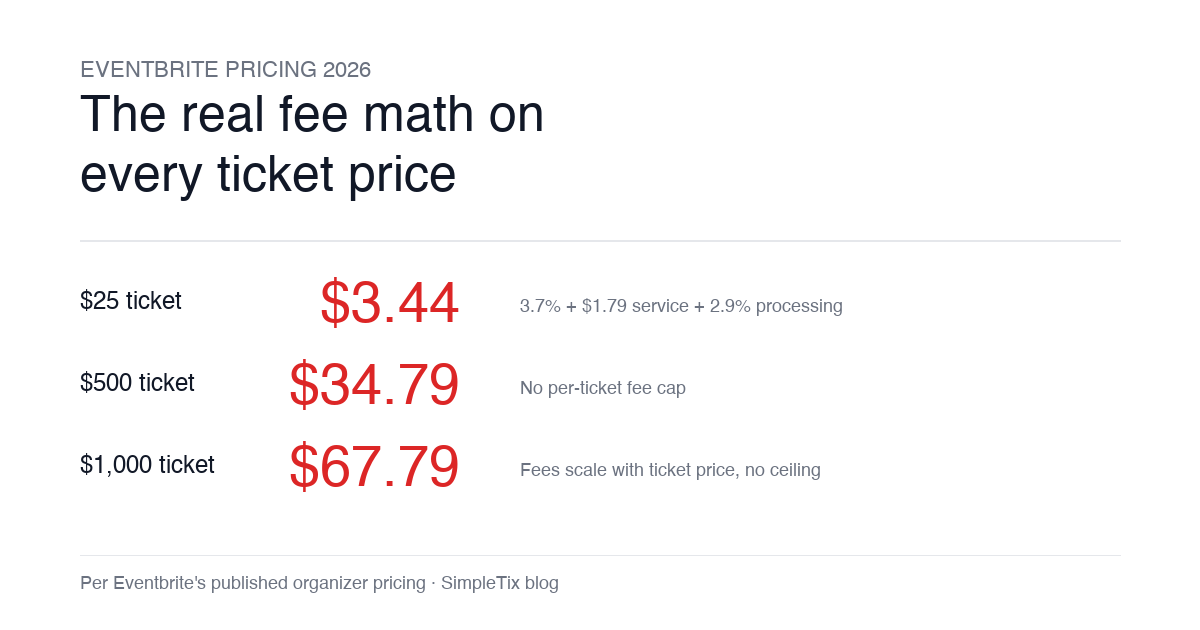
Eventbrite pricing 2026 is a lot for event organizers to sort through. There are longstanding policies that quietly cost paid-event operators real money, and there is genuine news under new ownership. This guide covers what the fees actually cost you today, what actually changed under the Bending Spoons acquisition, and how the alternatives compare on real numbers. Below is the honest breakdown, sourced to Eventbrite's own pricing page and SEC filings. Eventbrite pricing 2026: current fee structure As of 2026, Eventbrite charges 3.7% + $1.79 per paid ticket for the service fee, plus 2.9% for payment processing. In-person sales carry a $1 + 2.9% fee. There is no per-ticket fee cap. For a quick benchmark of total organizer-side fees: On a $25 ticket, fees total about $3.44 (13.8%) On a $50 ticket, fees total about $5.09 (10.2%) On a $100 ticket, fees total about $8.39 (8.4%) On a $500 ticket, fees total about $34.79 (7.0%) On a $1,000 ticket, fees total about $67.79 (6.8%) The fees scale with ticket price with no ceiling. That is the story for anyone selling premium tickets, season passes, VIP tiers, or corporate packages. Eventbrite pricing 2026: no per-ticket fee cap Eventbrite does not cap total ticket fees. This has been true since 2018, when Eventbrite removed the previous cap during its IPO. For most organizers selling everyday tickets ($20 to $50), the absence of a cap rarely comes up in the math. But for organizers selling premium tickets, the uncapped structure translates into real per-event cost. Take a conference selling three ticket tiers on Eventbrite: $150 general admission: fee about $12.34 (8.2%) $400 VIP ticket: fee about $27.09 (6.8%) $800 sponsor ticket: fee about $50.90 (6.4%) For a 200-person conference with a mix of GA and VIP tickets, that translates into hundreds of dollars...