Sell Merchandise Online with SimpleTix
-
 by
by
Riley Manning has worked as a travel and entertainment writer for more than 10 years. Today, he writes about unique events and the technology that helps make them happen.

As you work out event ticketing, you should consider a platform that can handle multiple types of sales seamlessly. Event ticketing software like SimpleTix allows you to streamline merchandise, concessions, and ticketing sales in one centrally located and easy to use platform.
While ticket sales will fund most of your event, offering merchandise and concessions helps generate revenue and cover expenses. Regardless of your event’s size, selling branded merchandise presents an incredible opportunity to make some extra money, offer your guests mementos, and advertise for your group’s next venture.
Table of Contents:
- Facilitate Versatile Transactions with Event Ticketing Software
- Choosing Merchandise for Your Event
- Learn from Your Attendees
Facilitate Versatile Transactions with Event Ticketing Software
Since not all event ticketing software facilitates merchandise or concessions sales, event organizers often have to implement several different point-of-sale systems to complete these various transactions. This can be difficult and frustrating to manage, as attendees must visit different areas to complete separate transactions or staff must cycle through various programs with one customer.
With a platform that can sell tickets, merchandise, and concessions, both attendees and staff can easily complete multiple types of transactions at once. This provides a better experience for attendees and makes them more likely to spend more money. Staff will only have to learn one system and have more flexibility throughout the event to perform different types of transactions.
SimpleTix also offers a partnership with Square, which means event staff and attendees won’t have to contend with the complications of cash transactions. Square also facilitates various payment types, such as ApplePay, AndroidPay, and contactless payments. More flexibility means you can accommodate more customers.
With event ticketing software like SimpleTix, you can even sell merchandise online when attendees buy their tickets. This is beneficial as attendees can wear their merchandise at the event if they buy a t-shirt or hat, and if they buy a cumbersome item like a framed poster, they can pick it up as they are leaving the event.
Online merchandise sales are also helpful for event organizers. Since you have a good idea of what people are buying online before the event, you can offer similar quantities the day of. For some events, you may even offer food reservations online to limit food waste.
Choosing Merchandise for Your Event

Endless branding opportunities abound for your event’s merchandise and concessions. Be creative and have fun thinking about your event’s message, the audience, and what types of items will satisfy both equally.
T-shirts and posters will always be around, but signature items unique to your event can be the most fun and sought after mementos. It’s necessary to offer items appropriate to the event as well. Beanies and hot chocolate will sell better at a winter event while sunglasses and ice cream will sell better outside in the summer.
Concessions
Concessions comprise a valuable portion of event revenue. Attendees will always want to buy bottled water and snacks to have on hand as they enjoy the event.
With event ticketing software, all sales go through one system and into one account. It’s easier for attendees to make one transaction, and it’s also effortless for event organizers to access revenue. SimpleTix even offers instant payouts, so you can receive your money immediately.
Apparel
T-shirts are ubiquitous as event merchandise because of their simple and comfortable versatility. Designing unique t-shirts that represent your event are both a fashion statement for attendees and a treasured memory. For annual events, repeat attendees will look forward to collecting each year’s installment.
You don’t have to limit yourself to t-shirts, however. Seasonal apparel like sweatshirts or tank tops can complement the weather at your event and even help out attendees who didn’t dress accordingly. Accessories like hats, beanies, and tote bags can similarly help out the unprepared.
Masks for the face and eyes are other accessories to consider branding for your event. Branded face masks for the health conscious can offer attendees a festive way to enjoy the event safely. Eye masks can take attendees home on a plane in style. Both masks will offer free promotion for your organization’s future events.
Art
You’ll probably work with a local artist to design the logo and aesthetic for your event, so you could also have them create vibrant art prints to visually tell your event’s story. Offering different mediums, including postcards, posters, and archival prints, will allow attendees to remember the event and decorate their homes at the level they are comfortable with.
For events like a music festival, offering small batches of prints signed by various performers will definitely be in demand by your most dedicated attendees. You can also offer high quality, framed official photography from past events.
Stickers are the easiest way to distribute art from your event, as they are small and cost-efficient. Plus, they are great advertising for future events.
Trinkets and Home Goods
Small items like magnets, buttons, and keychains are inexpensive yet fun ways for event goers to carry a little memory of your event with them. Chapstick and hand sanitizer are useful small items that can easily be branded. These are also easy to mass produce and transport to the festival. Plus, as they are inexpensive, it’s possible to sell a higher volume.
High quality items for home decoration and use are popular items at events as well. Favorite mugs are often chosen for sentimental value. For food and drink festivals, commemorative glasses or cups can be an appropriate souvenir. Items like branded candles and blankets create a cozy atmosphere in the home while serving as memorabilia.
Learn from Your Attendees

Use event ticketing software to track your sales and analyze the popularity of and profit margins from your concessions and merchandise. This process will help you develop a more informed strategy for your next event.
Communicating with your attendees after the event offers your team valuable wisdom. Part of your event’s post-attendance survey can ask attendees for their thoughts on the merchandise and concession offerings. This offers your attendees a chance to offer feedback and helps your future planning.
Whichever direction you choose for your event, make sure your event ticketing software supports seamless customer interactions and ticket sales. Selling merchandise at your event has never been easier with SimpleTix.
SimpleTix has offered an affordable, premium event ticketing platform that outperforms Eventbrite and similar apps for over 12 years. Compared to the competition, SimpleTix offers better options at a better price point. To learn more, call us at +1 (855) 550-3670 or email us at support@simpletix.com.
Latest News
Related Articles

Season Ticket Software for Fall 2026: Subscriptions, Reserved Seating & Renewals
-
 by
by
Fall subscription sales are the single biggest revenue moment for most performing arts organizations. Season packages, member renewals, and early access windows all open between July and September. So the season ticket software you pick this summer decides how the fall series actually sells. This guide covers what season ticket software needs to do in 2026, how to configure it for a theater, symphony, or concert series, and what SimpleTix costs for season-driven event programs. What season ticket software actually needs to do Selling season tickets is nothing like selling single-event tickets. First, one subscriber buys 4 to 20 events in a single package. Second, seats need to lock across the entire season. Third, renewals from prior subscribers happen weeks before the general public gets access. And fourth, add-ons like parking, pre-show dinner, and backstage passes attach to the subscription, not the event. So the operational checklist for season ticket software looks like this: Season pass or subscription products that group multiple events into one purchase Reserved seating with locked seats across the whole season, so the subscriber sits in the same seat every night Priority access windows for existing subscribers before general on-sale Payment plans or full-payment options so patrons can split large subscription costs Renewal workflows that let last year's subscribers re-up with one click Comp ticket management for donors, sponsors, and press seats Membership tiers with different pricing, benefits, and priority access Reporting by subscriber, not just by event If your current tool cannot handle these, you are probably running Excel spreadsheets on the side and losing renewals every year. What is season ticket software? Season ticket software is a ticketing platform designed to sell multi-event packages (season subscriptions) alongside individual tickets, with reserved seat continuity, subscriber priority access, and renewal workflows built in. The core difference...

Holiday Event Ticketing Software: Timed Entry, Reserved Seating & Capacity Control for...
-
by
If you run a holiday event, you are booking dates now. So the ticketing platform you pick this month determines how November and December actually go. This guide covers what holiday event ticketing software needs to do in 2026, how to configure it for the season crunch, and what SimpleTix costs for holiday events of any size. What holiday event ticketing software needs to do Holiday events compress a whole year of sales into six weeks. First, most tickets sell in a 4 to 8 week window between mid-November and January 1. Second, weather cancels outdoor events without warning. Third, family groups buy 4 to 8 tickets in one order, not 1. And fourth, capacity is measured per time slot, not per venue. So the ticketing checklist for holiday operators looks like this: Timed entry with per-slot capacity for drive-throughs, walk-throughs, and Santa visits Reserved seating for holiday theater, Nutcracker, and holiday concerts Group and family bundles so a family of six is one checkout, not six Fast scanning at the gate, including offline mode for cold outdoor venues Waitlists for when peak-hour slots sell out Add-ons for hot chocolate, photo packages, VIP tiers, and holiday merch Automated email reminders so guests do not forget their timed slot Same-day payouts to fund the season's operational costs If your current tool cannot do all of that, October is too late to switch. Move now. How do timed entry tickets work for holiday events? Timed entry lets you release a fixed number of tickets per time slot (typically every 15 or 30 minutes) so guests arrive in waves instead of one 6pm surge. For a Christmas light drive-through with a 45-minute route, that usually means 30 to 60 vehicles per 15-minute window. Over a 5-hour evening, you can process 600 to 1,200...
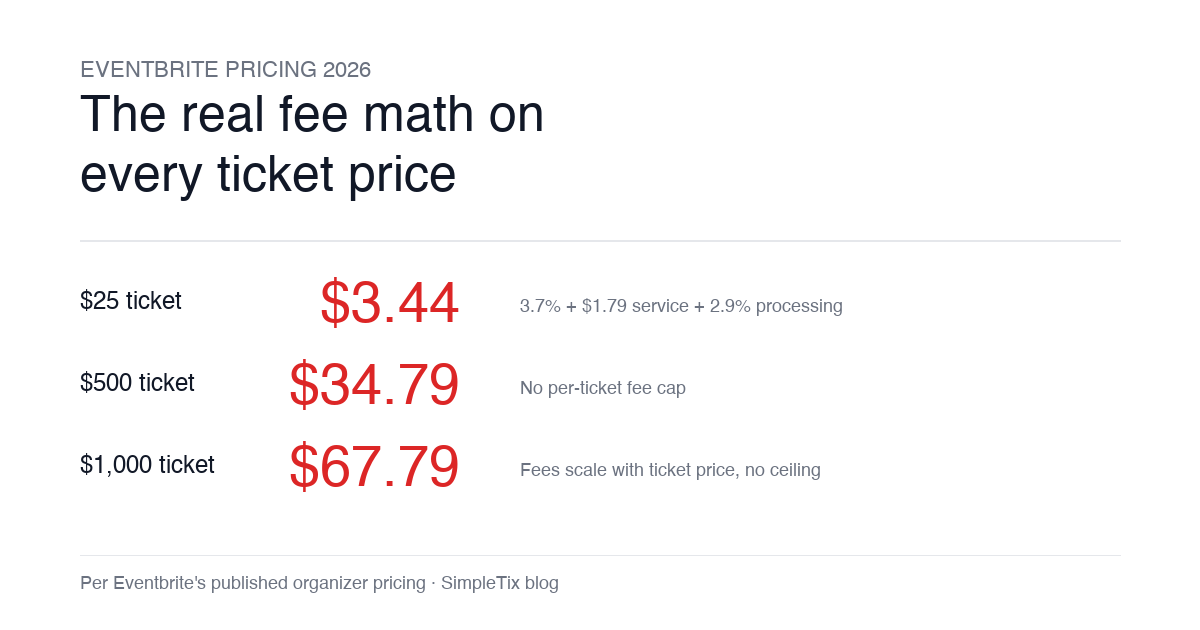
Eventbrite Pricing 2026: Fees, Refunds & What’s Actually Changed
-
by
Eventbrite pricing 2026 is a lot for event organizers to sort through. There are longstanding policies that quietly cost paid-event operators real money, and there is genuine news under new ownership. This guide covers what the fees actually cost you today, what actually changed under the Bending Spoons acquisition, and how the alternatives compare on real numbers. Below is the honest breakdown, sourced to Eventbrite's own pricing page and SEC filings. Eventbrite pricing 2026: current fee structure As of 2026, Eventbrite charges 3.7% + $1.79 per paid ticket for the service fee, plus 2.9% for payment processing. In-person sales carry a $1 + 2.9% fee. There is no per-ticket fee cap. For a quick benchmark of total organizer-side fees: On a $25 ticket, fees total about $3.44 (13.8%) On a $50 ticket, fees total about $5.09 (10.2%) On a $100 ticket, fees total about $8.39 (8.4%) On a $500 ticket, fees total about $34.79 (7.0%) On a $1,000 ticket, fees total about $67.79 (6.8%) The fees scale with ticket price with no ceiling. That is the story for anyone selling premium tickets, season passes, VIP tiers, or corporate packages. Eventbrite pricing 2026: no per-ticket fee cap Eventbrite does not cap total ticket fees. This has been true since 2018, when Eventbrite removed the previous cap during its IPO. For most organizers selling everyday tickets ($20 to $50), the absence of a cap rarely comes up in the math. But for organizers selling premium tickets, the uncapped structure translates into real per-event cost. Take a conference selling three ticket tiers on Eventbrite: $150 general admission: fee about $12.34 (8.2%) $400 VIP ticket: fee about $27.09 (6.8%) $800 sponsor ticket: fee about $50.90 (6.4%) For a 200-person conference with a mix of GA and VIP tickets, that translates into hundreds of dollars...